
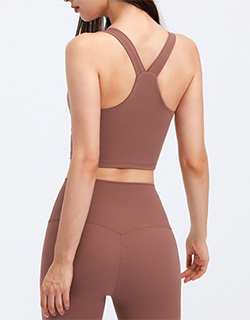
How to Choose the Right Custom Yoga Pants Manufacturer for Your Activewear Brand
Choosing the right custom yoga pants manufacturer is not mainly a price decision. It is a capability decision about fit accuracy, fabric performance, sample-to-bulk consistency, workable MOQ, quality control discipline, private label readiness, and global shipping support.
The right supplier for an activewear brand can prove five things in plain operational language: yoga pants specialization, testable fabric performance, transparent sampling and bulk timelines, multi-stage quality control, and compliance readiness for labeling, sustainability claims, and export.
Key Takeaways
- A startup-friendly custom yoga pants program usually starts with low but realistic MOQs, not ultra-small quantities.
- A strong supplier should discuss stretch recovery, opacity, GSM, moisture management, pilling, shrinkage, and colorfastness.
- A reliable manufacturer should show raw-material inspection, inline production checks, final inspection, and production tracking.
- Sustainability claims should be supported by recognized documentation such as OEKO-TEX or GRS.
- A scalable factory should support adjacent categories such as sports bras, tops, outerwear, plus-size, maternity, nursing, or adaptive activewear.
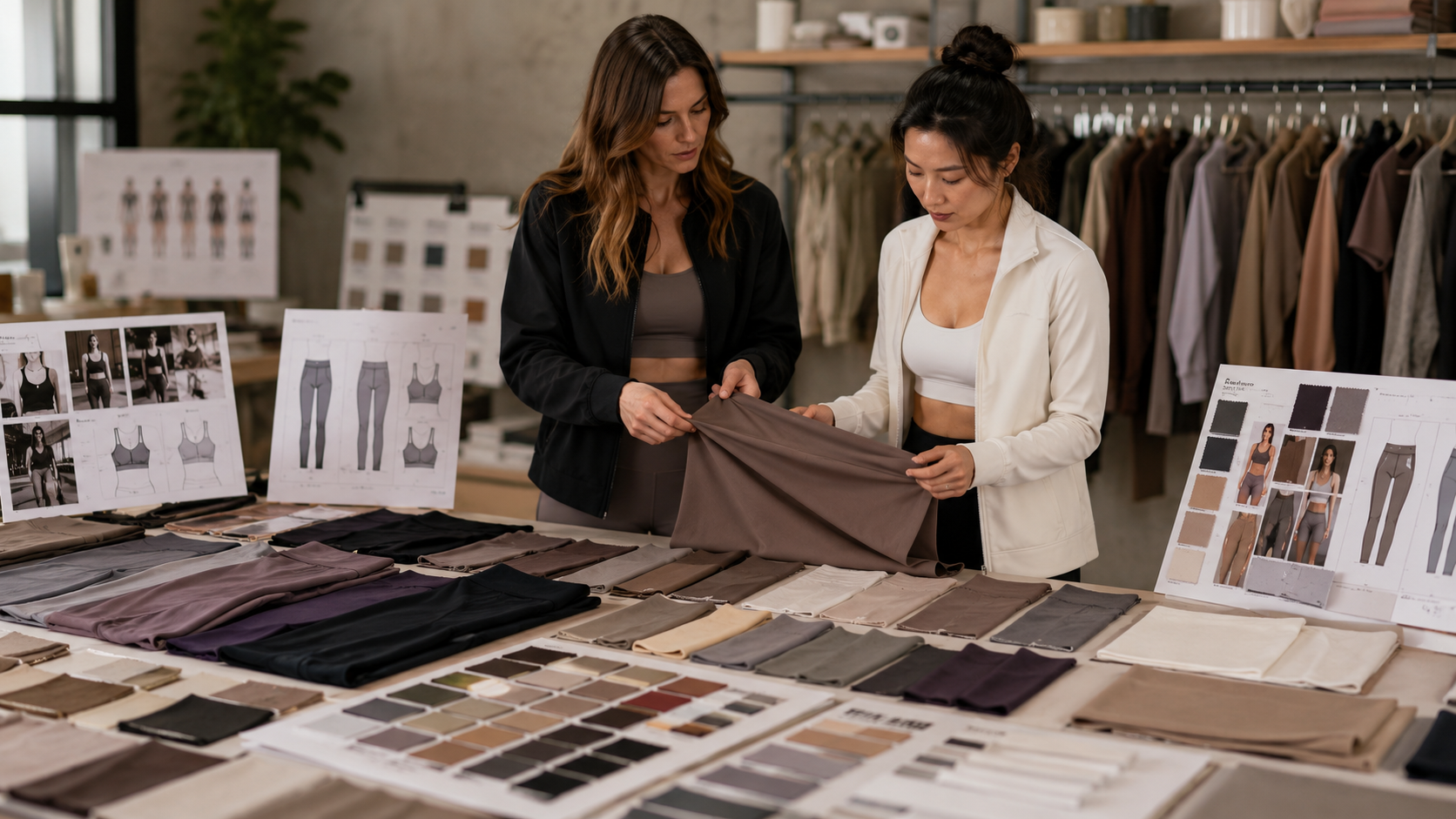
What Makes a Custom Yoga Pants Manufacturer the Right Fit for an Activewear Brand?
The right custom yoga pants manufacturer is the supplier that can prove yoga-specific product expertise, flexible but realistic MOQ, sample accuracy, strong fabric and trim sourcing, visible quality control, and enough production breadth to grow with the brand after the first leggings launch.
A seller that only promises “best price” is not enough for performance leggings. A supplier should expose OEM/ODM support, private label service, fabric guidance, manufacturing ability, quality control, supply chain visibility, and related activewear categories.
| Evaluation Area | Strong Manufacturer Signal | Weak Manufacturer Signal | Why It Matters |
|---|---|---|---|
| Product specialization | Focus on yoga wear, leggings, sports bras, and related activewear | Generic clothing factory positioning | Yoga pants require performance-fabric and fit expertise |
| MOQ policy | Clear and realistic MOQ for custom cut-and-sew programs | No MOQ listed or “anything is possible” | MOQ affects startup cash flow and unit economics |
| Sampling workflow | Sample timeline, revision logic, and approval steps are visible | No sample process or price-only quotes | Sample control predicts bulk consistency |
| QC visibility | Raw-material, inline, and final inspection stages are explained | Only says “we inspect before shipping” | Multi-stage QC reduces defect accumulation |
| Fabric capability | Can discuss blend, GSM, recovery, pilling, shrinkage, and colorfastness | Only says “soft” or “high quality” | Performance leggings fail when fabric specs are vague |
| Scalability | Can support matching bras, tops, outerwear, and special-fit programs | Single-product workshop | Growing brands need assortments, not one-off products |
Product breadth matters more than many new brands realize. A manufacturer that can produce yoga leggings, sports bras, T-shirts, hoodies, tank tops, track pants, women’s and men’s sportswear, maternity, nursing, and adaptive activewear is usually better positioned to support collection extensions and set-based merchandising.
Which Factory Capabilities Matter Most Before Sample Approval?
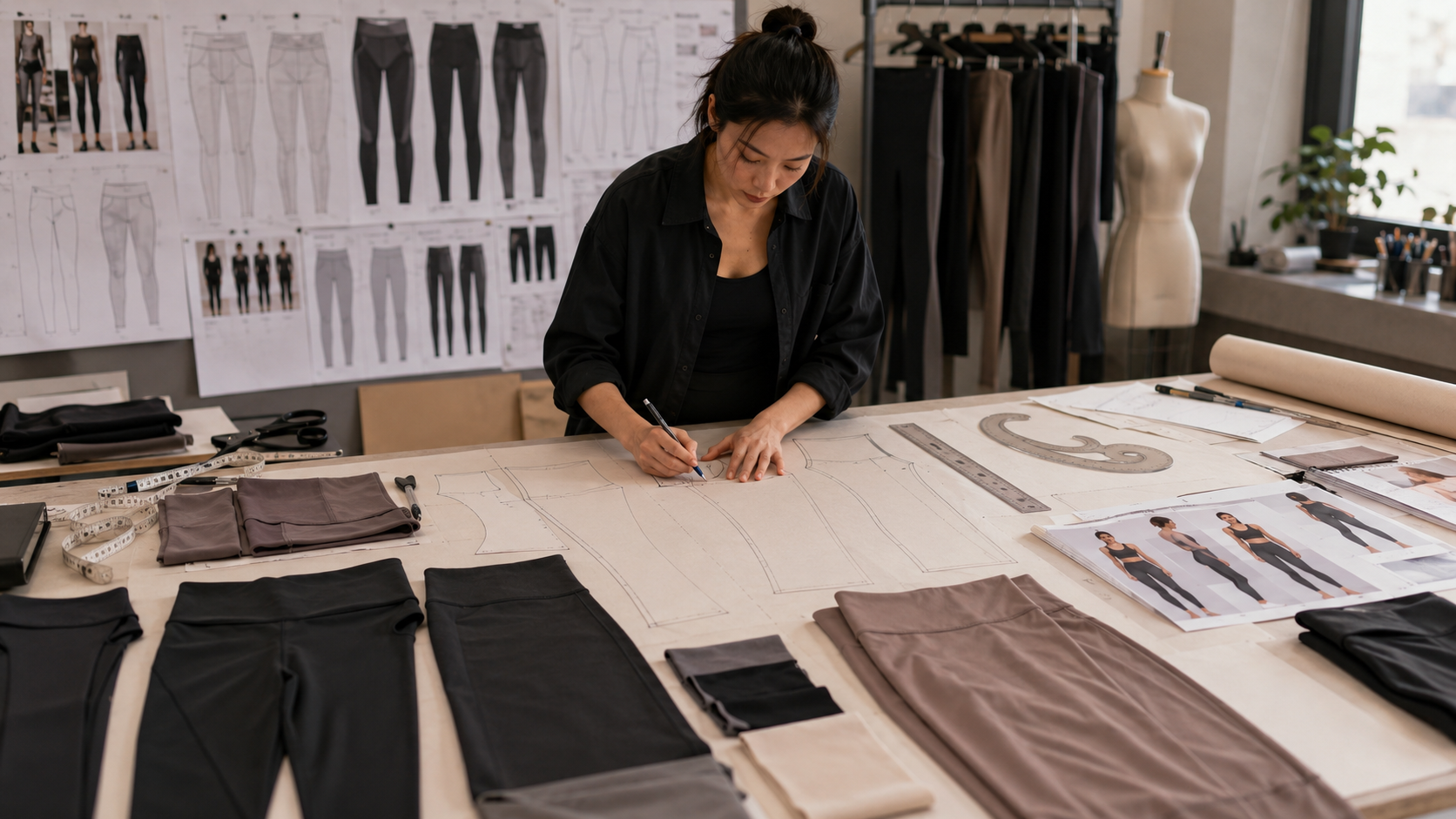
Before sample approval, the non-negotiable capabilities are pattern development, fabric sourcing, trim coordination, logo execution, and communication discipline. The pre-sample stage determines whether the factory can translate a concept into a repeatable product.
Brands usually do not lose money because the original concept is weak. They lose money because waistband tension, crotch depth, rise grading, opacity under stretch, and stretch recovery were never locked before bulk cutting.
Pattern Development
Accurate rise, waistband, inseam, gusset, and size grading.
Fabric Sourcing
Blend, GSM, opacity, recovery, handfeel, and shrinkage control.
Branding Support
Logo placement, heat transfer, woven labels, hangtags, and packaging.
Ask for These Sample-stage Deliverables
- A confirmed product brief that states the intended use, such as studio yoga, hot yoga, training, or all-day athleisure.
- A fabric card or swatch review that includes blend, GSM, handfeel, stretch, recovery, and opacity expectations.
- A sample calendar that separates first sample, revision sample, and bulk approval timing.
- A logo and trims plan that specifies print, heat transfer, embroidery, woven labels, hangtags, and packaging.
- Factory photos or videos of the sample before shipment.
How Should a Brand Compare Yoga Pants Fabrics and Construction Details?
A brand should compare yoga pants fabrics and construction by testable performance, not by handfeel alone. The right comparison framework is simple: test stretch recovery, opacity, GSM, moisture management, pilling resistance, shrinkage, and colorfastness, then review seam construction and high-stress reinforcement.
| Fabric Program | Best Fit for Brand Strategy | What to Verify Before Bulk | Main Caution |
|---|---|---|---|
| Nylon-spandex | Premium leggings, compression silhouettes, sculpting sets | Recovery, opacity, pilling, and shape retention | Soft handfeel alone does not guarantee bulk stability |
| Polyester-spandex | Value-conscious performance programs and fast-dry lines | Moisture management, colorfastness, and shrinkage | Cheap versions can feel too slick or too thin |
| Recycled nylon or recycled polyester with spandex | Sustainability-led activewear collections | GRS documentation, recovery, opacity, and color consistency | “Recycled” claims without certification are weak |
| Bamboo or cotton blends with spandex | Soft studio, lounge, or comfort-first capsules | Breathability, dimensional change, and care performance | Comfort-first blends may not deliver premium compression |
Minimum Performance Review for a Yoga Pants Sample
- Check squat-proof opacity under real stretch.
- Check recovery after repeated stretch.
- Check pilling resistance.
- Check colorfastness to washing and perspiration.
- Check shrinkage and growth after laundering.
- Check moisture transport when the brand promise includes sweat management.
What MOQ, Lead Times, and Cost Logic Are Realistic in Custom Yoga Pants Production?
Realistic custom yoga pants programs usually start with low-but-not-micro MOQs and require a calendar that separates fabric sourcing, sampling, revision, bulk sewing, inspection, packing, and shipping.
| Stage | Practical Timing Benchmark |
|---|---|
| Fabric sourcing | 3–7 days for standard programs; 7–15 days if materials are not ready |
| Initial sample | 7–10 days |
| Sample revision | 3–5 days |
| Bulk production | 20–35 days |
| QC and packing | 3–5 days |
| Air freight | 5–10 days |
| Sea freight | 20–40 days |
| Safe planning window | 60–90 days from sample approval to warehouse arrival |
| Program Type | Typical MOQ Logic |
|---|---|
| Standard cut-and-sew yoga pants or leggings | 50–100 pcs per style/color is common |
| Seamless sportswear | 150–300 pcs per style is common because machine setup is different |
| Hoodies and outerwear add-ons | 100–200 pcs per style is common |
Cost should be evaluated as total risk cost, not only ex-factory unit cost. Fabric choice, pocket construction, bonded or flatlock seams, logo method, packaging, mixed colors, and shipment mode all change the true landed cost.
How Can a Brand Verify Quality Control, Compliance, and Supply Chain Reliability?
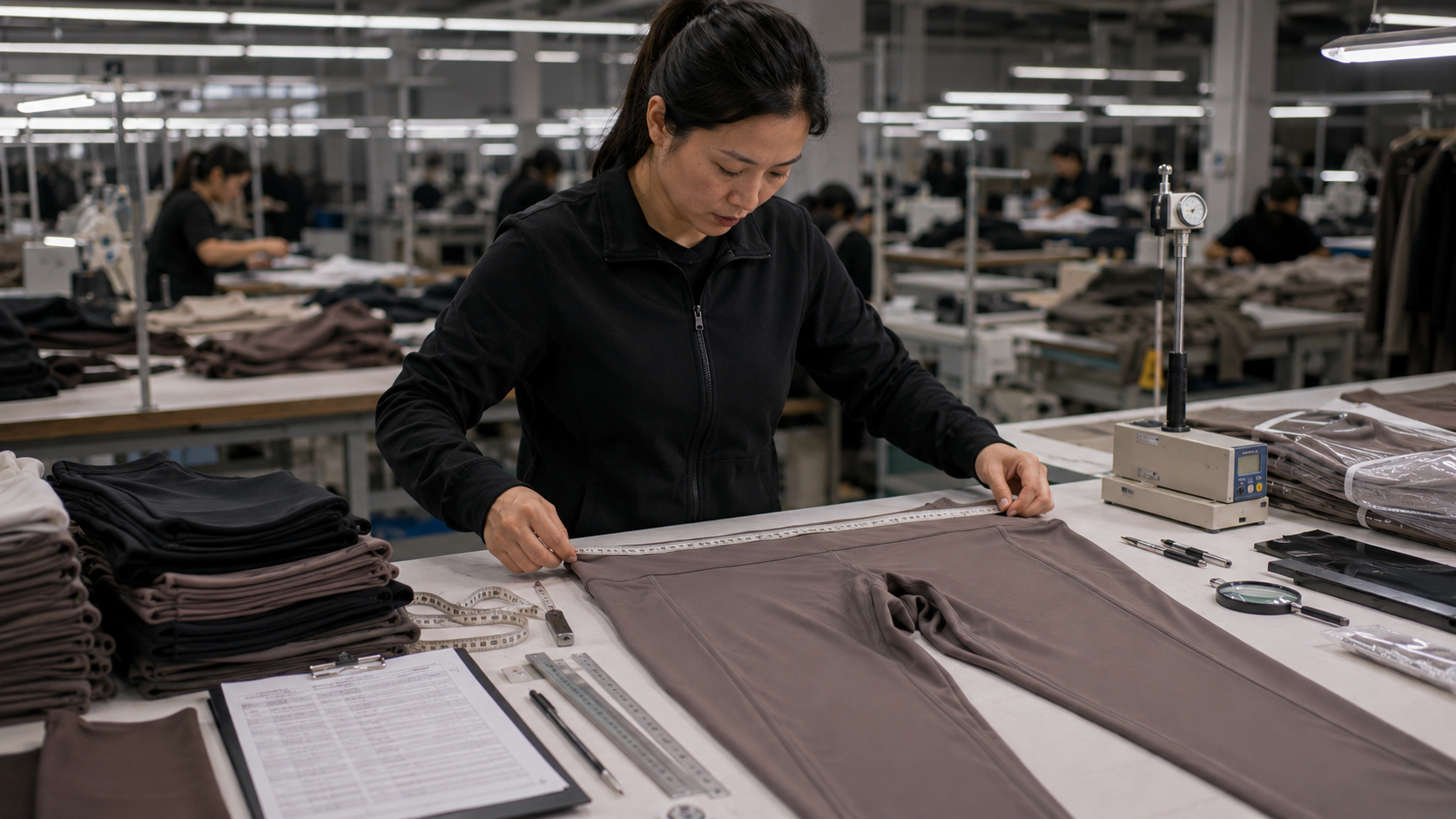
A brand can verify quality control and supply chain reliability only by checking documented inspection stages, recognized test methods, labeling readiness, sustainability evidence, and production visibility.
QC and Compliance Checklist for Custom Yoga Pants
- Ask how the factory inspects incoming fabrics and trims, including GSM, color consistency, visible defects, shrinkage, stretch recovery, and opacity.
- Ask what happens during inline inspection, including stitching, seam alignment, waistband construction, thread quality, and measurements.
- Ask whether final random inspection follows an AQL-based sampling method.
- Ask whether production progress is visible after PO release.
- Ask whether the supplier can provide or coordinate the right fabric tests.
A compliance-ready yoga pants supplier should also understand destination-market labeling, including fiber content, country of origin, and responsible marketer information. Sustainability claims should be documented, not improvised.
What Step-by-step Process Should a Brand Follow to Shortlist and Approve a Manufacturer?
The safest sourcing process is a staged workflow that moves from product brief to test reports to sample approval to pre-production control and final inspection.
Define the target wearer and use case.
Clarify whether the product is for studio yoga, hot yoga, strength training, athleisure, or inclusive sizing.
Send a usable development reference.
Provide a PDF design, photo, original sample, tech pack, or size reference.
Compare fabrics with test logic.
Review blend ratios, GSM, moisture management, recovery, pilling, shrinkage, and colorfastness.
Approve the first sample and revision sample.
Do not skip revision when waistband roll, opacity, or recovery is not correct.
Lock MOQ, lead time, branding scope, and shipping plan.
Confirm all production details in writing before bulk approval.
Approve a pre-production control package.
Cover approved fabric, color, size spec, logo placement, packaging, and QC checklist.
Track production milestones and final inspection.
Confirm procurement, production, QC, packing, and shipment status.
What Are the Most Common Questions Brands Ask Before Placing a Yoga Pants Order?
What is a realistic MOQ for a startup yoga pants brand?
A realistic MOQ for standard custom cut-and-sew yoga pants is often around 50–100 pieces per style/color. This range is usually low enough for testing and high enough for workable production efficiency.
Which fabric is usually better for premium yoga pants?
Premium yoga pants are usually chosen by performance target rather than trend language. The correct choice depends on whether the line prioritizes compression, softness, moisture handling, price efficiency, or sustainability.
How many sample rounds are normal?
At least one initial sample and one revision round are common when fit, fabric, or branding details still need correction.
What should a private-label yoga pants supplier actually provide?
A true private-label supplier should support custom labels, hangtags, packaging, accessories, logo application methods, and coordinated branding, not only sew blank leggings.
What is the most common reason bulk orders fail?
The most common reason bulk orders fail is that fabric performance and QC were not verified early enough. Stretch, moisture handling, pilling, shrinkage, and colorfastness need structured verification before bulk production.
Looking for a Reliable Custom Yoga Pants Manufacturer?
Work with a manufacturer that can support fabric sourcing, fit development, sampling, private label branding, bulk production, quality control, and global shipping for your activewear brand.
Contact OhsureWear