
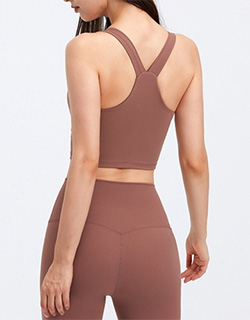
Activewear Production Risk Checklist: How to Avoid Delays, Defects and Unexpected Costs
OHSURE BUYER RESOURCES · B729-100
A practical checklist for clothing brands moving from an approved idea to a controlled bulk order.
How do you reduce activewear production risk?
To reduce activewear production risk, agree specifications, materials, sample approvals, inspection criteria, costs and delivery milestones before bulk production. Track each unresolved issue with an owner, deadline and required evidence. Release cutting and shipment only after the relevant approvals, and review changes in writing so delays, defects and extra charges remain visible.
A launch can slip even when sewing finishes on schedule: a fabric approval may still be open, a logo may need rework, or cartons may be waiting for corrected documents. A useful checklist connects each risk to the evidence needed before the next stage starts. It also makes the buyer’s own decisions visible, including late artwork, slow sample feedback and changing size quantities.
This guide covers custom activewear orders, including gym leggings and sports bras. The checklist below is a recommended buyer control framework. Exact checkpoints, acceptance rules and responsibilities should be agreed for your project.
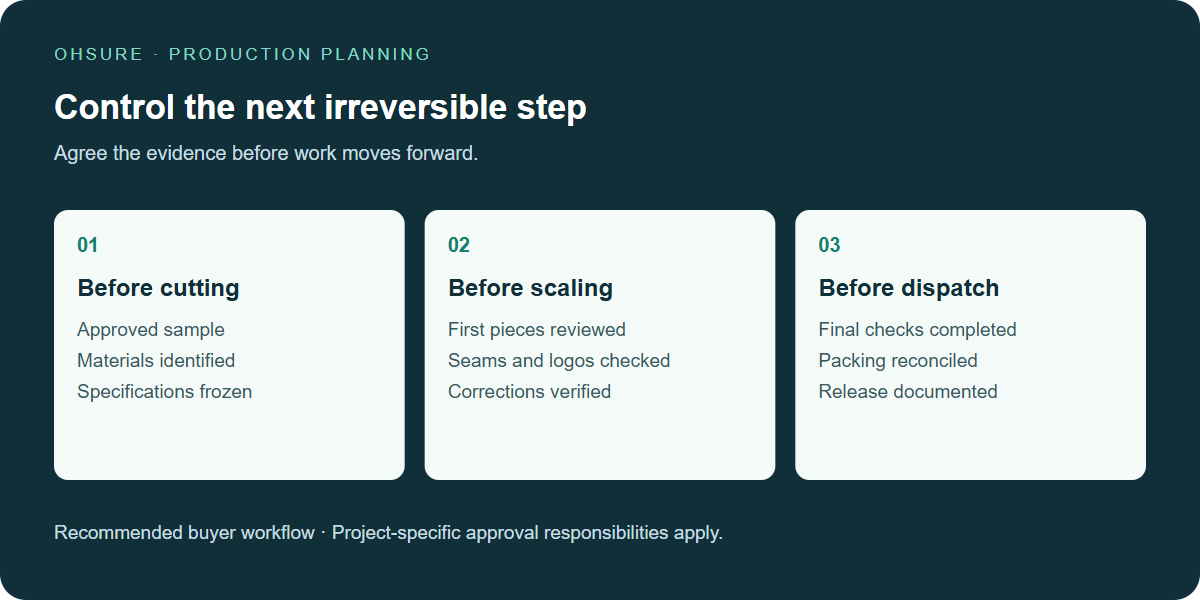
What is an activewear production risk checklist?
An activewear production risk checklist is a record of the issues that could prevent an order from meeting its approved specifications, quantity, budget or delivery requirement. Each item needs a clear owner, a due date, evidence and a release decision. A tick without a supporting record does little to protect the order.
A risk is an uncertain event, such as a fabric delay. An issue is something already happening, such as missing fabric. A defect is a product failing an agreed requirement. A release gate is a decision point at which authorized people check the evidence before permitting the next stage. An inspection plan describes what to examine and how; the risk checklist also tracks commercial, approval and logistics dependencies.
For example, “confirm fabric” is too vague. A useful entry reads: “Before bulk release, the factory project lead provides the material identifier, lot details, available quantity and incoming-check record for buyer review.”
Compare delay, defect and unexpected-cost risks
| Risk | Early warning | Control to agree | Evidence before release |
|---|---|---|---|
| Delay | Material date is unconfirmed; sample comments remain open. | Assign dependency owners and dated approvals; update the arrival forecast. | Material readiness and an approved milestone plan. |
| Defect | Measurements conflict; logo trial or movement checks are missing. | Agree tolerances and relevant checks; review initial pieces and inspect in process. | Approved reference, inspection results and closed corrective actions. |
| Unexpected cost | The quote omits setup, revisions, packing or transport assumptions. | Itemize inclusions and exclusions; approve each charge before the change proceeds. | Versioned quote and approved change record. |
| Arrival or receiving failure | Factory completion is called the delivery date; size counts do not reconcile. | Plan transport and receiving separately; verify quantities and documents. | Matched packing list, logistics instructions and release approval. |
One event can create all three main risks. A late fabric substitution may delay approval, change garment behavior and introduce new sampling or transport costs. Review its full impact before accepting it.
The 25-point activewear production risk checklist
Use these checks as a starting point. The owners shown are recommended roles; replace them with named people for the order. Record each item as Open, In review, Closed with evidence or Not applicable with a reason.
Before quotation and order confirmation
Suggested accountable role: Buyer sourcing lead
Freeze the product brief
Identify the style, intended activity, size range, drawings, construction and specification version.
Evidence: Versioned brief acknowledged by both parties.
Confirm quantities by style and color
Record every size split. Check whether fabric, trims, branding or packaging add minimums beyond the garment MOQ.
Evidence: SKU quantity sheet and written minimum-order confirmation.
Compare the complete quotation
State currency, validity, delivery basis, included work, excluded work and one-time charges. Clarify payment triggers and the approved recipient.
Evidence: Itemized quote linked to the brief version.
Set the arrival requirement
Separate the requested warehouse arrival date from factory completion. Assign responsibility for transport, clearance and receiving estimates.
Evidence: Milestone plan with dated assumptions and owners.
Agree how changes are authorized
Name the person who may approve substitutions, extra charges or revised dates. Define escalation and agreed defect-reporting arrangements.
Evidence: Written change and escalation procedure.
Before sample approval
Suggested accountable role: Buyer product developer
Identify the intended bulk fabric
Record composition, construction, weight, finish, color reference and material identifier. Confirm availability for the order.
Evidence: Approved swatch and sourcing confirmation.
Define measurements and fit checks
Use named points of measure, a measurement method, size chart, grading rules and tolerances. Include movement checks appropriate to the garment.
Evidence: Measurement record and fit-review notes.
Set product-specific performance checks
Agree relevant checks for opacity, stretch recovery, shrinkage, colorfastness or pilling. State the method, conditions and acceptance criteria.
Evidence: Agreed check plan and results for the relevant material or garment.
Review logos, trims and packaging
Approve artwork version, placement, application method, labels, hangtags, bag and carton requirements. Review destination requirements with the responsible party.
Evidence: Signed artwork, trial application and packing specification.
Close every sample exception
List substituted materials and unresolved details. Give each a responsible person and due date; do not treat a substituted sample as proof of final material performance.
Evidence: Tagged reference sample with written approval scope and exception log.
Before cutting and bulk release
Suggested accountable role: Factory project lead, with buyer release
Reconcile all approval versions
Check that the purchase order, tech pack, sample, fabric and artwork identify the same agreed product.
Evidence: A single controlled approval package.
Verify material readiness
Confirm required quantities, incoming inspection, color lots, trims and reservation status. Require approval before any substitution.
Evidence: Material readiness record and lot references.
Confirm the production window
Obtain order-specific start conditions and milestone dates. Identify holidays, outside processes and unresolved dependencies.
Evidence: Capacity confirmation and updated schedule.
Agree inspection and acceptance rules
Define defect categories, measurement tolerances, inspection scope and any chosen sampling plan. Identify who may authorize release.
Evidence: Written quality plan; any agreed AQL arrangement named explicitly.
Authorize bulk production in writing
Confirm approved specifications, quantities, materials, payment conditions and open issues before work starts.
Evidence: Dated bulk-release authorization from the named approver.
During production
Suggested accountable role: Factory production and quality leads
Review initial production pieces
Check measurements, seams, waistband or band behavior, pockets and logos against the approved reference before repeated output accumulates.
Evidence: First-piece review with corrective actions.
Track lots and size identification
Maintain traceability for fabric lots and finished units. Manage shade differences under the agreed procedure.
Evidence: Lot records, size identifiers and shade decisions.
Check work while corrections are possible
Review branding and semi-finished work, including stitch appearance and relevant measurements. Record the inspection scope.
Evidence: Dated in-process inspection records.
Escalate missed milestones promptly
Report the affected order stage, cause, revised forecast and recovery options. Obtain approval for any cost or specification change.
Evidence: Issue log and approved recovery plan.
Verify corrective work
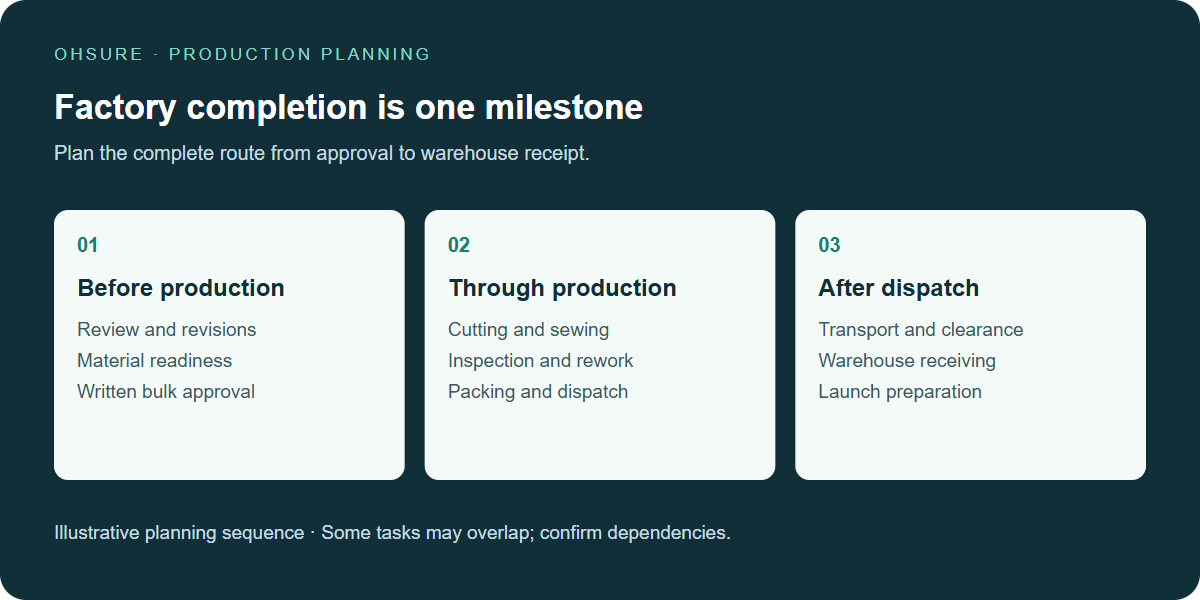
Contain affected quantities, agree the remedy and reinspect. Check whether the same cause affects other lots or sizes.
Evidence: Corrective-action record with reinspection results.
Before shipment and order closure
Suggested accountable role: Buyer sourcing lead and appointed logistics owner
Complete final inspection
Assess the finished goods against the agreed reference, tolerances and acceptance rules. Resolve failed checks before release.
Evidence: Final report, defect disposition and release decision.
Reconcile packing and quantities
Check style, color and size counts; unit identification; carton marks; packing protection; and agreed shipment documents.
Evidence: Packing list matched to the order and physical cartons.
Confirm the transport arrangement
Record the agreed delivery basis, named place, responsibilities, shipment booking and current arrival estimate. Confirm actual packing dimensions for cost estimates.
Evidence: Approved logistics instructions and booking details.
Close payment and dispatch conditions
Review any agreed inspection, document and payment prerequisites with the authorized parties. Keep payment authorization separate from unresolved quality decisions.
Evidence: Written dispatch approval and applicable records.
Record receipt and follow-up
Reconcile received quantities and condition promptly. Report issues within the agreed period with order, lot, photos and count evidence.
Evidence: Receiving report, issue record and reorder lessons.
How to use the checklist in six steps
- Create one order record. Add the order reference, style, specification version and required arrival date. Keep the approved tech pack, swatches, sample references and quotation accessible from that record.
- Assign owners and due dates. Give the buyer and factory separate actions where needed. A factory cannot close a fit approval that still needs the buyer’s decision.
- Prioritize by consequence and deadline. Review risks that could invalidate the product, stop the next stage or miss the launch first. An unknown material status needs investigation rather than a reassuring score. Optional risk scores can help organize discussion, but should never override a failed release condition.
- Review before each release. Compare the evidence against the agreed requirement before cutting, expanding production or dispatching. Close an item only when the record supports closure.
- Control changes. Record the old and new requirement, affected quantities, price impact, schedule impact, checks to repeat and the authorized decision. Identify which earlier approvals are superseded.
- Learn after receipt. Compare planned and actual milestones, record defects and unresolved costs, and update the next order’s specifications and checklist.
Make costs and lead-time assumptions visible
Build an order budget from identifiable items
Unit price is only one part of the outlay. Ask which costs are included before adding development, logo setup, labels, special packaging, tests, inspections, freight, clearance, duties or taxes. A separate line may be zero because it is included elsewhere. Write that down to prevent double-counting.
| Item | Assumption | Amount |
|---|---|---|
| Garments | 300 pieces × $12 | $3,600 |
| Development and sample courier | Assumed combined allowance | $240 |
| Inspection | Assumed separate charge | $180 |
| Transport and handling | Assumed separate charge | $480 |
| Planned outlay before excluded items | $3,600 + $240 + $180 + $480 | $4,500 |
| Late packing change | 300 pieces × $0.30 | +$90 |
| Extra sample review and courier | Illustrative additional cost | +$110 |
| Revised outlay | $4,500 + $90 + $110 | $4,700 |
At 300 received pieces, the example moves from $15.00 to approximately $15.67 per piece before excluded items. Duties, taxes, storage and any other unlisted charges are excluded; this is not a complete landed-cost estimate. If fewer units are saleable, calculate effective cost using the actual saleable quantity rather than assuming every ordered unit is available for sale. The example shows why small changes need written approval.
Plan backward from warehouse arrival
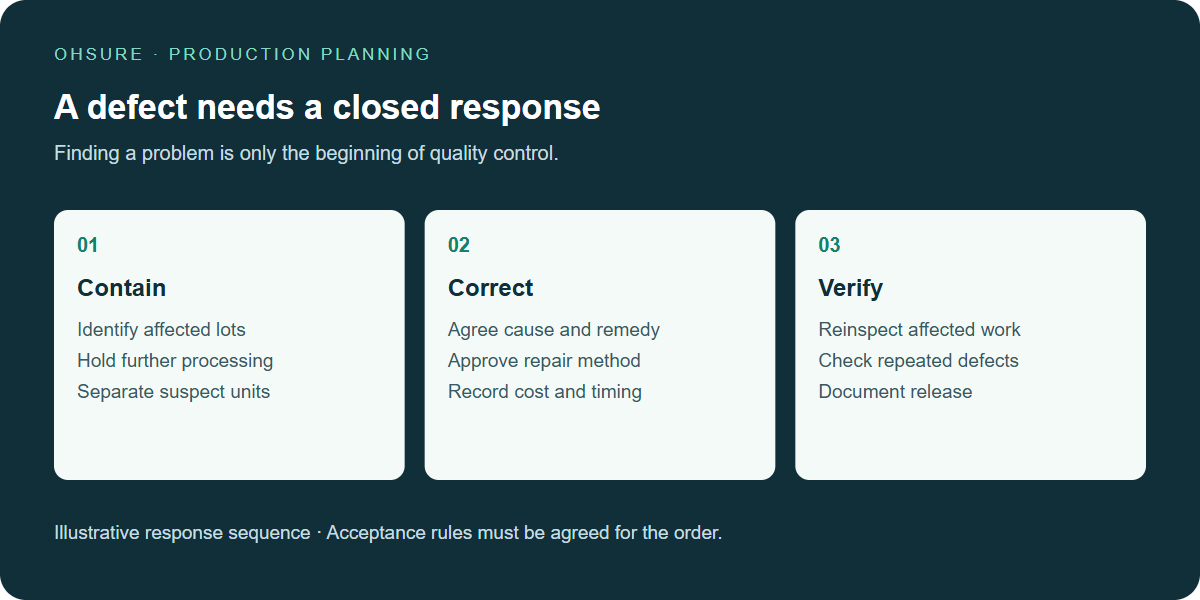
Allow for specification review, material readiness, sampling, buyer feedback, revisions, bulk production, inspection, possible rework, packing, transit, clearance and receiving. Some activities can overlap; others depend on approval. Ask whether each quoted duration uses working days or calendar days and what starts the clock.
Illustrative schedule check: If an agreed sequential plan allocates 12 calendar days to remaining development and material preparation, 28 to bulk production, 4 to inspection and packing, 18 to transport and receiving, plus 7 days of unallocated buffer, the planning span is 69 calendar days. A five-day delay in sample approval consumes five buffer days if later stages cannot move earlier. These durations are hypothetical and are not Ohsure lead-time commitments.
Keep a baseline and a current forecast. Buffer is visible recovery time, not permission to leave unresolved issues unreported. When work overlaps, map the actual dependencies instead of adding every task duration together.
Common mistakes that leave production risks open
- Approving a photograph as the full specification. A picture does not establish measurements, stretch behavior, fabric identity or construction. Attach the missing technical details.
- Calling every open item “low risk.” Missing evidence means the status is unknown. Investigate it before a dependent stage starts.
- Using a general “squat-proof” claim as acceptance criteria. Agree the relevant sizes, colors, fit, movement and viewing conditions. A fabric weight alone does not prove garment opacity.
- Waiting until final inspection to discover repeat defects. Agree earlier checks for material, logos and semi-finished work while corrections are still manageable.
- Accepting an undocumented substitution. A similar fabric or trim may change fit, feel, appearance, claims or testing needs. Review those effects and record the decision.
- Assuming an inspection guarantees every unit. Confirm its scope and sampling rules; retain receiving and issue-reporting procedures.
- Treating a launch date as a confirmed factory promise. Obtain an order-specific schedule and allocate transit and receiving time separately.
- Allowing extra charges to emerge after the work. Approve the scope, amount and timing impact of changes before they proceed.
Manufacturer perspective: make the approved product reproducible
From a production-planning perspective, “make it like the sample” works only when the sample is linked to identified materials, measurements, construction, artwork and an approval version. If the waistband, fabric or logo changes, the factory and buyer need to know which checks must be repeated. That is why a controlled approval package is more useful than scattered messages.
Ohsure’s published service scope includes OEM, ODM and private-label development, sample review, manufacturing and packaging customization. Buyers can use the custom activewear manufacturing service to discuss the order brief and use the private-label service to confirm branding, labels and packing requirements. These service descriptions establish discussion areas; the exact deliverables and release responsibilities belong in the order agreement.
Ohsure’s quality-control page describes checks for raw materials, printing, semi-finished products and finished garments. Ask which records, methods, tolerances and inspection scope will apply to your styles. The existence of these stages does not establish an independent test result, an agreed AQL standard or a zero-defect guarantee.
For quantity planning, Ohsure’s published starting MOQ is 100 pieces per style per color, with mixed sizes available; final requirements depend on the project. For example, two styles in two colors imply four style/color combinations, or 400 pieces at that starting minimum, subject to confirmation. Review the relevant fabric options alongside availability and any material minimums.
Sample timing is confirmed after reviewing the design, materials and customization requirements. Bulk-production timing is confirmed according to approved specifications, material availability and the production schedule. Request dates and start conditions for your own order.
Frequently asked questions
What should be approved before activewear bulk production starts?
Confirm the final specification version, identified materials, sample approval, artwork, size and color quantities, quality plan and commercial start conditions. List any exceptions and obtain written release from the named approver before cutting begins.
Which risks should a small brand review first?
Review risks that could make the product unsuitable, stop the next production stage or miss the required arrival date. Material availability, fit approval, performance evidence, minimum quantities and omitted quote items deserve early attention.
Does a passed final inspection guarantee a defect-free order?
No. An inspection assesses the defined scope under agreed rules. Confirm what was examined and any sampling limitations, resolve failed checks, and retain the receiving and defect-reporting process agreed for the order.
How should a fabric substitution be handled?
Identify the proposed replacement and its effect on fit, appearance, garment behavior, claims, price and timing. Agree which checks and samples must be repeated, update the specification and obtain written approval before use.
How can buyers reduce unexpected charges?
Compare quotations against the same specification and quantities. Record inclusions and exclusions, one-time fees, revision terms, packing and transport assumptions. Approve each change with its cost and timing impact before the work proceeds.
What should happen when a defect is found during production?
Identify the affected lots and quantities, contain suspect work, agree the cause and remedy, and verify the correction through reinspection. Record the release decision and review whether other sizes or lots may be affected.
What does Ohsure’s 100-piece starting MOQ mean?
It means 100 pieces per style per color, with mixed sizes available, subject to project confirmation. It does not mean an unrestricted 100-piece mix across several styles and colors. Confirm material, trim and customization minimums as well.
Can an order checklist guarantee on-time delivery?
No. It makes dependencies and decisions visible so problems can be addressed earlier. Obtain a project-specific schedule, track changes and include transport, clearance and receiving in the arrival plan.