
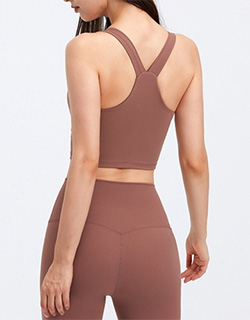
Custom Gym Wear Manufacturing Guide: Performance and Durability
Translate a training concept into a product specification that a brand and manufacturer can actually approve.
For fitness brands, product developers and sourcing teams · Published 6 November 2026
Custom gym wear manufacturing turns a training brief into garments with agreed fit, movement, moisture and durability requirements. Select fabrics and construction for the intended exercise, then assess finished samples before and after care. Confirm measurable acceptance criteria, branding, minimum quantities, costs and production milestones before approving bulk orders; fabric composition alone cannot guarantee performance.
What is custom gym wear manufacturing?
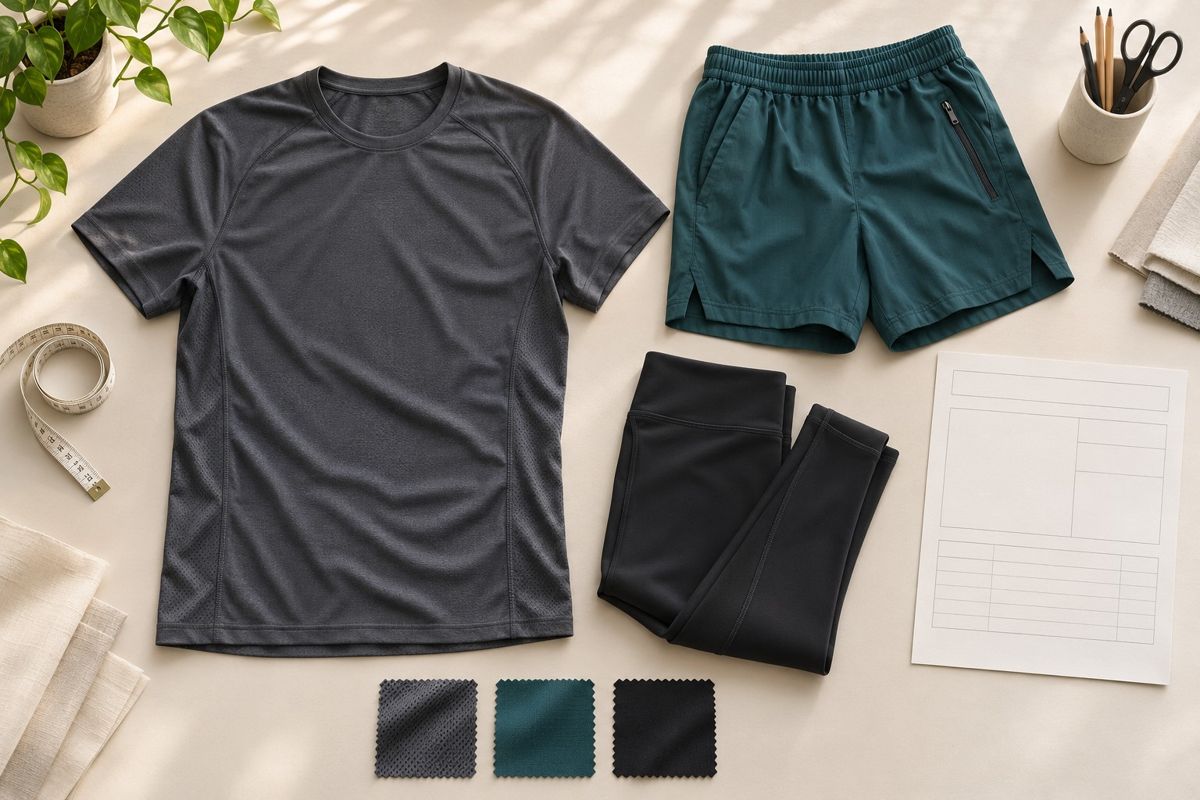
Custom gym wear manufacturing is the development and production of training apparel to a brand’s agreed specification. It connects the intended exercise, wearer and commercial brief with materials, patterns, seams, trims, decoration and care instructions. The scope can include training T-shirts, tanks, shorts, leggings, sports bras and warm-up layers.
Performance means how the garment functions in its intended use: movement, coverage, moisture behaviour, pocket stability and comfort. Durability means how well it retains the required appearance and function after the agreed wear, care and exposure conditions. A garment can feel comfortable during a first fitting yet lose shape or develop seam problems later.
Stretch is extension under defined conditions; recovery is return after that extension. Pilling is the formation of small fibre balls on the surface. Abrasion resistance concerns resistance to damage from rubbing. These properties are related to use but should be assessed separately. GSM means grams per square metre and describes fabric mass per area.
Define the training context first. Strength training may prioritise range of movement and coverage; circuit sessions may add repeated jumping and pocket movement; relaxed gym layers have different requirements from close-fitting training pieces. A sports bra intended for high-impact use requires its own support evaluation. A fitted silhouette alone does not substantiate compression or support claims.
Use Ohsure’s custom gym wear manufacturing service to discuss the collection brief. For silhouette references, start with the custom gym shorts, custom training T-shirts and custom gym leggings collections.
Compare fabric systems against the exercise
A fibre percentage is a sourcing input, not a finished-product verdict. Knit or woven construction, yarn, weight, finishing, colour and pattern ease all affect the result. The following table is a shortlist for sample discussion, not a ranking or an assertion that every fabric in a category performs the same way.
| Candidate | Potential role | What to verify |
|---|---|---|
| Polyester/spandex knit | Training tops and fitted bottoms where the selected material meets the brief | Moisture behaviour if claimed, surface feel, recovery, snagging, opacity and decoration compatibility |
| Nylon/spandex knit | Close-fitting leggings, shorts and bras | Recovery, coverage at extension, pilling, colour transfer and handfeel after care |
| Stretch woven fabric | Training shorts and selected outer layers | Available movement, seam behaviour, pocket construction, snagging and liner interaction |
| Cotton or cotton-blend jersey / fleece | Oversized training tees and warm-up layers | Dimensional change, twisting, wet feel, surface appearance and decoration after care |
| Recycled-content option | An alternative material route within a suitable fabric system | Exact specification, claim documents, availability and the same functional acceptance criteria |
Make the fabric brief traceable
Record the supplier’s fabric code, composition, construction, target weight with tolerance, colour reference, finish and usable width. For stretch fabrics, specify the directions of extension and how extension and recovery will be assessed. Retain labelled swatches so that a later material substitution cannot pass as an unchanged sample.
Ask for options against the same written brief through Ohsure’s activewear fabric guide. Confirm availability for the particular order. A soft handfeel does not prove resistance to pilling, and a high GSM does not guarantee squat coverage. Evaluate the actual garment colour and size at the extension expected in use.
Build a performance and durability approval matrix
Replace “premium quality” with an observable requirement. For each risk, specify the sample identity, procedure, conditions, acceptance limit, responsible person and result. Select representative sizes and colours, including the combinations most likely to reveal a problem. Agree which checks are development screens and which need a laboratory method.
| Risk | Assessment route | Record and agree |
|---|---|---|
| Movement and fit | Squat, lunge, reach and rotate in the intended garment size | Body measurements, movement sequence, restriction, waistband migration and chafing locations |
| Coverage | Review close-fitting bottoms at agreed extension | Colour, size, lighting, underlayer and acceptable show-through; repeat after care |
| Stretch recovery | Assess residual growth after a defined extension and rest | Direction, extension, repetitions, rest time and permitted residual change |
| Moisture and drying claims | Use a method appropriate to the precise claim | Specimen preparation, method, conditions, performance threshold and report identity |
| Surface durability | Assess pilling and abrasion separately where relevant | Method, exposure, rating or endpoint, agreed limit and reference photos |
| Seams, pockets and trims | Assess seam integrity and functional details under agreed use | Seam location, movement/load conditions, opening or breakage, pocket distortion and zipper function |
| Care and decoration | Compare before and after the agreed care sequence | Care settings, cycle count, dimensional change, twisting, colour transfer, logo cracking or lifting |
Separate moisture transport, drying and breathability
These words should not be used interchangeably. AATCC TM195 addresses liquid moisture management properties of textile fabrics. A result under that method should not automatically become a quick-drying or air-permeability claim. Ask a qualified test provider to select the method appropriate to each intended statement.
Separate surface appearance from fabric breakdown
ISO 12945-2:2020 specifies a modified Martindale method for evaluating fabric propensity to pilling, fuzzing and matting. This is not a universal measure of garment life. A good surface result does not establish pocket strength or seam integrity. Agree suitable additional assessments for the product’s actual risks and use the applicable method edition confirmed by the testing provider.
Compare like with like. A test result is meaningful alongside its method, conditions and acceptance limit. Different procedures or endpoints can produce numbers that should not be directly ranked. Neither a home wear trial nor a single laboratory result establishes a guaranteed number of workouts.
Use a repeatable care comparison
Measure approved points before care and again after the agreed procedure, allowing the specified conditioning or relaxation period. Keep flat widths and circumferences clearly labelled. Calculate signed dimensional change as (after − before) ÷ before × 100. For example, a 50.0 cm flat width becoming 48.5 cm gives −3.0%. This is an arithmetic example, not Ohsure test data or an acceptance limit.
A buyer can use a small, agreed wash sequence to identify early development problems, but should record the procedure and avoid presenting that screen as a recognised certification. Any claim about resistance after a stated number of washes needs evidence that matches the claim.
Design durability into seams, pockets and logos
Identify stress and rubbing zones on the drawing: crotch junctions, inner thighs, armholes, hems, waistband joins and pocket openings. Ask the manufacturer to propose a seam construction and thread combination that suits the fabric and expected movement. “Flat seams” or “reinforced stitching” are incomplete specifications without the actual construction and approval sample.
For training shorts, test pocket depth and position with the intended carried item. Record its dimensions and mass, then review movement, bounce, access and fabric distortion. A reinforcement at a pocket corner can address a local stress point, but its placement and stitch density still need approval on the selected fabric.
For tops, check overhead reach, hem lift and armhole contact. For leggings, review waist stability, crotch pressure, coverage and seam behaviour in deep hip flexion. Check representative sizes across the proposed range; approval of one middle size cannot establish that every graded size works.
Place decoration away from high-extension or rubbing zones where the design allows. Approve the actual logo size, process and placement on the intended fabric, including stretch and care behaviour. Digital artwork approval alone cannot show whether a transfer lifts or a large decoration changes comfort.
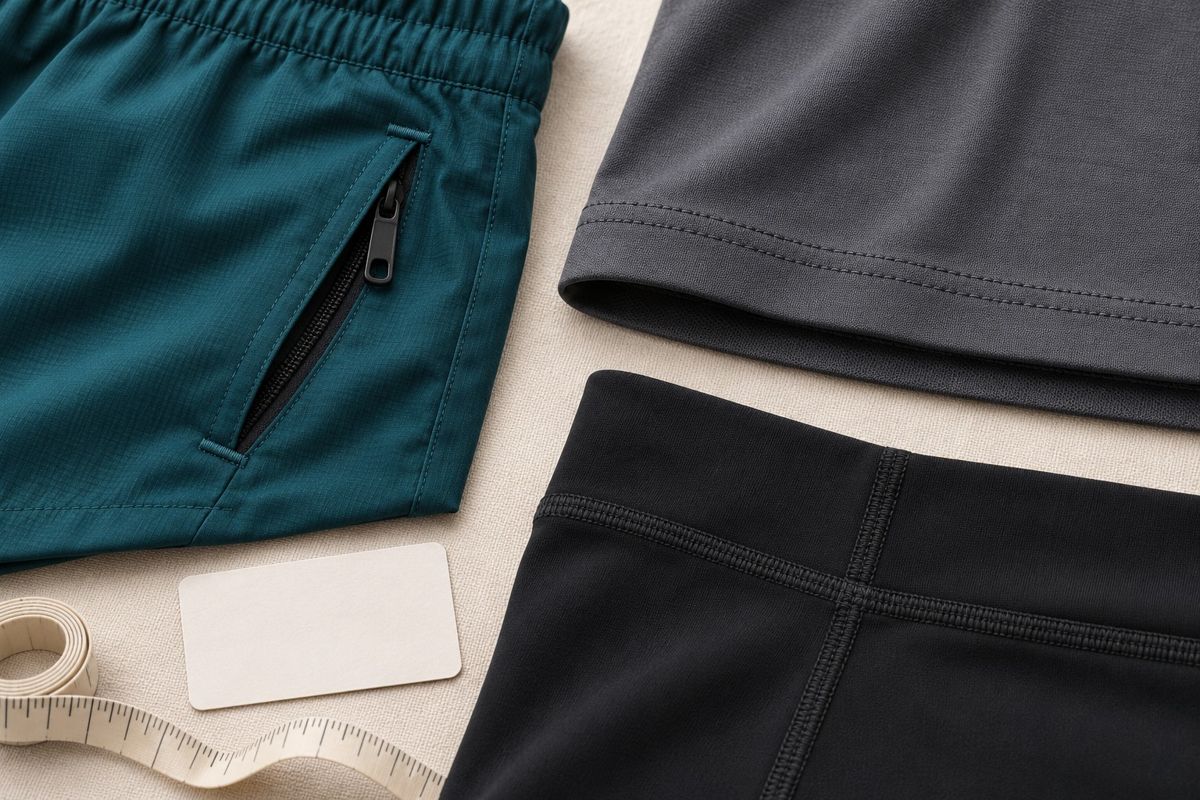
Seven steps from training brief to bulk production
This is a buyer planning workflow derived from the advertised service scope and general development practice, not a verified description of Ohsure’s internal operating procedure.
Define the wearer, exercise and product claim
State the training activities, size range, target customer and commercial priorities. List claims such as quick-drying separately from design preferences such as a cropped length.
Prepare the technical specification
Provide drawings, measurement diagrams, target body chart, finished-garment measurements, tolerances, bill of materials, colours, construction and packaging. Ask the supplier to flag gaps before pattern development.
Shortlist and identify materials
Compare actual fabric references against the approval matrix. Resolve custom colour submissions, decoration compatibility and material minimums before committing to a price comparison.
Review samples in movement and after care
Label each revision and record what changed. Use representative wearers and sizes, and inspect the complete garment rather than relying on loose fabric or standing photos.
Close failures and retain the approved reference
Assign each issue an owner and a decision. Recheck changes that affect fit, material or construction. Retain a signed or otherwise traceably approved production reference and the matching specification.
Confirm bulk controls and commercial terms
Agree incoming-material checks, decoration review, in-process and finished-garment inspection, sampling arrangements, defect handling and packing requirements. Confirm quantities, payment milestones and the production start conditions.
Inspect, release and plan replenishment
Review the agreed inspection results before shipment release. Confirm transport arrangements and retain material and garment references for repeat orders. Assess changes in fabric lot, shade or supplier component before treating a reorder as identical.
Discuss project responsibilities through Ohsure’s OEM and ODM service and confirm inspection scope through its clothing quality-control page.
Plan quantity, total cost and development time
Count order lines by style and colour
Ohsure’s published starting MOQ is 100 pieces per style per colour, with mixed sizes available. Final order requirements are subject to project confirmation. It does not mean 100 pieces distributed across unlimited styles and colours. Confirm separate requirements for fabrics, custom dyeing, decoration and packaging.
Illustrative launch: 2 T-shirt colours + 2 shorts colours + 1 leggings colour = 5 style-colour lines. At an assumed 100 pieces per line, the plan totals 500 garments.
If the tees and shorts are sold together, 200 tees plus 200 shorts can form at most 200 complete two-piece sets, subject to the size mix. The additional 100 leggings are separate garments. Confirm whether the supplier quotation counts pieces or sets.
| Driver | Why it affects the plan | Buyer action |
|---|---|---|
| Fabric and colour | Custom materials or dyeing can add minimums and approval work | Confirm stock/custom status, colour approval and order-specific minimums |
| Pattern and construction | Liners, pockets, panels and complicated seams add development and sewing work | Compare options with equivalent measurements and functional requirements |
| Branding and packaging | Processes, placements and components can introduce setup costs and separate minimums | Cost the actual artwork, label, hangtag and pack specification |
| Validation and revisions | Tests, sample freight and repeat approvals consume budget and calendar time | Assign owners, quote validation separately and close comments in one revision record |
| Production and inspection | Material readiness, order complexity and production scheduling affect release | Confirm start conditions, inspection scope and achievable milestones |
| Delivery and destination | Freight, import charges and local delivery depend on the arrangement | Agree the trade term and included costs; avoid comparing unlike quotations |
Compare landed cost per sellable garment
A useful planning model is (goods + development + validation + packaging not already included + logistics + applicable import charges) ÷ expected sellable units. Record what each quotation includes to avoid counting an item twice. Keep the supplier’s quoted trade term and currency alongside the total.
For example, assume 500 garments at US$12 each, US$350 for development, US$250 for validation and US$900 for logistics and import charges, with packaging already in the goods price. The total is US$7,500, or US$15 per garment if all 500 are sellable. If only 490 are expected to be sellable, it becomes approximately US$15.31. These are hypothetical planning inputs, not Ohsure prices, freight rates or an assumed defect rate.
Build the calendar around approvals
Sample timing is confirmed after reviewing the design, materials and customisation requirements. Bulk-production timing is confirmed according to the approved specifications, material availability and production schedule. Keep revisions, claim testing, colour approval, inspection and transit visible as separate milestones. Some can overlap; the delivery date depends on the critical path, not a simple addition of every task duration.
Request dates for material readiness, first sample, consolidated feedback, final approval, production start, inspection, dispatch and destination arrival. A quoted production period is not automatically a delivered-to-warehouse period.
Common gym wear sourcing mistakes
- Choosing the softest swatch as the most durable. Assess pilling, recovery, abrasion and care behaviour separately from first-touch preference.
- Specifying “four-way stretch” without a check. Agree directions, extension, recovery and finished-garment movement requirements.
- Approving a fit photograph as a performance result. Add movement, coverage and care review using identified samples and sizes.
- Changing fabric after sample approval without reassessment. Revisit affected fit, shade, decoration and functional checks.
- Requesting reinforcement everywhere. Locate actual stress points and approve the construction; extra stitching can change bulk, comfort and fabric behaviour.
- Comparing a goods-only quote with a landed quote. Align specifications, quantities, inclusions, trade terms and expected sellable units.
- Publishing claims before gathering evidence. Match the claim to a relevant report or evaluation for the selected product.
Ohsure’s manufacturing perspective: connect approval to bulk checks
Ohsure’s public materials describe OEM/ODM development, a sample room, pattern designers and custom branding and packaging services. Its fact library records material options and a starting MOQ by style and colour. These are service descriptions, not proof that a particular garment has achieved a specific performance rating.
Its quality-control description covers raw-material control, printing-process inspection, semi-finished sampling and finished-garment inspection. The fact library lists checks involving colour difference, weight, pilling, colourfastness, shrinkage, garment measurements, stitching and accessories. Buyers should agree the applicable methods, tolerances, sampling rules and acceptance limits for their project.
A practical manufacturer discussion
Consider an illustrative shorts review in which a loaded pocket pulls the side seam out of position during lunges. Ask whether the issue comes from pocket position, bag depth, material extension, seam construction or the intended item’s weight. Revise the relevant detail, identify the new sample and repeat the same check. A stronger pocket-corner stitch alone may not resolve a pattern or placement problem. This is an editorial problem-solving example, not a reported Ohsure customer case.
Send the sample room one consolidated issue list with annotated images, measurements, priorities and pass/fail decisions. Once approved, make the retained garment, material references and technical file agree. This gives the production team a clearer target than separate chat messages describing “better quality.”
Use the approval worksheet. The performance and durability checklist below provides fields for the requirement, method, agreed limit, sample reference, owner, result and approval. Complete the limits jointly before testing; blank limits are not acceptance.
For a project review, send Ohsure your gym wear specification, quantity matrix, proposed claims and target arrival date. Request a quotation tied to the same approved brief.
Gym wear performance and durability checklist
For each item, record the sample revision, style, colour, size, method and conditions, agreed criterion, result, owner, corrective action and approval date.
| Stage | Check |
|---|---|
| Movement and fit | Squat, lunge, reach and rotate in the intended garment size; Body measurements, movement sequence, restriction, waistband migration and chafing locations |
| Coverage | Review close-fitting bottoms at agreed extension; Colour, size, lighting, underlayer and acceptable show-through; repeat after care |
| Stretch recovery | Assess residual growth after a defined extension and rest; Direction, extension, repetitions, rest time and permitted residual change |
| Moisture and drying claims | Use a method appropriate to the precise claim; Specimen preparation, method, conditions, performance threshold and report identity |
| Surface durability | Assess pilling and abrasion separately where relevant; Method, exposure, rating or endpoint, agreed limit and reference photos |
| Seams, pockets and trims | Assess seam integrity and functional details under agreed use; Seam location, movement/load conditions, opening or breakage, pocket distortion and zipper function |
| Care and decoration | Compare before and after the agreed care sequence; Care settings, cycle count, dimensional change, twisting, colour transfer, logo cracking or lifting |
| Signed dimensional change (%) | (after - before) / before * 100; same measurement and care conditions |
Custom gym wear manufacturing FAQ
What should I send a custom gym wear manufacturer?
Send garment drawings or references, intended training use, target body-size chart, finished measurements, fabric requirements, colours, construction details, branding artwork and quantities by style, colour and size. Include care expectations, proposed performance claims, acceptance criteria, destination and required delivery date.
Is nylon or polyester better for gym wear?
Neither fibre name establishes the best finished garment. Compare the actual fabric construction, weight, finish, extension, recovery and care behaviour against the intended use. Evaluate identified swatches and complete garments using the same conditions, including moisture or durability testing where the brief requires it.
What GSM should custom gym wear use?
There is no universal fabric weight for every training garment. GSM measures fabric mass per area; it does not independently prove breathability, opacity or durability. Choose a candidate weight for the garment and assess its actual construction, colour, fit and performance before approval.
Does a pilling test prove gym leggings will last?
A pilling test assesses a specific type of surface change under specified conditions. It does not establish seam strength, abrasion resistance, stretch recovery, logo durability or a guaranteed number of wears. Combine relevant material tests with finished-garment checks and a documented care review.
Can a moisture-wicking result support a quick-dry claim?
Do not treat the terms as interchangeable. Liquid moisture transport and drying behaviour require evidence relevant to the particular claim. Agree the test method, preparation, conditions and acceptance criteria with a qualified provider; retain the report for the exact material or garment being marketed.
What is Ohsure’s MOQ for custom gym wear?
Ohsure’s published starting MOQ is 100 pieces per style per colour, with mixed sizes available. Final order requirements are subject to project confirmation. Fabric, custom dyeing, decoration and packaging minimums may affect the quotation, so confirm the applicable requirements for each order line.
How long does custom gym wear manufacturing take?
Sample timing is confirmed after reviewing the design, materials and customisation requirements. Bulk timing is confirmed according to approved specifications, material availability and the production schedule. Plan separately for revisions, testing, approvals, inspection and transport, and agree the start conditions for each milestone.
Can I use recycled fabric without changing the performance checks?
Apply the same functional requirements to the selected recycled-content fabric as to any alternative. Also confirm composition, availability, minimums and documentation for the exact content claim. Recycled content alone does not prove stronger seams, better moisture handling, longer life or a broader environmental benefit.
Sources and scope
Prepared from the supplied Ohsure article fact library and content-plan entry 85, with public page references checked on 6 November 2026. The buyer matrices, calculations and problem-solving scenario are editorial tools, not factory test results or customer case data.
- Ohsure custom gym wear service — product scope and published MOQ.
- Ohsure OEM/ODM and quality control — service and inspection descriptions.
- AATCC TM195 — liquid moisture management method scope.
- ISO 12945-2:2020 — pilling, fuzzing and matting method scope.
AI-generated images illustrate development concepts. No named technical reviewer or laboratory validation is claimed. Project-specific prices, timelines, test requirements and claims must follow the agreed order documents.