
Custom Tennis and Golf Apparel Manufacturing Guide
How to specify fabrics, movement, collars, pockets and sample approvals for a court-to-course collection.
Published 6 November 2026 · For apparel brands and procurement teams
What is custom tennis and golf apparel manufacturing?
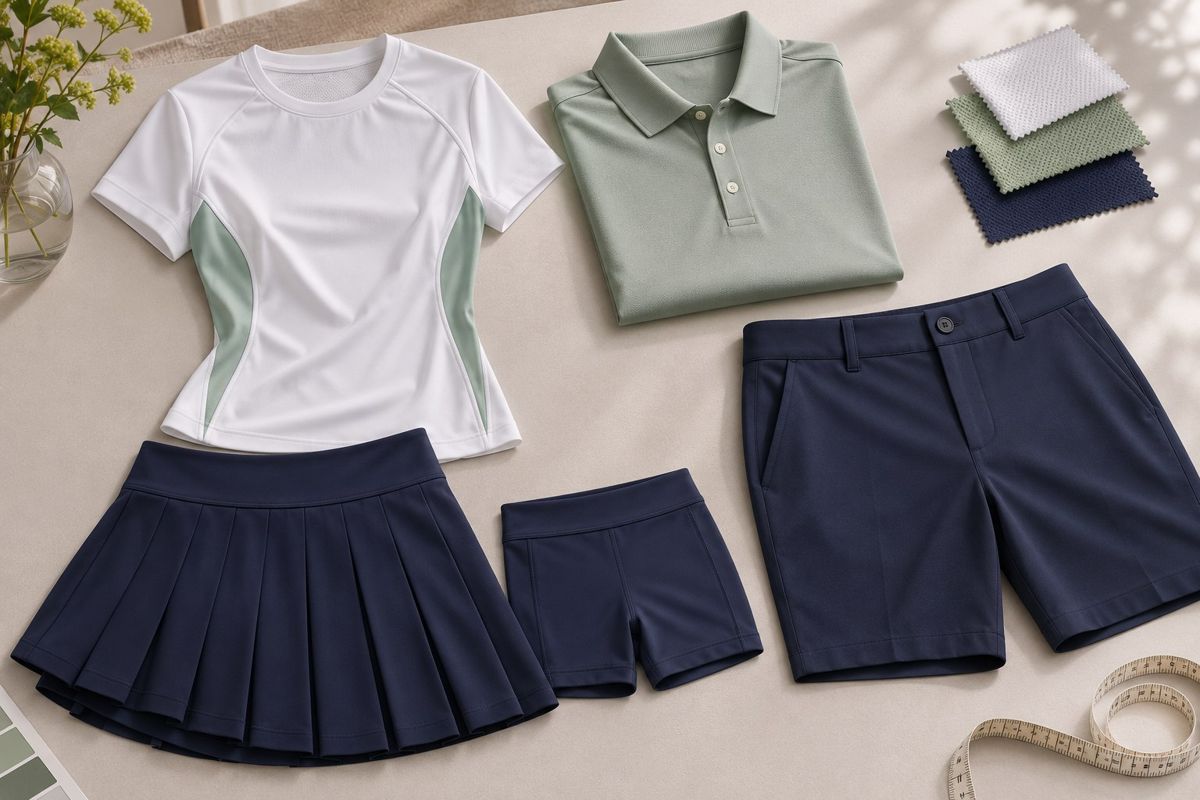
It is the development and production of garments against a brand’s agreed specification: materials, silhouette, measurements, size grading, construction, colors, trims, logos, labels and packaging. The specification should describe how the garment will be used, as well as how it should look. A tennis dress and a golf dress can share a visual direction while needing different pocket access, inner-short fit and coverage checks.
OEM generally means manufacturing to the buyer’s design and specifications. ODM generally starts with a supplier-developed design that is adapted for the brand. Private label describes selling under the buyer’s brand and can overlap with either route. Agree the actual development responsibilities, pattern ownership, permitted design changes and deliverables in the quotation.
Begin with Ohsure’s custom tennis wear manufacturing service and custom golf wear collection to identify a product direction. Then prepare a separate specification for each style rather than applying one generic sportswear brief to the whole collection.
Tennis vs golf: which requirements should change?
Use the table as a development checklist, not a universal dress code. Confirm the intended club, event or retail audience’s clothing requirements before freezing a design. A collar, skirt length or logo layout acceptable for one customer may need a different specification for another.
| Decision | Tennis apparel | Golf apparel | Sample approval check |
|---|---|---|---|
| Movement | Overhead reach, rotation, lateral steps and lunges | Shoulder turn, follow-through, bending and walking | Observe hem lift, armhole pull, waist movement and fabric restriction. |
| Typical silhouettes | Tops, polos, shorts, skorts and dresses | Polos, trousers, shorts, skirts, dresses and layers | Confirm wearer, intended fit, length and layering needs for each style. |
| Pockets | Ball retention and convenient retrieval where required | Access to balls, tees, markers or a scorecard as specified | Load the intended items; check bounce, bulging, access and seam strain. |
| Inner layers | Inner shorts or integrated support on selected designs | Inner shorts or lining on selected skirts and dresses | Check coverage, attachment, roll-up and practical dressing. |
| Appearance | Coverage through movement and coordinated color | Collar, placket, waistband and a tidy silhouette | Review the garment at rest, in motion and after laundering. |
| Surface and seams | Skin-contact comfort during repeated movement | Comfort during prolonged wear and contact with accessories | Inspect seam junctions, print edges, snagging and rubbing points. |
A shared fabric may simplify sourcing, but only use it across both sports after evaluating each finished garment. A stable polo collar does not demonstrate unrestricted tennis reach, and a comfortable tennis liner does not establish a suitable golf trouser fit.
Select fabrics by construction and finished-garment behavior
Do not buy on fiber percentage alone. Request composition, knit or weave construction, mass in g/m², usable width, stretch direction, recovery, finish, color reference and care instructions. Compare swatches before choosing the final garment fabric, then check the production color in the sample. A pale fabric and a dark fabric need their own opacity review.
| Fabric route | Possible role | What to verify | Development tradeoff |
|---|---|---|---|
| Polyester/spandex jersey | Stretch tops, dresses and selected inner layers | Recovery, damp comfort, opacity and logo compatibility | Stretch percentage does not establish cooling or support. |
| Nylon/spandex knit | Fitted panels and inner shorts | Hand feel, recovery, abrasion and seam extension | A soft surface does not establish drying performance. |
| Piqué or textured knit | Tennis and golf polos | Surface texture, snagging, collar compatibility and wash stability | Body fabric, collar and placket must behave well together. |
| Stretch woven | Selected shorts, trousers and outer skirts | Movement ease, pocket distortion, seam puckering and crease appearance | Stretch direction and pattern ease must match the movement brief. |
| Cotton-rich knit | Lifestyle or club-inspired collections | Damp feel, shape retention and intended activity | Evaluate against the actual use rather than assuming performance equivalence. |
Ohsure lists multiple material families in the supplied fact library; this does not confirm every weight, weave, color or finish. Use its fabric guide service to discuss suitable candidates. Ask the supplier to identify which components are stocked and which require separate sourcing or material minimums.
Translate claims into evidence requests
For a quick-dry claim, agree a test method, conditions, wash state and acceptance criterion. For an airflow or moisture-management claim, request an evaluation that actually measures that property. Do not replace one result with another. If UPF, antimicrobial, recycled-content or certified-material claims are part of the selling proposition, define the exact claim and request supporting reports or documentation for the relevant material and product. A fiber name, product title or generic certificate does not establish all finished-garment claims.
Resolve pockets, inner layers and collar shape on samples
Tennis skorts and dresses: make ball storage usable
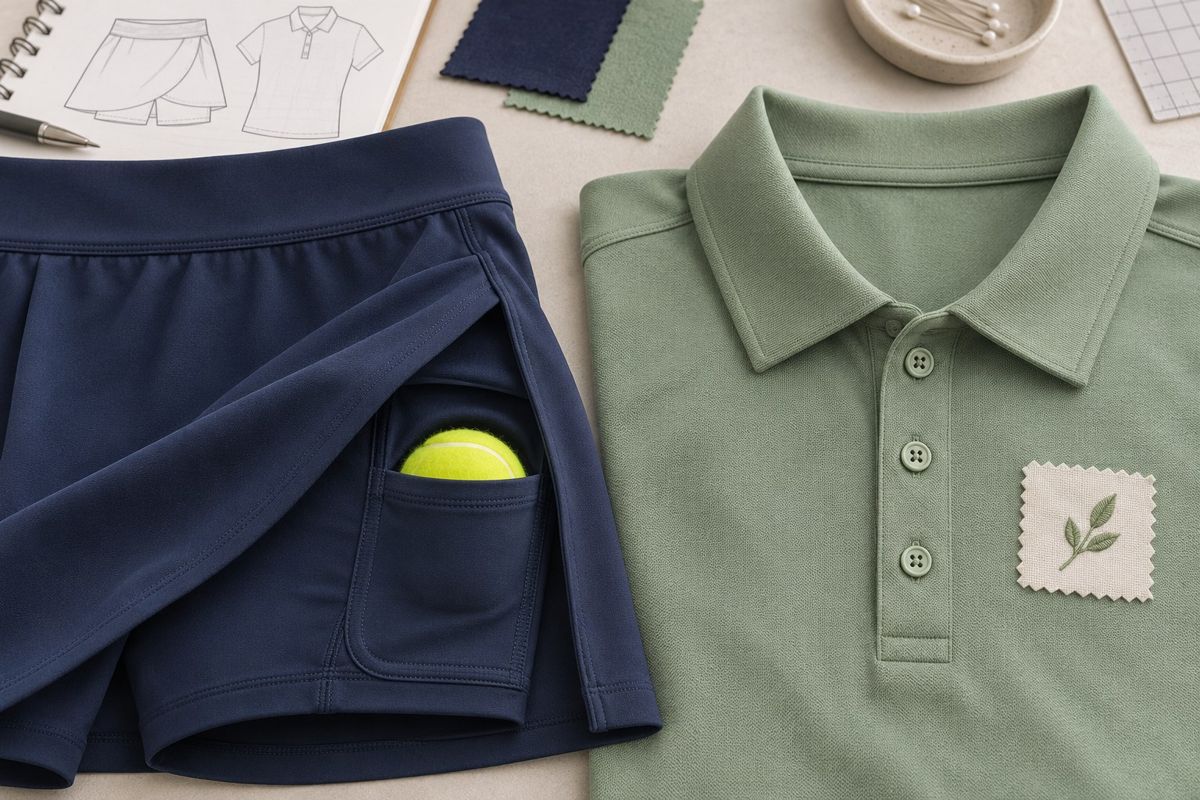
Specify whether the ball pocket is in the outer garment or inner shorts, the opening direction, finished dimensions, attachment points and intended capacity. Ask the wearer to place and retrieve the ball with the preferred hand, then repeat lateral steps and lunges. Record whether the ball shifts, the outer layer catches, or the liner leg moves upward. Review both loaded and empty pocket appearance.
For inner shorts, specify inseam, leg opening, rise, stretch direction and the attachment method. Assess coverage during overhead reach and deep bending, and confirm that the garment remains practical to put on and remove. If an integrated bra is requested, develop its fit and support separately; the presence of a lining or shelf does not establish a particular support level.
Golf polos: approve the collar as part of the garment
Identify whether the collar is self-fabric or a separate rib component, how it is attached, and how the placket is stabilized. Confirm collar dimensions, button spacing, button attachment and the inside neck finish. Compare collar shape and placket alignment before and after the agreed wash procedure. Check embroidery on the actual fabric because a dense design can distort a light knit.
Ohsure’s OS053 men’s golf polo product page provides one reference and lists a 95% polyester / 5% elastane fabric. Treat that as a product-specific reference; confirm the current sample, sleeve configuration and requested construction before ordering. For a skirt direction, review the women’s athletic golf skirt product page and specify inner layers and storage explicitly.
Choose branding around contact and movement
Mark logo width, height, placement from fixed garment reference points and color on the artwork sheet. Evaluate inside embroidery backing, print stiffness and stretch recovery where the logo crosses a moving area. For coordinated sets, approve colors together under agreed lighting; identical color names do not guarantee that different fabrics will match.
A seven-step development and approval process
The following is a recommended buyer workflow, not a claim about a factory’s internal operating procedure.
- Define the collection. List wearer, sport, climate, garment type, fit, sales market, size range, club or event requirements and planned launch date. Distinguish a single garment from a coordinated set.
- Prepare a technical brief. Include front, back and inside views, measurement points, grading, tolerances, seam and trim details, pocket load, inner-layer requirements, logo artwork, labels and packaging.
- Confirm materials and quotation scope. Select fabric candidates, colors and trims. Ask for component minimums, sample charges, testing costs, revision scope and production assumptions.
- Review the first sample in motion. For tennis, include reach, rotation and lateral movement. For golf, include swing simulation, walking, bending and sitting. Use the intended pocket contents and record wearer measurements.
- Check care behavior and revise. Measure before and after the agreed care procedure. Review collar shape, pleat appearance, shrinkage, color transfer, seam appearance, print adhesion and inner-short recovery as applicable.
- Approve the production reference. Retain the final garment, fabric and trim references, color standards, measurements, tolerances, artwork and signed revision record. Review representative size extremes before releasing the order.
- Agree bulk inspection and delivery. Set inspection scope, sampling rules, acceptance criteria, packing checks, shipment terms and the procedure for reporting discrepancies. Keep the approved reference available for comparison.
MOQ, cost and lead time: build a complete buying plan
Ohsure’s published starting MOQ is 100 pieces per style per color, with mixed sizes available. Final requirements depend on the project. This does not mean 100 pieces distributed freely across multiple styles and colors. Confirm separate fabric, dyeing, collar, trim, logo and packaging minimums, and ask how sets and separately sold components are counted.
Illustrative quantity calculation
Suppose a launch contains two polo styles and one skort style, each in two colors. At an assumed minimum of 100 pieces for every style–color combination, the plan requires 3 styles × 2 colors × 100 pieces = 600 pieces. An illustrative split within each 100-piece combination could be XS 10, S 25, M 30, L 25 and XL 10. Choose the actual size curve from your customer data. Confirm that the selected styles and components qualify for the stated minimum.
| Driver | Why it matters | What to request |
|---|---|---|
| Fabric and colors | Special materials or separate dye lots can change minimums, waste and procurement time. | Fabric reference, consumption basis, minimums and availability. |
| Construction | Inner shorts, pleats, extra pockets and separate collars add components and operations. | A breakdown for the agreed construction, including size-related assumptions. |
| Branding and packaging | Artwork setup, backing, labels and custom packing can carry separate charges. | Setup costs, unit costs and quantities covered. |
| Samples and verification | Revisions, size sets, wash trials and laboratory work can affect both budget and release date. | Included rounds, extra-round costs and approval milestones. |
| Delivery | Freight, insurance, duties and local charges depend on the arrangement. | Named shipping terms, destination, exclusions and separate freight estimate. |
Budget example only, not an Ohsure quotation: at an assumed average garment price of US$14, the 600-piece order would have a garment subtotal of US$8,400. Adding hypothetical development charges of US$300 and verification costs of US$200 produces US$8,900 before freight, duties, taxes and other excluded charges. Dividing that subtotal by 600 gives US$14.83 per piece. Replace every assumption with itemized quotes; different styles need their own unit prices.
Plan around approvals rather than an unconfirmed delivery promise
The supplied fact library records inconsistent sample and bulk-production timelines across Ohsure’s public pages. Sample timing should therefore be confirmed after design, material and customization review. Bulk timing should be confirmed against approved specifications, material availability and the production schedule.
Work backward from the required arrival date through transport, final inspection, production, material sourcing and sample approval. Some activities may overlap only if the supplier confirms that plan. Ask whether quoted days are working or calendar days, what starts each stage, how revisions affect it, and whether transit and customs are included. A late collar or custom-color approval can affect the entire coordinated collection.
Common mistakes that lead to avoidable revisions
- Approving only the standing appearance. Add sport-specific movement and loaded-pocket checks so restriction and coverage issues become visible.
- Choosing white fabric from an unstretched swatch. Review the intended color over seams and inner layers, both relaxed and extended, including damp conditions where relevant.
- Measuring a skort as one layer. Specify the outer skirt and inner shorts separately, including their attachment relationship.
- Approving collar and body fabric independently. Wash the assembled polo and assess differential shrinkage, curl and placket distortion.
- Using a product title as performance evidence. Request evidence for the specific claim and production material before writing the sales copy.
- Spreading an MOQ across the entire collection. Calculate each style–color combination and confirm any component minimums.
- Changing construction after price approval without a revised quote. Reconfirm price, material needs and schedule when pockets, lining, pleats or branding change.
Manufacturer perspective: turn visible details into controllable specifications
Ohsure’s OEM and ODM service page describes sample development, pattern support, bulk production and customization such as printing, embroidery, private labels, hangtags and packaging. These are relevant capabilities to discuss for tennis and golf projects; availability of a particular construction still needs confirmation.
Its quality-control page outlines checks covering materials, printing, semi-finished work and finished garments. A useful procurement step is to connect each approved detail to an inspection point: material color and mass on receipt, logo position before assembly, pocket construction during sewing, and dimensions and accessories on the finished garment. Agree the methods, tolerances and sampling rules for your order.
From a development perspective, the highest-value questions concern interfaces: how the collar behaves against the body fabric, how an inner short supports its pocket, and how a waistband responds when pockets are loaded. This is editorial manufacturing guidance derived from the garment’s construction, not a reported Ohsure customer case or a factory trial result. The supplied library contains no verified tennis or golf case study with measured outcomes, so no rejection-rate, cost-saving or performance figures are attributed to Ohsure here.
For a private-brand collection, discuss labels and packaging through the private-label service while keeping the garment approval record tied to the same style code.
Tennis and golf apparel approval checklist
For each check, record style, color, size, agreed requirement and tolerance, observed result, photo reference, corrective action and approval name and date.
- Fabric identity, mass and color
- Relaxed and extended opacity
- Tennis overhead reach and lateral movement
- Golf rotation, bend and walking
- Loaded pocket retention and access
- Inner-short inseam, leg opening and recovery
- Collar and placket after care
- Seams, junctions and contact comfort
- Measurements before and after care
- Branding position, backing and wash behavior
- Representative size extremes
- Bulk inspection and packaging
Frequently asked questions
Can one collection serve both tennis and golf?
A collection can share colors and selected materials, but each style needs a sport-specific brief. Evaluate tennis reach, lateral movement and ball storage separately from golf swing rotation, collar appearance and walking comfort. Confirm the intended club or event requirements before approving the design.
What is Ohsure’s minimum order quantity?
The published starting point is 100 pieces per style per color, with mixed sizes available. Final requirements are subject to project confirmation, including the selected fabric, colors, trims, branding and packaging. Confirm how sets and separate components are counted.
Which fabric is best for tennis and golf clothing?
There is no single best fabric for every garment. Compare construction, mass, stretch, recovery, opacity, care behavior and the intended use. Polyester/spandex, nylon/spandex, textured knits and stretch wovens are routes to discuss; confirm exact availability and test the finished sample.
Should a tennis skirt include built-in shorts and a ball pocket?
That depends on the product brief. If included, specify the inner-short fit, inseam, attachment and pocket orientation. Test ball retention, retrieval, coverage and leg movement during play-related motions. Do not assume a skirt reference includes these features.
How should a golf polo collar be approved?
Review the assembled garment before and after the agreed care procedure. Check collar dimensions, curl, symmetry, placket alignment, buttons and the inside neck finish. Confirm that the collar and body fabric remain compatible after laundering.
Can the garments be marketed as UPF or quick-drying?
Only use claims supported by appropriate evidence for the relevant material and product. Agree the claim, test method, conditions and acceptance criteria with the supplier or laboratory. A generic material description or product title is not sufficient evidence.
How long do sampling and bulk production take?
Sample timing is confirmed after reviewing design, materials and customization. Bulk-production timing depends on approved specifications, material availability and the production schedule. Ask for written milestones, start conditions and whether the quoted timing includes working days, transit or customs.
What should be sent to the manufacturer for an accurate quote?
Provide garment references, the sport and wearer, measurements and size range, fabric targets, colors and quantities per style, pocket and inner-layer details, collar requirements, logo artwork, labels, packaging and the desired arrival date. Ask the supplier to identify all assumptions and exclusions.
Prepare a quotation-ready tennis or golf brief
Send the garment references, wearer and sport, fabric target, size range, measurements, color quantities, pocket and inner-layer details, collar specification, artwork and required arrival date. Ask for a written proposal covering samples, material minimums, unit prices, verification and the production schedule.