
Custom Running Apparel Manufacturing: Fabrics, Seams and Visibility
A practical buyer’s guide to developing running tops, shorts and tights that can be evaluated before a bulk order.
Published 6 November 2026 · Buyer development guide
Custom running apparel manufacturing starts with the intended run: climate, distance, fit and lighting conditions. Choose fabrics by moisture handling, airflow and wet comfort; evaluate seams through movement and wash trials; and specify reflective placement with evidence for any visibility claims. Approve the complete garment before bulk production, including pockets, labels and care instructions.
What is custom running apparel manufacturing?
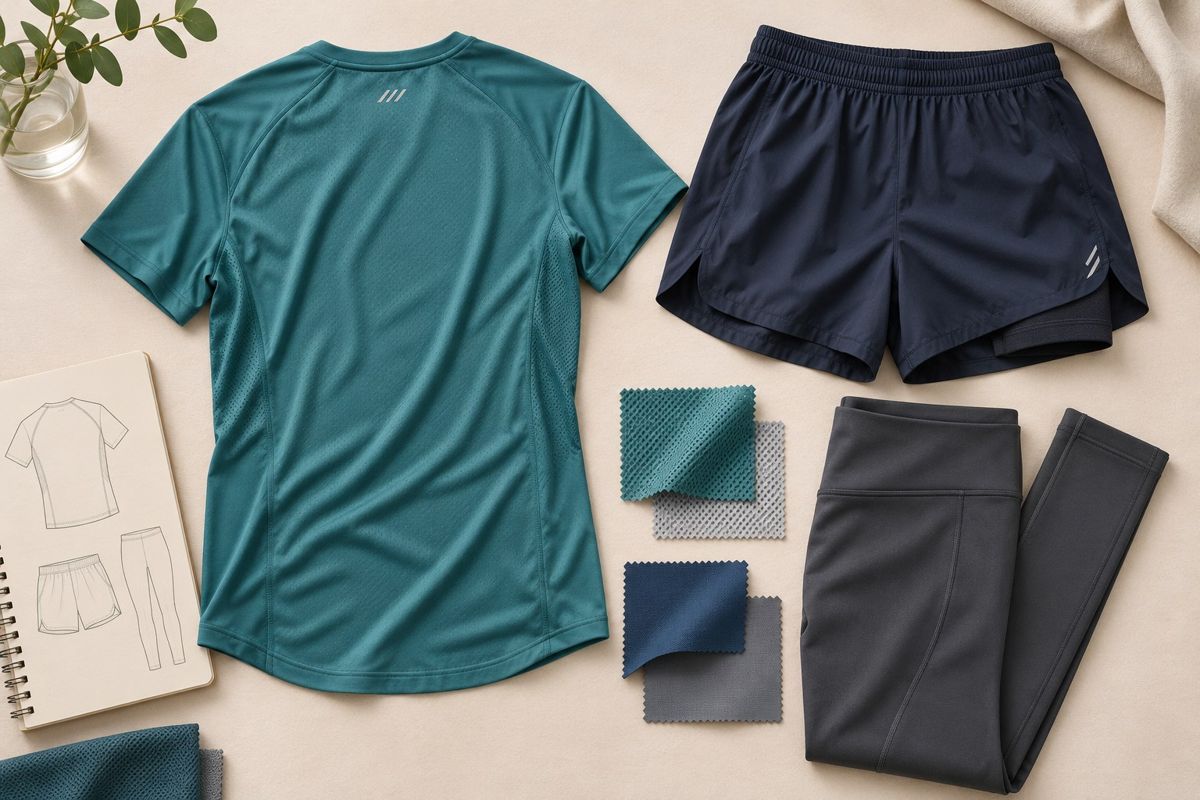
It is the development and production of running garments to an agreed specification: fabric, pattern, size grading, construction, trims and branding. A running shirt may resemble a gym T-shirt, but repeated arm swing, wet fabric contact and distance running create different approval priorities. Shorts also need evaluation of stride clearance, liner fit and pocket movement.
Define the product before requesting a quote. A race singlet, everyday training shirt, lined road-running short and cold-weather tight need separate briefs. This guide focuses on non-waterproof running tops, shorts and tights. Waterproof outerwear, medical compression claims and protective visibility equipment require additional specifications and validation.
For initial product references, review Ohsure’s custom sports T-shirts and custom shorts. Use the catalog to communicate silhouettes, then confirm the running-specific construction you need.
Choose the fabric by its job on the run
Fiber composition is one input. Knit or weave structure, mass, surface finish, stretch direction and garment fit also affect the result. Compare actual swatches and finished samples under the same conditions. “Moisture-wicking,” “breathable” and “quick-drying” describe different properties; one result should not stand in for all three.
| Fabric route | Potential application | What to evaluate | Tradeoff to resolve |
|---|---|---|---|
| Light polyester knit or mesh | Training tops and race singlets | Wet cling, airflow, drying behavior, opacity and snagging | An open structure may need a more careful opacity and durability review. |
| Polyester/spandex knit | Fitted tops and stretch panels | Recovery after extension, wet fit and print compatibility | Extra stretch does not automatically improve cooling or fit. |
| Nylon/spandex knit | Running tights and inner liners | Surface feel, recovery, abrasion and contact-point comfort | Do not infer moisture performance from a soft hand feel. |
| Light stretch woven | Outer shorts shells | Stride clearance, noise, pocket stability and seam puckering | Shell freedom and liner support must work together. |
| Cotton-rich knit | Casual running-inspired products | Wet mass, cling, drying behavior and intended activity | Do not substitute a lifestyle brief for a performance-running brief. |
Ask for the composition, construction, fabric mass in g/m², usable width, color reference and finish for each candidate. Agree tolerances and test conditions in writing. Ohsure lists several material families; availability of a particular mesh, woven shell, weight or finish needs project confirmation. Its activewear fabric guide can support that discussion.
Separate liquid transport, airflow and drying
For liquid moisture management, AATCC TM195 provides a textile evaluation method. Pair relevant liquid-management testing with separately agreed airflow and drying evaluations when those claims matter. Ask the laboratory to identify the method, conditioning, units and wash state. A wet sample drying beside a window is a useful comparison exercise, but it is not a standardized laboratory result.
Evaluate the exact production color and finish where relevant. A dark swatch, pale swatch and printed panel should not be treated as interchangeable evidence. For recycled or organic claims, request documentation that supports the specific material and claim being sold.
Specify seams around movement and skin contact
A seam name alone does not establish comfort. Seam allowance direction, thread, stitch tension, crossing points and the position on the body all matter. Map the underarm, inner thigh, waistband and liner opening before approving construction. Add label edges, drawcord ends and zipper backs to the same contact map.
| Construction | Where to consider it | Approval check | Cost or development implication |
|---|---|---|---|
| Overlock with managed allowance | Top and shorts assembly | Allowance direction, ridge height, thread ends and extension | Establish a practical baseline before adding specialist operations. |
| Flatseam / flatlock construction | Skin-contact stretch panels and liners | Inside feel, seam width, extensibility and junction bulk; agree the actual construction | Machine setup and operator capability need confirmation. |
| Coverstitch finish | Stretch hems and selected edges | Hem recovery, tunneling, skipped stitches and skin feel | Additional finishing operations affect handling time. |
| Bonded finish, if available | Selected low-bulk hems or panels | Peeling, stiffness, stretch compatibility and wash durability | Requires material compatibility trials and capability confirmation. |
Run a comparison in the finished garment. Use the same wearer, route, approximate duration, pocket load and care procedure, and record the conditions. Inspect the garment dry, during wear when damp, and after washing. Record where rubbing occurs rather than marking the whole garment simply “comfortable.” A small development trial supports revisions; it does not prove a universal “chafe-free” claim.
Define what “visibility” means before adding reflective details
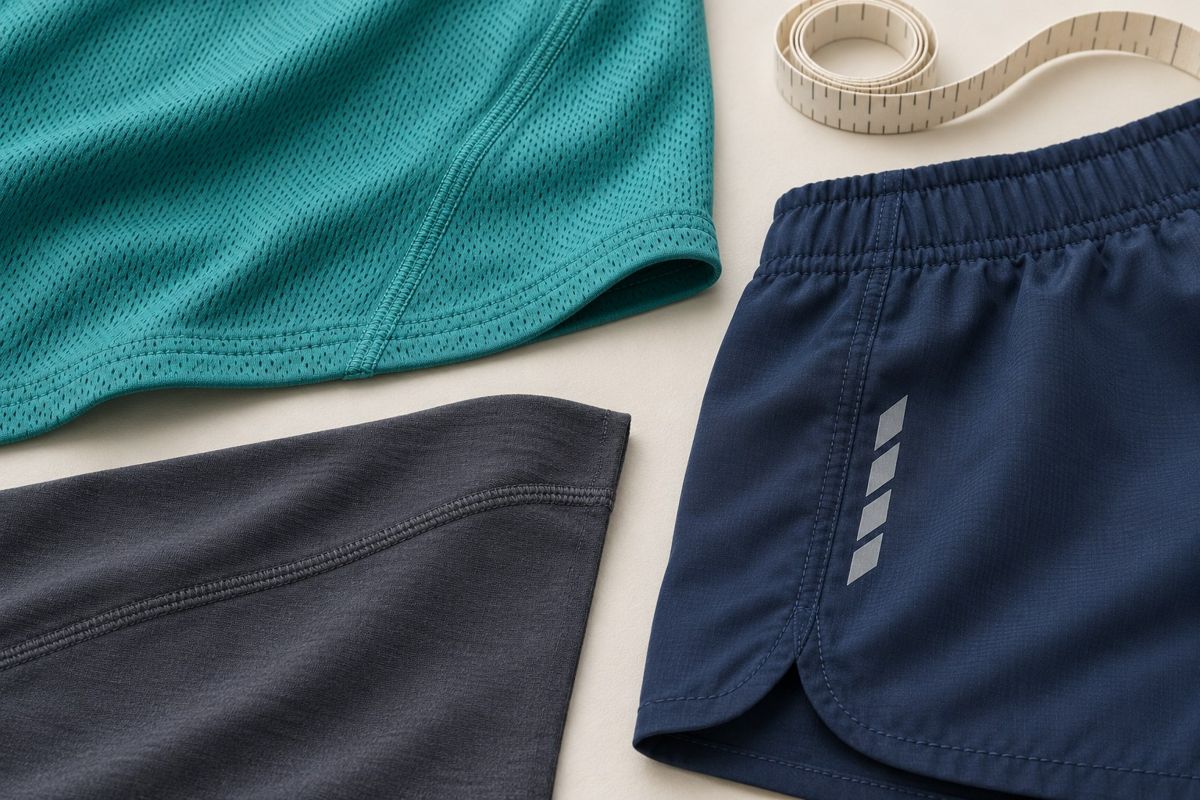
Bright color, fluorescent material and retroreflective material are different design elements. Retroreflective details return incident light toward its source; they do not generate light. A silver-looking logo in an ordinary photograph does not show how it will perform when illuminated, stretched or washed.
For an ordinary running collection, draw a placement map showing front, back and side views, dimensions and garment reference points. Check whether arm swing, a vest, a jacket or a loaded pocket covers the details. Review the smallest and largest sizes, not only the central sample size. Keep the approved artwork and trim reference with the garment specification.
Decoration and verified protective performance have different evidence requirements. EN 17353:2020+A1:2025 addresses enhanced visibility equipment for medium-risk situations, including material performance and placement. Its scope excludes high-risk equipment covered by EN ISO 20471. The ISO 20471 overview also describes requirements for material performance, area and placement. A trim report alone cannot establish conformity of a finished garment.
If the range is intended to carry a protective visibility claim, define the destination market, intended use and applicable assessment route with a competent specialist before freezing the design. Obtain evidence for the exact material and finished design. Otherwise, describe the physical reflective detail accurately without presenting the garment as certified protective equipment or promising a visibility distance.
Before bulk approval, review transfer adhesion, edge lifting, cracking and appearance after the agreed care sequence. A consistent light-source comparison can help identify application differences, but certification or quantitative performance claims need the applicable formal assessment. Ask Ohsure to confirm whether the chosen reflective process and material can be supplied; the general availability of logo printing does not confirm this specialist option.
A seven-step sample-to-production workflow
Write the running-use brief
State the target runner, climate, distance, fit, intended lighting conditions and product category. Identify whether the item is everyday sportswear or is intended to make a protective claim. List the features that will decide approval.
Build a measurable tech pack
Provide front and back drawings, measurement points, size chart, tolerances, seam callouts, pocket dimensions and branding positions. For shorts, specify inseam measurement method, liner length, waistband construction and the object the pocket must carry.
Compare fabrics and trims
Select a small number of candidates against the same brief. Record composition, fabric mass, stretch directions, color and finish. Confirm the liner, elastic, drawcord, labels and any reflective material as separate components.
Evaluate the first garment sample
Check measurements, movement and contact points. Load a pocket with the intended phone or gels. Evaluate bounce, sagging, access and pressure during running; a standing fitting cannot resolve all of these issues.
Complete wear, wash and claim reviews
Agree the wear protocol and care conditions, then repeat relevant checks after washing. Record changes in fit, seam feel, print adhesion and trim condition. Commission the testing needed for the proposed claims.
Approve a production reference
Freeze the revised specification, approved sample, artwork, materials, size grading and packing instructions. Review size extremes where risk is high. Agree how a material substitution or application change will trigger reapproval.
Check bulk against the approved reference
Agree inspection timing, sampling, tolerances and defect criteria before production. Check incoming materials, application processes, sewn assemblies and finished garments. Confirm packing and shipment details against the purchase order.
This is a recommended buyer workflow, not a claim about a verified internal Ohsure procedure.
Ohsure’s manufacturing perspective: turn references into approval records
Ohsure’s published OEM and ODM service describes sample development, pattern support, garment production and customization. A useful enquiry therefore combines a design reference with measurements and construction requirements. A photograph is a starting point; a marked-up tech pack makes revisions easier to track.
For a running project, send a contact-point map and a trim-placement drawing alongside that pack. Ask for separate confirmation of mesh or woven-shell sourcing, liner assembly, the proposed seam construction and reflective application. These are project-specific requests, not assumptions based on a general sportswear service description.
Ohsure’s quality-control page describes material checks, printing inspection, semi-finished sampling and finished-garment inspection. Translate those stages into agreed checkpoints for your order, such as fabric identity, artwork placement, seam workmanship and measurements. Keep specialist performance testing separate from routine visual inspection.
Use the private-label service to discuss labels and packaging. Place labels where their edges can be assessed during the wear trial; branding should be part of comfort approval.
Plan costs around the complete specification
A basic shell short and a lined short with secure storage have different material and operation requirements. Cost drivers include shell and liner consumption, fabric and color minimums, seam operations, pocket assembly, reflective artwork, labels, testing and packaging. Request the same specification from each supplier before comparing prices.
Example: a 300-piece first collection
Ohsure’s published starting MOQ is 100 pieces per style per color, with mixed sizes available, subject to project confirmation. Two shirt colors at 100 pieces each plus one shorts color at 100 pieces gives 300 pieces across three style-color combinations. It does not mean 100 pieces spread across all three combinations.
For size planning only, a 100-piece color could be split S 15 / M 35 / L 35 / XL 15. Replace this illustrative ratio with your audience data and confirm size availability.
Illustrative budget, not an Ohsure quotation: 300 garments × an assumed average US$9 = US$2,700; development US$180; testing US$240; freight US$360. Total = US$3,480, or US$11.60 per garment, before duty, taxes and other destination charges. Each amount is an arbitrary planning input, not a market-price estimate.
Ask the quote to identify what the unit price includes, one-time development charges, testing scope, packing and transport basis. Confirm customs and destination charges separately. If a revised liner or reflective specification changes the work, update the price before approving bulk production.
Use approval gates to plan time
Sample timing is confirmed after reviewing the design, materials and customization requirements. Bulk-production timing is confirmed according to the approved specifications, material availability and production schedule. These are the appropriate Ohsure planning statements until the project schedule is agreed.
Build the launch calendar backward from the required in-hand date: delivery and destination handling, final inspection, bulk production, material readiness, sample revision, wear-and-wash evaluation and final approval. Confirm whether each estimate uses working or calendar days, its start condition, and which tasks can overlap. Reserve a revision window; do not count an unapproved first sample as production-ready.
Common purchasing mistakes and their fixes
- Approving fabric by touch alone. Compare wet behavior, movement and post-wash condition in the finished garment.
- Calling every flat-looking seam “flatlock.” Approve an inside construction sample with the actual stitch and thread combination.
- Promising “chafe-free” after a short fitting. Record contact-point feedback across the intended use; keep claims within the evidence.
- Buying reflective trim after the artwork is frozen. Resolve placement, application compatibility and claim requirements during development.
- Checking pockets while empty. Test the specified load during movement and after washing.
- Using a single size to approve the whole range. Review grading, seam position, liner opening and trim placement at size extremes.
- Changing material after approval without a review. Recheck affected fit, comfort, application and performance requirements.
A running apparel approval sheet your team can use
Assign an owner, acceptance criterion and evidence file to every row below. Enter a method and threshold before testing; “good quality” is not a measurable approval criterion. Use the approval sheet below as your project record.
| Approval area | Record before testing | Evidence to retain |
|---|---|---|
| Use and claims | Climate, distance, fit, lighting conditions, market and exact proposed claims | Signed brief and claim review |
| Fabric identity | Composition, construction, mass, finish, color and tolerances | Approved swatch and material reference |
| Moisture and airflow | Methods, units, conditioning, wash state and acceptance criteria | Reports linked to the tested material |
| Seam comfort | Contact map, construction, wear protocol and feedback criteria | Inside photographs and wear log |
| Pocket and liner | Load dimensions and mass; fit, access and movement criteria | Loaded wear-review record |
| Reflective details | Material, application, placement by size, care sequence and claim requirements | Approved drawing, application sample and applicable reports |
| Wash durability | Care procedure, cycles, measurement points and permitted changes | Before/after measurements and images |
| Bulk release | Approved sample, grading, inspection plan, defect criteria and packing | Approval sign-off and inspection record |
Frequently asked questions
What fabric should I choose for custom running shirts?
Start with the running conditions and compare suitable lightweight knits or meshes. Evaluate liquid moisture management, airflow, drying behavior, wet cling and opacity separately. Approve the exact fabric, finish and garment fit rather than choosing by fiber name alone.
Does flatlock stitching guarantee a chafe-free garment?
No. Seam placement, thread, tension, crossing points, fit and wet contact all affect comfort. Approve the actual construction through a documented wear-and-wash review, including underarms, inner thighs, waistbands and labels.
Can I add a reflective logo to running shorts?
Ask the manufacturer to confirm the reflective material and application process for the chosen fabric. Specify position, dimensions and care requirements, then review adhesion and durability. A reflective logo does not by itself establish certified garment visibility.
Is EN 17353 the same as ISO 20471?
No. EN 17353 addresses enhanced visibility equipment for medium-risk situations and excludes high-risk equipment covered by EN ISO 20471. Identify the intended use and relevant assessment route before making protective visibility claims.
What is Ohsure’s starting MOQ for a running collection?
The published starting MOQ is 100 pieces per style per color, with mixed sizes available. Final order requirements depend on the project. Confirm the selected garment, fabric, colors, branding and packaging before using that quantity in a purchase order.
How long will sampling and production take?
Sample timing is confirmed after design, material and customization review. Bulk timing depends on approved specifications, material readiness and the production schedule. Request a project calendar that includes revisions, wear-and-wash checks, inspections and transport.
How should I test a running shorts pocket?
Use the intended phone, gels or other load and record its dimensions and mass. Check access, bounce, sagging, pressure and retention during movement, then repeat relevant checks after the agreed care sequence. Keep the load and conditions consistent between samples.
What should I send to get a useful manufacturing quote?
Provide drawings or references, measurement points, size grading, fabric requirements, seam details, liner and pocket specifications, branding artwork, quantities by style and color, packing needs and the required in-hand date. State any proposed performance or protective claims up front.
Prepare a running apparel enquiry
Send your garment sketches, target quantities by style and color, size range, running-use brief, proposed claims and required in-hand date through Ohsure’s enquiry page. Ask for confirmation of the fabric route, seam construction, reflective options, sample scope and production schedule before placing the order.
Sources and editorial basis
Company statements are based on the supplied Ohsure article fact library and the linked official service pages. Fabric comparisons, the buyer workflow, checklist and budget example are editorial development guidance, not reported Ohsure test results or customer cases. Public sources checked 6 November 2026.
- Ohsure homepage: published starting MOQ.
- Ohsure OEM/ODM, quality control and fabric guide: service scope and material discussion.
- AATCC TM195 scope: liquid moisture-management evaluation.
- EVS official EN 17353:2020+A1:2025 record and ISO 20471 official overview: visibility-equipment scope and requirements.