
Sustainable Activewear Packaging: Materials, Costs and Trade-Offs
Choose packaging that protects the garment, fits the supply chain and makes claims you can support.
Ohsurewear | Published: 5 November 2026 | Sources checked: 5 November 2026
Sustainable activewear packaging uses no more material than needed to protect garments and supports a realistic reuse, recycling or composting route in the destination market. Compare paper, recycled-content plastic and compostable options against moisture protection, packing efficiency, shipping volume and verified claims. The strongest choice depends on the complete delivery system, not a material label alone.
What does sustainable activewear packaging mean?
For procurement, sustainable packaging is a design approach: reduce avoidable material, maintain the protection the garment needs, and choose an end-of-use route customers can actually access. A lower-impact claim needs evidence against a stated baseline. A kraft colour, leaf graphic or premium unboxing experience does not establish that result.
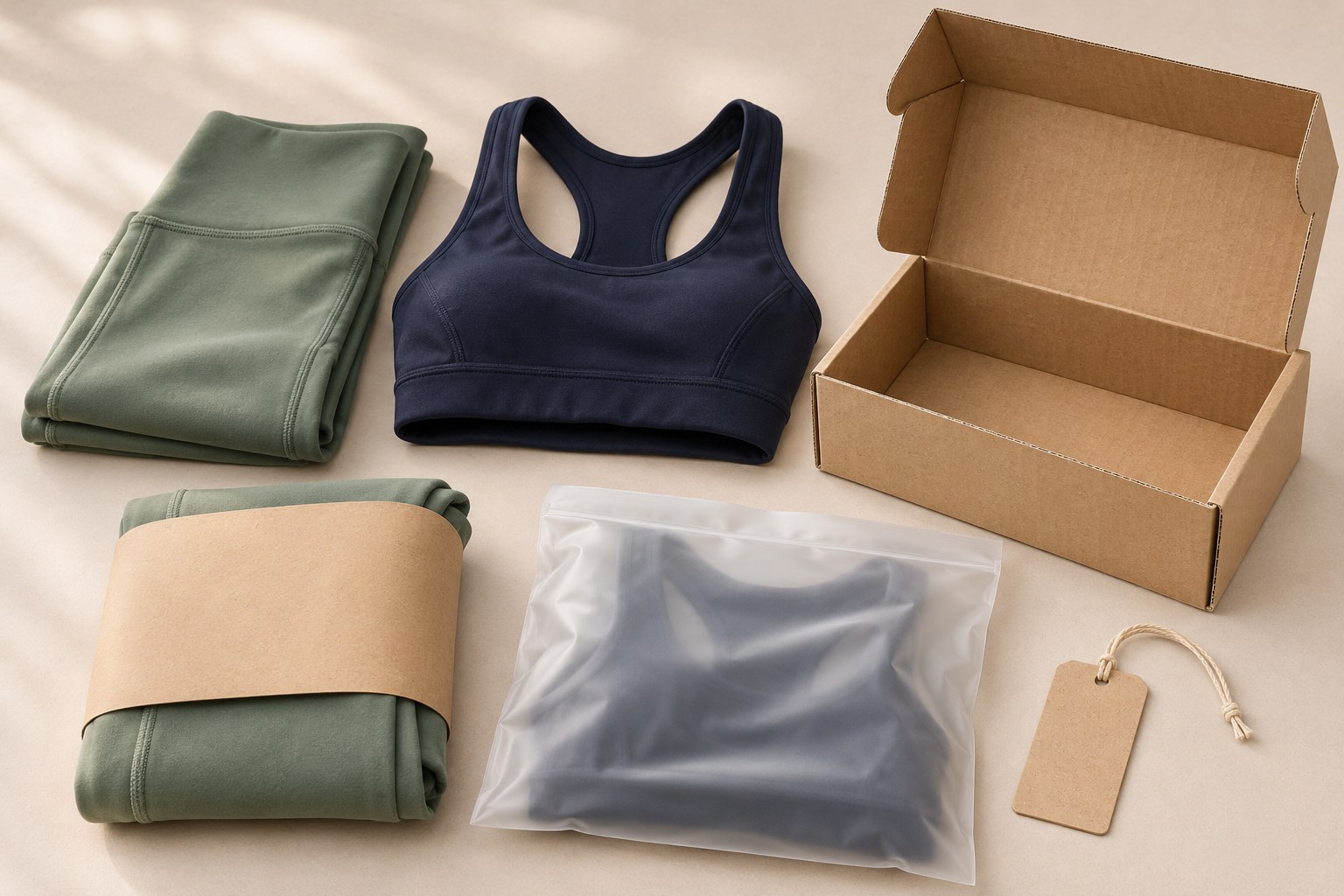
Separate three layers before comparing suppliers. Individual garment packaging keeps a folded item together and supports SKU identification. Delivery packaging carries a customer order through handling and transport. Bulk transport packaging groups factory shipments. Replacing one layer may change what another layer must do.
Four terms that answer different questions
- Recycled content: what proportion of the material comes from recovered inputs? Ask whether it is post-consumer or pre-consumer and how it is documented.
- Recyclable: can this exact format be collected and processed in the destination system? Resin identification and recycled content do not answer that question.
- Compostable: does the finished item meet specified composting conditions, and is a suitable collection route available?
- Bio-based: does some material come from biological feedstocks? This does not by itself establish biodegradability or compostability.
The European Commission explains these distinctions and the risk of sending compostable plastics into conventional plastics recycling. Treat each term as a separate evidence request.
Packaging materials: protection, cost drivers and trade-offs
The comparison below is a buyer’s screening tool. It does not rank carbon footprints or establish Ohsure’s stock availability. Thickness, coatings, closures and transport conditions can change the result.
| Option | Practical fit and protection | Cost / operating trade-off | End-of-use check |
|---|---|---|---|
| Paper sleeve or belly band | Useful for keeping folded garments together in protected retail or bulk handling; limited enclosure. | Can simplify the presentation pack, but may still need separate transit protection. | Confirm paper grade, inks, adhesives and acceptance by the local paper stream. |
| Paper garment bag or mailer | Encloses the garment; tear strength and wet resistance depend on construction. | Larger sizes, heavier paper and barrier layers can increase material and packing demands. | Check whether coatings, windows and closures affect local collection and processing. |
| Recycled-content PE garment bag or mailer | Flexible, compact format; test the actual film, seams and closure for the route. | Recycled percentage, thickness, printing, size and supply consistency influence the quote. | Verify recovered-input claims separately from destination film-recycling acceptance. |
| Compostable flexible bag | Possible option where the specified finished bag and collection route are suitable. | Qualification, shelf-life conditions, handling and custom minimums need confirmation. | Distinguish home from industrial composting; confirm facility acceptance, not only a certificate. |
| Reusable pouch or returnable mailer | May support returns or repeated delivery when the design and operating system enable reuse. | Higher initial commitment may need return logistics, inspection and replacement allowance. | Measure actual reuse and losses; giving away a durable pouch does not prove repeated use. |
| Corrugated box | Can group orders and add structural protection; size it around the packed garments. | Material weight, void space, assembly, storage and freight can outweigh a low unit price. | Confirm local acceptance of the complete box; review tape, liners and other additions. |
Choose the route before the material
For bulk orders delivered to a retailer, discuss whether shared carton protection can remove an unnecessary individual layer without losing cleanliness, identification or handling control. For direct-to-consumer orders, test the individual pack and outer mailer together. For a reusable system, define who collects, checks and recirculates the packaging before paying for a durable format.
As one destination example, the US EPA’s recycling guidance says plastic bags and film generally do not belong in curbside bins. This is a reason to check the customer’s collection route, not a universal instruction for every market.

What evidence should a packaging supplier provide?
Ask for documents tied to the item being ordered. A supplier certificate can support a sourcing review, but a generic certificate image does not prove the composition or status of every bag or box the supplier sells.
| Claim or question | Evidence to request | Boundary to keep clear |
|---|---|---|
| Recycled-content bag | Material specification, claimed percentage and basis, input type, supporting traceability or verification records linked to the order. | A recycled-content claim is not proof of local recyclability or lower life-cycle impact. |
| FSC-labelled paper packaging | Supplier identity, certificate code, valid status and relevant scope; matching product/invoice claim and approved artwork. | FSC concerns forest-based sourcing claims; it does not establish package waterproofness or local recycling acceptance. |
| Compostable finished bag | Applicable scheme or test basis, certificate number and validity, covered product and thickness, ink/adhesive/closure coverage, disposal conditions. | Industrial and home composting are different; certification alone does not ensure local facility acceptance. |
| Reusable format | Design specification, closure durability trial, collection procedure and records of completed uses, losses and replacements. | A theoretical maximum or customer intention does not establish realised reuse. |
| Recyclable final pack | Complete component list and destination-program guidance covering the assembled format. | Check coatings, labels and closures; a material name alone is insufficient. |
For paper, FSC distinguishes its 100%, Mix and Recycled labels. Mix does not mean 100% recycled. Check certificate validity and scope through the FSC public certificate search resources, then match the claim to the actual packaging order. Confirm permitted artwork and label use with the authorised supplier.
Keep packaging claims visibly separate from garment claims. A recycled-fabric sports bra and its mailer need their own evidence; documentation for either one does not certify the other.
A six-step packaging approval process
The following is a recommended buyer workflow, not a verified Ohsure internal procedure. Agree test methods, conditions and acceptance limits with the project team.
Map the delivery and return route
Identify bulk or customer shipment, destination markets, warehouse handling, exposure conditions, SKU scanning and returns. Record the current layers, package weight and packed dimensions as the comparison baseline.
Remove avoidable layers and size the pack
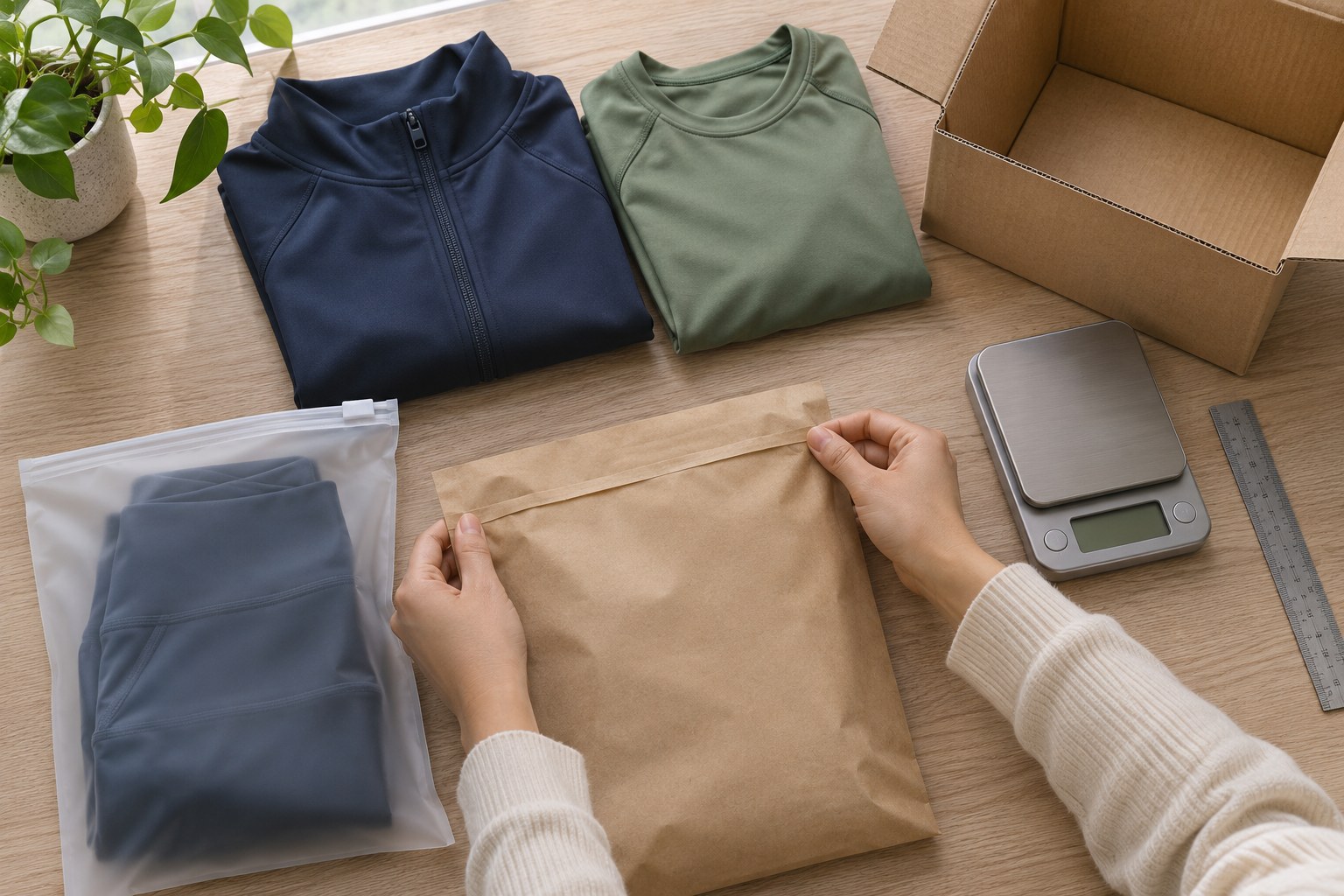
Trial the smallest practical format around the actual folded garment, leaving space for closure and handling. Compare tissue, inserts, individual bags and outer protection as one system. Keep any layer needed for product protection or agreed retail operations.
Request comparable samples and quotations
Send the same dimensions, quantity, material specification, branding file and protection requirements to each supplier. Ask for minimums, excess-component ownership, setup fees, storage conditions and replenishment terms.
Check documentation and disposal wording
Match claims and certificates to the finished packaging. Confirm the destination collection route and draft precise customer instructions. Resolve evidence gaps before approving printed environmental statements.
Trial packing and delivery performance
Pack real production-representative garments. Check closure integrity, tearing, label adhesion and scan readability, ink transfer onto fabric, unpacking and repacking. Agree route-relevant handling, compression and moisture-exposure checks; use a qualified test provider where required. A desk check alone does not validate a shipping system.
Approve a controlled specification and review the pilot
Retain the approved sample and versioned pack specification, including dimensions, tolerances, material, artwork, closure, label position, fold and carton quantity. Review pilot damage, packing time and customer disposal questions before expanding the order.
Compare total packaging cost, not only bag price
Use a common order quantity and delivery basis. Request a line-by-line quote for the packaging components, print setup, development, testing, packing labour and freight. Include the financial effect of unused custom stock and damage or repacking where you have a defensible estimate.
Planning formula: total packaging-related cost per dispatched order = component cost + allocated setup/testing + packing labour + incremental freight + expected packaging-related damage/rework cost.
This is a commercial planning tool. It does not measure environmental performance.
| Cost item | Pack A | Pack B |
|---|---|---|
| Packaging components | $0.20 | $0.30 |
| Allocated setup and testing | $0.05 | $0.06 |
| Packing labour | $0.08 | $0.06 |
| Incremental freight allocation | $0.12 | $0.05 |
| Expected damage/rework allowance | $0.10 | $0.04 |
| Total per order | $0.55 | $0.51 |
| Total for 1,000 orders | $550 | $510 |
In this invented example, B has a higher component price but a lower total because its other assumed costs are lower. The $40 difference is arithmetic, not an Ohsure quote, observed damage rate or environmental saving. Replace every input with comparable quotations, packing trials and pilot evidence. Avoid counting the same freight cost twice.
Why minimums and timing change the result
A packaging supplier’s minimum may exceed the garment order. If you buy 2,000 printed bags for a 1,000-unit launch, show the full cash commitment and separately account for usable stock. Do not assume that the remaining printed bags have value if the design, legal wording or size may change.
Map artwork approval, document review, physical sampling, testing, component production, delivery to the sewing factory and final packing. Custom sizes, multiple prints, certificate checks or a failed trial can add approval rounds. Obtain dates for each stage and agree when the lead-time clock starts. Packaging readiness must fit the garment schedule.
Ohsure’s fact library contains inconsistent public sample and bulk-production timelines. For this reason, confirm sampling after review of the design, materials and customisation; confirm bulk timing against approved specifications, material availability and the production schedule. No fixed packaging surcharge or lead time is established here.
Common mistakes in sustainable packaging decisions
- Choosing by appearance. Brown paper and minimal artwork do not prove composition, sourcing or impact. Ask for the specification.
- Replacing plastic with paper without a route trial. Check whether additional protection is needed and include that material in the comparison.
- Confusing recycled and recyclable. Keep input evidence and disposal instructions separate.
- Ordering compostable bags without collection access. Verify actual facility acceptance and the required conditions.
- Buying an oversized presentation box. Measure the final packed dimensions and freight implications.
- Ignoring packing time and excess stock. Include labour, component minimums and obsolescence in the commercial review.
- Printing broad claims before approval. Keep wording specific to the documented component and market; avoid unsupported “zero-impact” or universal “eco-friendly” claims.
- Assuming a reusable pouch will be reused. Define the return or reuse mechanism and measure actual behaviour.
Ohsure’s manufacturing perspective: make packaging part of the product brief
Ohsurewear is a China-based activewear manufacturer in Dongguan, Guangdong. Its supplied fact library describes OEM, ODM and private-label support, including labels, hangtags and custom packaging. Its private-label service page also presents printing and packaging services. Specific materials, certifications, minimums and testing arrangements remain project-dependent.
The practical manufacturing lesson is to approve the packaging around the finished garment. Fold thickness, accessories, size labels and carton quantities all affect the pack specification. Ohsure’s advertised quality-control activities provide a starting point for discussing checks, but packaging acceptance limits and shipping tests still need written agreement. This is manufacturing guidance based on the documented service scope, not a claimed customer case study or measured factory result.
For custom gym leggings, sample the fold and pack with the intended size range. When sourcing recycled-fabric gym wear, document garment and packaging claims independently. Bring both requirements into the custom activewear manufacturing brief before bulk approval.
Order planning: MOQ starts at 100 pieces per style per colour, with mixed sizes available. Final order requirements are subject to project confirmation. That garment MOQ does not establish the minimum for printed bags, mailers or boxes.
Copy-ready packaging enquiry
“Please quote packaging for [garment/style], [quantity] and [destination/route]. Confirm internal dimensions, material composition, thickness or paper weight, closure, artwork, component MOQ and excess-stock ownership. Provide documentation for each proposed recycled-content, sourcing or compostability claim. Include sample approval, agreed performance checks, packing method, itemised costs, component delivery dates and replenishment conditions.”
Attach a folded-garment sample or measurements, SKU label requirements and the current package baseline. This gives the manufacturer a concrete specification to review and makes competing quotations easier to compare.
Frequently asked questions
What is the best sustainable packaging for leggings?
Start with the delivery route and protection requirement. A fitted paper sleeve may suit protected retail stock; a verified recycled-content garment bag may suit handling that needs a moisture barrier. Trial the complete pack and confirm the destination collection route before choosing.
Is paper packaging always better than plastic?
No universal ranking applies. Compare the amount of material, protection, coatings, shipping volume and actual disposal route. A heavier box that adds no necessary protection can use more space and material than a smaller format. A credible environmental comparison needs a defined life-cycle scope.
Can recycled plastic garment bags go into household recycling?
That depends on the local program and exact packaging. Many curbside programs do not accept plastic bags or film. Check current destination instructions and any dedicated collection route; recycled content alone does not establish recyclability.
Are compostable garment bags suitable for home composting?
Only make a home-composting claim when evidence covers that specific finished bag and those conditions. Industrial compostability does not establish home compostability. Also check whether the intended local facility accepts the item, including its printing, adhesive and closure.
Does FSC Mix mean the paper is 100% recycled?
No. FSC Mix may include material from FSC-certified forests, recycled sources and controlled wood. FSC Recycled is a different claim. Verify the supplier certificate, scope and product documentation, and confirm label use with the authorised supplier.
How much does sustainable activewear packaging cost?
There is no single price or universal premium. Specify dimensions, material, thickness or paper weight, artwork, closure and order quantity, then compare packaging, setup, packing labour, freight and expected damage or rework costs on the same basis.
Does a 100-piece garment MOQ also apply to custom packaging?
Not necessarily. Ohsure’s published starting garment MOQ is 100 pieces per style per colour, with mixed sizes available and final requirements subject to project confirmation. Printed bags, boxes and other custom components may have separate supplier minimums and excess-stock commitments.
Can Ohsure provide certified packaging and a fixed delivery date?
Ohsure advertises custom packaging services. Availability of a particular certified material, documentation, component minimum and delivery date must be confirmed for the project. The supplied fact library does not establish a universal certified packaging range or a standard packaging lead time.
Sources and scope
Company statements follow the supplied “Ohsure文章事实资料库” and the official product and service pages linked above. Packaging terminology, collection guidance and FSC label distinctions are attributed beside the relevant sections to the European Commission, US EPA and FSC. Local collection instructions should be checked for the intended destination at launch.
The workflow, procurement comparisons and numerical example are editorial buyer tools. This guide does not establish a certified Ohsure packaging range, measured environmental reduction, universal material ranking or guaranteed cost and delivery result.