
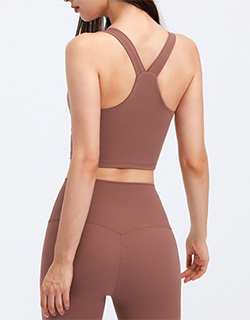
What Does MOQ Mean in Activewear Manufacturing?
MOQ definition for activewear buyers · Evidence checked September 9, 2026
What Does MOQ Mean in Activewear Manufacturing?
Direct answer: MOQ means minimum order quantity: the smallest quantity a supplier will accept for a defined product or production combination. In activewear manufacturing, the number may apply per order, style, color, fabric lot, print, logo method or component—not automatically to the whole purchase order. Ohsure currently publishes a standard bulk starting point of 100 pieces per style and color, with sizes mixed within that combination. The written quotation controls the final requirement for a specific project.
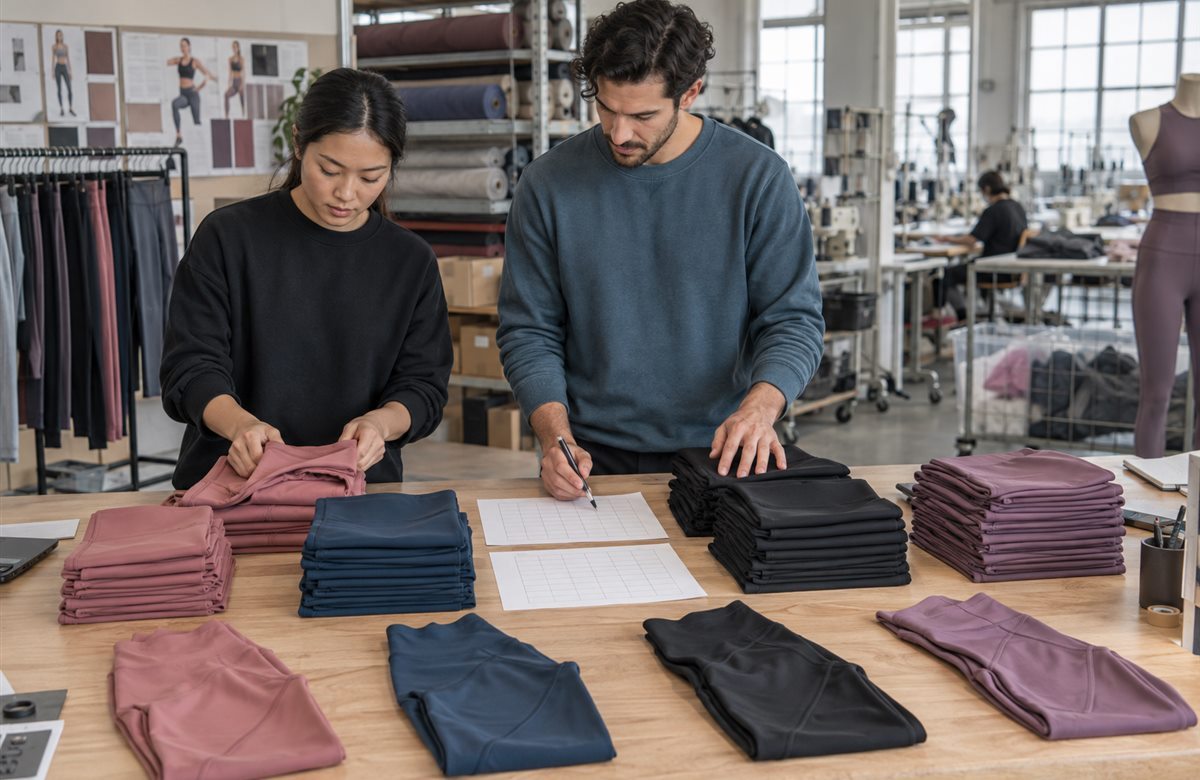
MOQ Is a Quantity Plus a Counting Rule
A statement such as “MOQ 100 pieces” answers only half the question. Buyers also need to know what must reach 100 pieces. One factory may allow multiple colors to share an order minimum, while another may require every style-color combination to meet it separately. Material mills and branding suppliers can also impose their own minimums.
A complete MOQ statement
Quantity + basis + allowed mix + exclusions. For example: “100 pieces per style per color; sizes may be mixed; custom-dyed fabric and special components remain subject to separate supplier minimums.”
| Counting level | What it usually controls | Question to put in writing |
|---|---|---|
| Per order | The total units across an allowed product mix | Which styles and colors may be combined? |
| Per style | One construction, pattern or product code | Which design changes create a new style? |
| Per color | One shade within one style | Must each color reach the full minimum? |
| Per size | A minimum for individual sizes | Can sizes share the style-color minimum? |
| Per material lot | Fabric knitting, dyeing, printing or finishing | Will unused material be charged or stored? |
| Per decoration or component | Logo setup, labels, zippers, packaging or trims | Does each artwork, placement or color have another minimum? |
How Style, Color and Size Affect the Total Order
In activewear, construction and color often determine the manufacturing batch. Sizes are commonly mixed inside a qualifying style-color combination, but the exact size ratio still matters for materials, grading and inventory.
Five sizes can share the quantity if the supplier allows mixed sizes.
Each color reaches the stated style-color minimum.
Six separate style-color combinations qualify.
These examples use Ohsure’s published standard only to show the arithmetic. They do not replace a quote. A different fabric, custom shade, specialized seam, logo application or packaging item can change what is commercially workable.
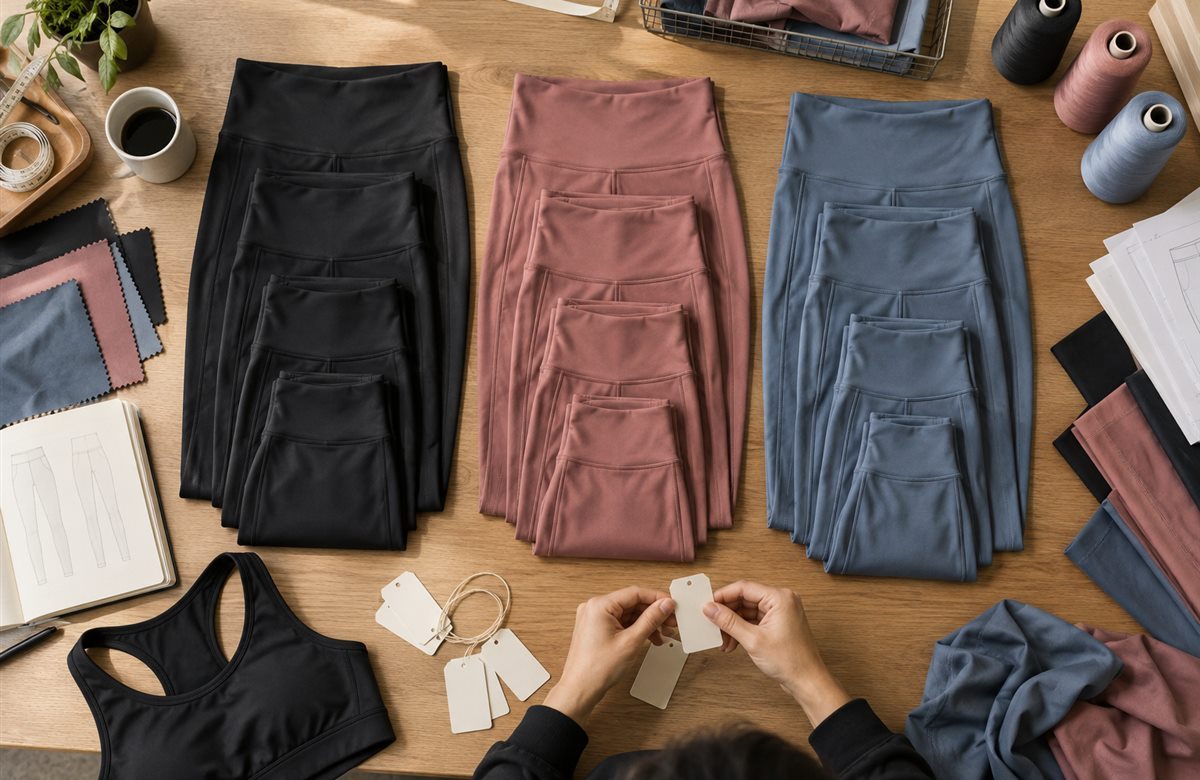
Why Activewear Manufacturers Use MOQs
MOQ is not simply a sales preference. It connects the order to the fixed work and upstream purchasing needed to make repeatable garments. A short run still requires technical review, pattern and sample work, fabric approval, cutting preparation, machine setup, logo tests, inspection and packing.
Fabric availability
Stock fabric may support a smaller run. Custom knitting, dyeing, printing or finishing can create a much larger mill minimum.
Production setup
Markers, cutting layers, machine adjustments and seam trials take time before efficient bulk sewing begins.
Component purchasing
Elastic, labels, transfers, zippers, hangtags and bags may be sold in quantities that do not match the garment order.
Quality control
Measurement, appearance, function and packing checks have order-level effort even when the batch is small.
When these fixed costs are spread across fewer garments, the unit cost normally rises. A low MOQ can reduce inventory exposure, but it does not guarantee the lowest total cost or the best cost per unit.
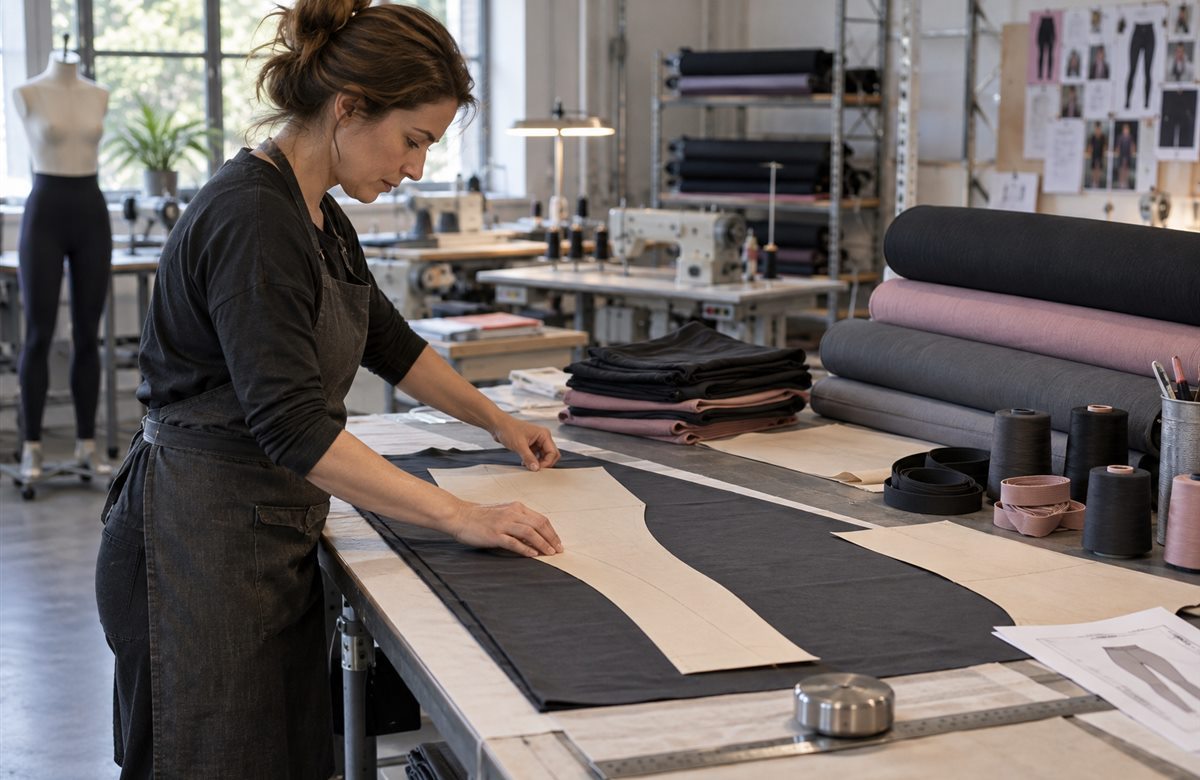
MOQ, MCQ and MOV Are Different
| Term | Meaning | Activewear example |
|---|---|---|
| MOQ | Minimum order quantity | Minimum garments per style and color |
| MCQ | Minimum color quantity | Minimum units or fabric yardage for one shade |
| MOV | Minimum order value | Minimum monetary value across an accepted mix |
A supplier may use more than one threshold. An order can meet the garment MOQ yet fail a fabric mill’s color minimum or a component supplier’s purchase minimum. Ask the factory to separate garment, material, decoration and packaging constraints instead of compressing them into one number.
What Changes the Practical MOQ?
- Stock versus custom fabric: an available fabric and shade may avoid a new production lot.
- Construction complexity: bonded seams, molded parts, unusual panels or specialist equipment can limit short-run efficiency.
- Color route: stock colors, lab dips, custom dyeing and prints have different setup and material rules.
- Branding: screen printing, embroidery, heat transfer, silicone marks and custom hardware have separate setup requirements.
- Size range: extended grading, low-volume edge sizes and unique components can affect the allowed mix.
- Packaging and compliance: custom bags, labels, barcodes, tests and market-specific documents can add supplier minimums.
- Capacity and timing: factory schedules, material availability and holiday periods can affect whether a small run is accepted.
How a Startup Should Evaluate an MOQ
- Calculate the real unit count. Multiply qualifying styles and colors, then allocate sizes according to demand evidence.
- Price the whole received order. Include development, samples, bulk garments, branding, packaging, testing, inspection, freight, duties and local charges.
- Estimate sellable units. Allow for samples, shortages, defects and damage instead of dividing cost by the ordered quantity automatically.
- Test inventory risk. Model slow sales by style, color and size and compare that exposure with the unit-price saving from a larger run.
- Check reorder continuity. Record fabric and trim references, leftover ownership, storage terms and what may change on a repeat order.
The lowest MOQ is not automatically the safest offer. A workable first order balances cash, differentiation, quality evidence, delivery needs and the ability to reproduce the product later.
Questions to Ask Before Accepting an MOQ
- Is the minimum per order, style, color, size, fabric, print or component?
- Which design changes create a separate style?
- Can sizes be mixed, and is there a minimum for any one size?
- Do stock and custom colors have different requirements?
- Are samples and development fees separate from bulk quantity?
- What happens to excess fabric, labels and packaging?
- Which costs are included in the unit price and which are extra?
- What approvals must occur before material booking and bulk cutting?
- Will the same materials and terms be available for a reorder?
Put the answers in the quotation, specification or purchase order. A chat message that mentions a quantity without its basis is too easy for either side to interpret differently.
Frequently Asked Questions
Does MOQ mean I must order one size only?
No. MOQ and size minimum are separate concepts. Ohsure currently says sizes may be mixed within its published style-color minimum, but the buyer should provide a size ratio and confirm whether any individual-size limit applies.
Is Ohsure’s MOQ 100 pieces for the entire order?
Not necessarily. Ohsure’s current public wording is 100 pieces per style and color. One style in two colors would therefore normally represent two qualifying combinations. The current written quote remains controlling.
Can MOQ be negotiated?
Sometimes the production route can be changed by using stock material, fewer colors, shared components or simpler branding. That is a technical and commercial review, not a guaranteed discount or exception.
Are samples included in the MOQ?
Samples are normally a development stage, while MOQ usually describes bulk production. Confirm the sample type, fee, revisions and approval process separately.
Why can custom colors raise MOQ?
A custom shade may require a lab dip and a bulk dye lot. The fabric mill’s minimum can exceed the sewing factory’s garment minimum.
Is a higher MOQ always cheaper?
A larger run can spread fixed costs across more garments, but it also increases cash and inventory exposure. Compare total cost, cost per sellable unit and realistic sell-through.
Bottom Line
MOQ means the smallest quantity accepted for a defined manufacturing combination. For activewear, always attach the number to its counting level: order, style, color, size, fabric, decoration or component. Ohsure currently publishes a standard bulk starting point of 100 pieces per style and color with mixed sizes, but the final project quotation should state every applicable minimum and allowed mix.
For a deeper planning framework, read the related activewear manufacturing MOQ guide. You can also review company information, browse the product catalog and use the current contact details when preparing a project-specific request.
Editorial note: Ohsure-specific statements were checked September 9, 2026 against its current homepage, custom activewear manufacturing page, MOQ FAQ and published MOQ guide. Public information can change. The written quotation and approved production package control the actual quantity, price, timing and scope.