
Activewear Manufacturer Evaluation Scorecard: Downloadable Buyer Template
BUYER RESOURCES · B729-98
A practical way to compare manufacturing partners using the same requirements, traceable evidence and clear decision rules.
Evaluate an activewear manufacturer with a weighted scorecard covering product capability, fabric evidence, quality control, development, commercial terms, delivery planning, identity and logistics. Score documented evidence against the same brief, record unknowns separately, and apply mandatory gates before considering the total. Use the result to shortlist suppliers, then validate the choice through samples and project-specific due diligence.
Download the buyer template
Use the fillable HTML scorecard for automatic totals, mandatory-gate checks, saved evaluation records and printing. Prefer a spreadsheet? Download the CSV and add the formula described below.
Download buyer scorecard templates (ZIP)The ZIP includes a fillable HTML scorecard and a CSV worksheet. Extract it, open the HTML file in your browser, and save the evaluation as JSON before closing. The CSV does not contain automatic formulas.
What is an activewear manufacturer evaluation scorecard?
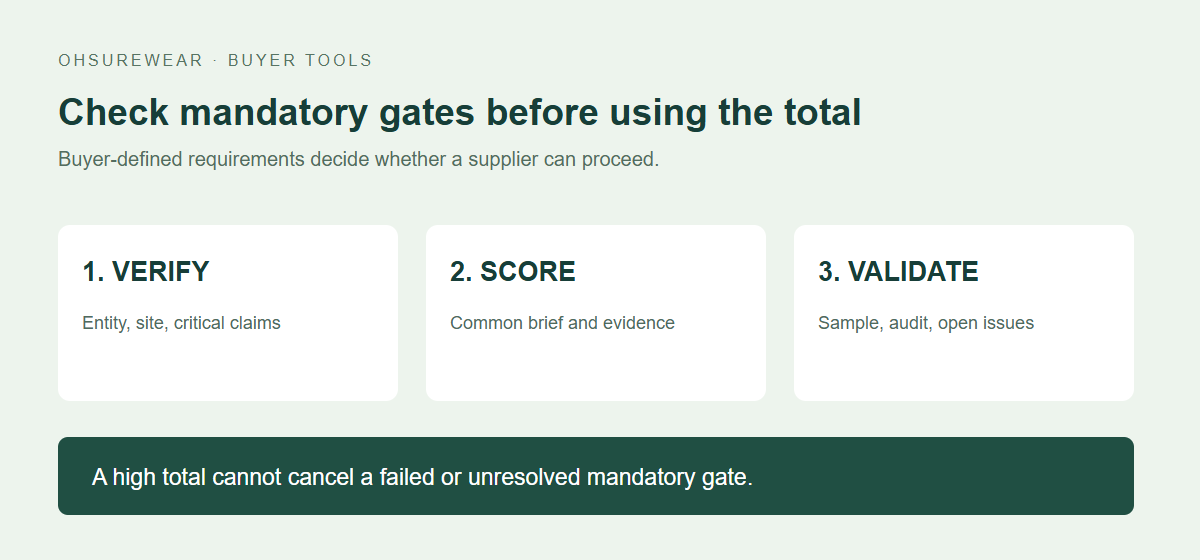
An evaluation scorecard is a structured buyer worksheet that turns sourcing requirements into criteria, weights, evidence records and a documented decision. A weight states the importance of a criterion; a rating describes how well the supplier meets it. A mandatory gate is a non-negotiable requirement that cannot be offset by strengths elsewhere.
For activewear, the review should connect the intended garment with its material, fit, construction and manufacturing controls. A well-made cotton hoodie does not establish competence with a close-fitting stretch legging. Likewise, an attractive prototype cannot establish the consistency of a future production lot.
This template is designed for comparing suppliers for one defined project. It is a proposed sourcing tool, not an audit certificate, a ranking of manufacturers or evidence that any supplier has passed. No customer results or actual supplier scores are claimed.
Start with mandatory gates: what must be resolved first?
Write your gates before requesting proposals. Use Pass, Fail or Unresolved and retain supporting records. An unresolved gate means hold the decision while evidence is obtained; it does not automatically prove misconduct.
- Identity and site relationship: verify the contracting entity and its relationship with the production site. Clarify which operations are performed at that site and which may be subcontracted.
- Mandatory product or claim requirements: identify requirements applicable to your garment, market and intended claims. Where documentation is required, check the issuer, scope, validity and relevance to the actual material or product. A logo or generic certificate image is insufficient.
- Critical project risks: resolve essential sample, quality and commercial requirements before the relevant commitment. Examples include an unacceptable critical sample defect, refusal to agree specifications, or unclear payment-recipient identity.
The required evidence can differ by stage. Before paying for a development sample, define the sample-stage gates. Before a bulk order, expand them to cover final approvals and agreed production controls. Passing an early review does not authorize later commitments automatically.
The 100-point manufacturer scorecard
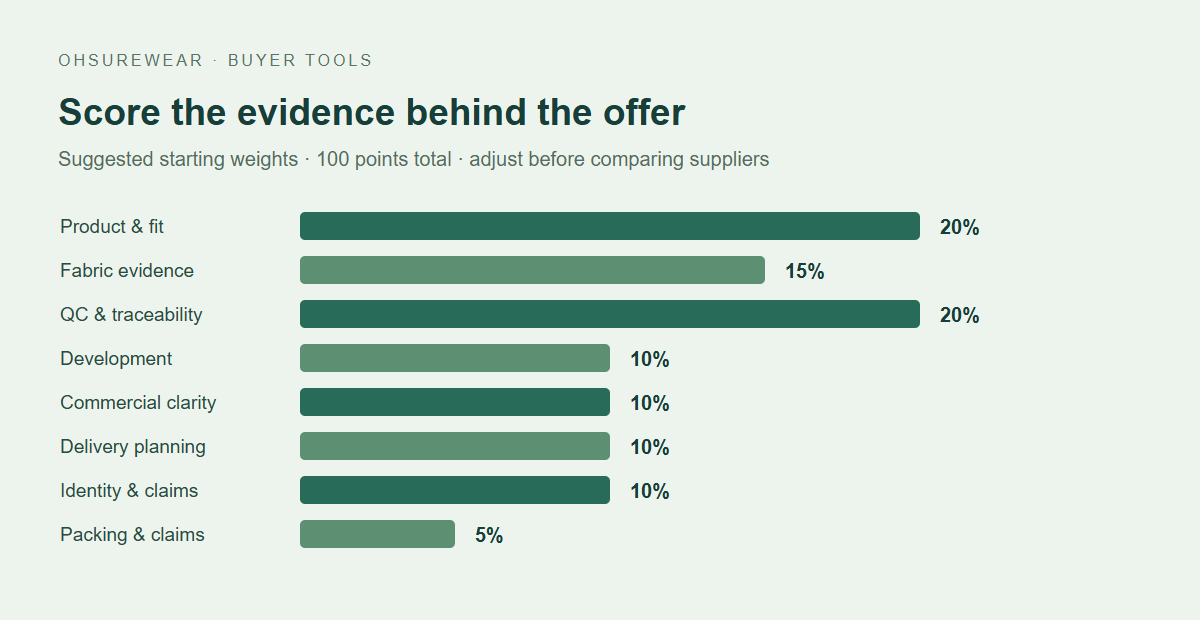
The following allocation emphasizes product suitability and quality control. Adjust it for your collection before sending the same brief to all candidates. Keep the total at 100 and record the version so that the shortlist remains comparable.
| Criterion | Weight | Useful evidence |
|---|---|---|
| Product and fit capability | 20 | Relevant garment sample; measurement record; agreed fit and movement review |
| Fabric and performance evidence | 15 | Identified fabric; retained reference; project-relevant test scope and results |
| Quality control and traceability | 20 | Inspection checkpoints; defect record; lot traceability; corrective-action example |
| Development and communication | 10 | Versioned tech pack; consolidated sample comments; named owner |
| MOQ and commercial clarity | 10 | Written style/color MOQ; itemized quote; payment and revision terms |
| Capacity and delivery planning | 10 | Project-specific material plan; production milestones; disclosed subcontracting |
| Identity and claim verification | 10 | Verified contracting entity; production-site relationship; applicable claim documents |
| Packing, logistics and claims | 5 | Packing specification; shipping responsibility; defect-reporting and remedy terms |
For a leggings project, examine waistband construction, agreed coverage checks, seam behavior and measurement consistency. For sports bras, define intended activity, fit and support evaluation before scoring. The custom gym leggings range and custom sports bras range can help frame a product brief; a catalog listing alone earns no capability rating.
How to calculate a weighted score without hiding missing evidence
Use the same rating anchors for every supplier. Document the evidence, its date, who reviewed it and any limitations. A supplied document is evidence to examine; it is not automatically evidence that the requirement has been met.
| Rating | Interpretation | Buyer action |
|---|---|---|
| Unverified | Evidence is absent, outdated, irrelevant or still under review | Record the gap; assign zero current points and leave it visibly unverified |
| 1 | Relevant evidence confirms a major gap | Record the failure and check whether it triggers a gate |
| 2 | Requirement is partly met | Specify what remains unresolved |
| 3 | Evidence supports the agreed brief | Record acceptance and boundaries |
| 4 | Evidence also demonstrates relevant controls in practice | Check records and repeatability |
| 5 | Independent corroboration or repeated relevant records strengthen confidence | Identify exactly what was corroborated; avoid unrelated credentials |
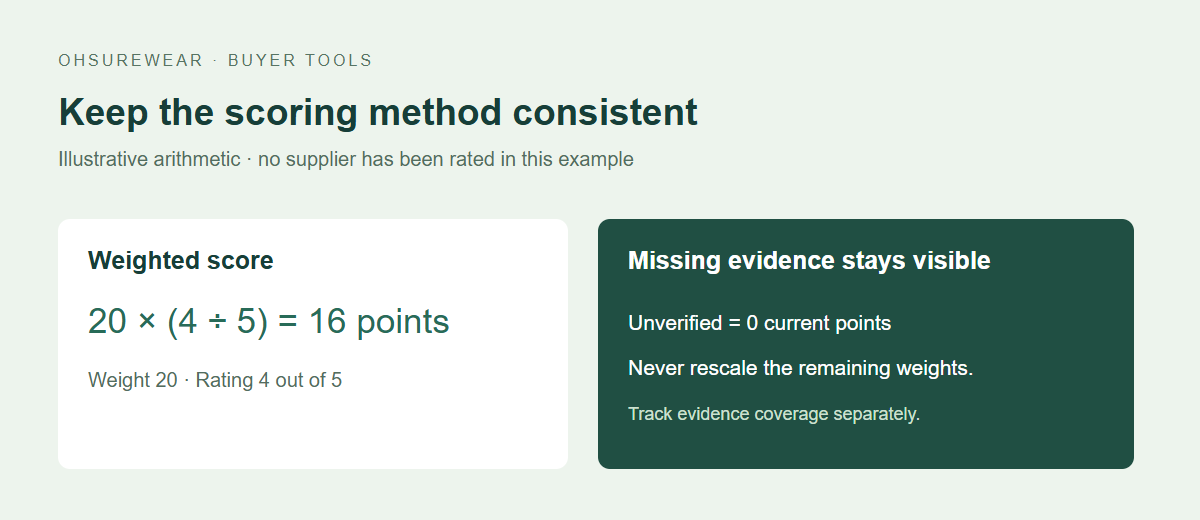
Criterion points = weight × rating ÷ 5
Total = sum of the eight criterion scores
Rated-weight coverage = sum of weights with a recorded numeric rating
A 20-point criterion rated 4 contributes 16 points. If a 15-point fabric criterion is unverified, it contributes zero current points and reduces rated-weight coverage by 15 percentage points. Do not redistribute that weight across the remaining criteria: doing so could make a poorly documented supplier appear stronger.
The template uses a holistic rating for each category. If evidence within a category is mixed, record the sub-findings and use a conservative, explained rating. Any missing mandatory item remains a gate issue regardless of the category score. Coverage is a completion measure, not a guarantee of evidence quality.
Suggested interpretation after every gate passes: 80–100 points indicates a strong shortlist candidate; 65–79 calls for a conditional review and documented actions; below 65 calls for an improvement review before advancing. These are proposed buyer rules, not universal cutoffs. Resolve material evidence gaps before a final comparison.
How to use the template in seven steps
- Define one comparable project. Specify garment type, intended use, size range, reference sample or tech-pack version, fabric direction, branding, order quantities and destination. Mark fixed requirements separately from options open to development.
- Freeze the rules. Set weights, category anchors and mandatory gates before looking at quoted prices. Record who can approve the decision. If the brief changes, reassess every candidate under the revised version.
- Send one evidence request. Ask for relevant sample records, material identification, inspection controls, an itemized quote, material assumptions and milestone dates. Allow redacted examples where customer confidentiality prevents sharing originals.
- Verify evidence and record gaps. Match documents to the entity, site, garment and material in question. Record the date, source and reviewer. Keep supplier claims separate from buyer observations and independent checks.
- Review the actual sample. Agree measurement methods, fit and movement checks and relevant material or branding checks. Tag the sample with its material and specification version. A substitute-fabric sample leaves some conclusions provisional.
- Score and calibrate. Complete one record per supplier. Discuss major reviewer differences using the evidence rather than averaging unexplained judgments. Calculate totals and coverage, then apply all gates.
- Close actions and document the decision. Name owners and deadlines for open issues. Confirm what must be demonstrated before sampling, a pilot order or bulk release. Revisit the score after meaningful new evidence, a material change or an agreed production review.
For a spreadsheet version, import the CSV, enter ratings in column C and use =IF(C2="",0,B2*C2/5) in D2; fill down to D9. Sum D2:D9 for the total. Sum the weights of rated rows separately for coverage, and retain a separate gate record. Restrict ratings to whole numbers from 1 to 5.
Comparison example: the highest total may still be on hold
The invented ratings below demonstrate the method. They do not describe Ohsurewear, an actual competing factory or an observed sourcing outcome.
| Criterion | Weight | Supplier A rating | A points | Supplier B rating | B points |
|---|---|---|---|---|---|
| Product and fit capability | 20 | 4 | 16 | 5 | 20 |
| Fabric and performance evidence | 15 | 4 | 12 | 4 | 12 |
| Quality control and traceability | 20 | 4 | 16 | 4 | 16 |
| Development and communication | 10 | 3 | 6 | 4 | 8 |
| MOQ and commercial clarity | 10 | 3 | 6 | 4 | 8 |
| Capacity and delivery planning | 10 | 3 | 6 | 4 | 8 |
| Identity and claim verification | 10 | 4 | 8 | 3 | 6 |
| Packing, logistics and claims | 5 | 3 | 3 | 4 | 4 |
| Total / rated-weight coverage | 100 | 100% | 73 | 100% | 82 |
| Mandatory-gate status | Separate decision | All passed | One unresolved critical commercial term | ||
Supplier A enters a conditional review at 73. Supplier B remains on hold at 82 until the critical term is resolved. B's commercial category can still have a numeric rating because other commercial evidence was reviewed; the unresolved mandatory term overrides the total. Neither result authorizes a bulk order by itself.
Cost and time: compare the full sourcing commitment
A lower unit price can come with different material assumptions, order minimums or exclusions. Compare quotes on the same garment, quantity, packing and delivery basis. Record the currency, validity period and responsibilities for freight and other applicable charges.
Comparable project outlay = development + goods + agreed testing and inspection + packing + freight + applicable duties/taxes and other charges
Divide by the agreed expected sellable quantity when calculating a planning cost per unit, and show any allowance explicitly. Avoid adding freight twice when the quoted delivery basis already includes it. Confirm revision charges, retesting, failed-inspection handling and remedies rather than assuming they are included.
Illustrative comparison: at an equal quantity of 500 units, Quote A at $10 per unit plus $700 in agreed extras totals $5,700. Quote B at $9.50 plus $1,200 in extras totals $5,950. A is $250 lower on those assumptions. These invented figures exclude any unlisted charges and are not Ohsurewear pricing.
For timing, compare evidence collection, clarification, sample development, transit, buyer review, any revisions, material readiness, production and shipment separately. Ask what starts each clock, whether days are working or calendar days, and what happens if an approval is late. Work backward from the required arrival date using confirmed milestones and an explicit contingency.
Ohsurewear's supplied fact library records MOQ starting at 100 pieces per style per color, with mixed sizes available, subject to project confirmation. Two styles in two colors would therefore imply 400 pieces if that minimum applies to each combination. Confirm the actual fabric, branding and packaging requirements. Sample and bulk-production dates require project-specific confirmation because published timing statements vary.
Common scoring mistakes and how to avoid them
- Scoring a presentation instead of a product. Link the rating to relevant samples and records.
- Changing weights after seeing a preferred supplier. Freeze the model first; apply documented revisions to everyone.
- Treating no evidence as a neutral score. Keep it unverified, show zero current points and track coverage.
- Letting a strong total erase a critical failure. Check gates separately and retain the hold.
- Double-counting a credential. Score its actual relevance once; do not reward the same document under every category.
- Confusing a good sample with bulk consistency. Request production controls and an agreed inspection plan.
- Comparing incompatible quotations. Align material, quantity, delivery basis and exclusions before rating cost clarity.
- Making unsupported performance claims. Match evidence to the exact garment, material, method and claim.
Manufacturer perspective: make the evidence request actionable
From a manufacturing perspective, a useful scorecard asks questions that can be answered against a specific brief: Which fabric was used? What measurement method applies? Which sample version was approved? What defect record and correction can be shown? A broad request for “best quality and fastest delivery” leaves these decisions unresolved.
Ohsurewear's OEM/ODM manufacturing service describes sampling and customization support. Its quality-control page describes inspection activities, while the fabric guide offers material-selection directions. Use these pages to prepare questions, then request evidence for your project. Published service descriptions do not establish a completed evaluation score.
For labels, logos and packaging, use the private-label service page to define the required scope. Ask for the approved artwork, placement, application method and packing specification. The same scoring rules should apply to Ohsurewear and every other candidate.
This is practical manufacturing guidance based on the supplied fact library and public service descriptions. It is not a quotation from a factory employee or a claim of measured customer savings.
Frequently asked questions
What is a good score for an activewear manufacturer?
In this suggested model, 80–100 points supports a strong shortlist and 65–79 calls for conditional review. These are buyer-defined thresholds. A failed or unresolved mandatory gate overrides the total, and missing material evidence should be closed before a final comparison.
Should price have the largest weight?
Set weights around the project risk before reviewing quotes. This template gives commercial clarity 10 points and emphasizes product capability and quality control. Compare full project outlay separately; a transparent low price does not compensate for an unsuitable garment.
How should I score missing evidence?
Leave the category unverified and assign zero current points. Record what is missing and track rated-weight coverage separately. Do not rescale the remaining criteria to 100. If the missing item is mandatory, keep the relevant gate unresolved.
Does a factory certificate automatically earn five points?
No. Check what the document covers, its issuer, validity and connection to the entity, site, material or product. A rating of five requires relevant corroborated or repeated evidence under the defined criterion; an unrelated credential cannot establish product capability.
Can a startup use this scorecard for a small order?
Yes. Simplify the evidence request to the project while preserving identity checks, essential product requirements and clear terms. Confirm the minimum for each style and color, material requirements and development charges before committing.
Can the template compare OEM, ODM and private-label suppliers?
Yes, when the required scope is explicit. Define who supplies the design, pattern, materials, artwork and approvals, then compare suppliers against that same scope. Different service labels alone are not comparable evidence.
Does this article rate Ohsurewear against other manufacturers?
No. The comparison is hypothetical and no supplier assessment has been completed. Ohsurewear service pages and the supplied fact library provide starting questions; buyers still need project-specific evidence and approvals.
How do I save the downloadable evaluation?
Open the fillable HTML template in a browser, enter the gates, ratings and evidence, then save the evaluation as JSON. Load that JSON into the same template to resume. You can also print the completed form or use the CSV for a spreadsheet-based review.
Prepare a clearer sourcing discussion
Choose one target garment, record its requirements and send the same evidence request to each candidate. Use the downloadable scorecard to organize the response, close mandatory gaps and decide which supplier deserves the next sample or verification step.
For an Ohsurewear project, begin with the custom activewear manufacturing service and ask for a project-specific review of materials, development scope, MOQ and production milestones.