
Reducing Activewear Sample Revisions Through Better Tech Packs: A Development Example
About this example: The content plan calls for a customer case study. Authorized customer records, project dates and before-and-after results were not supplied. This article therefore uses a hypothetical development scenario and proposed controls; it reports no measured reduction in sample rounds, cost or lead time.
What is a tech pack, and what does it control?
A tech pack is the documented technical brief used to develop and manufacture a garment. It connects drawings, materials, measurements, construction and approvals to an identified style and version. A bill of materials (BOM) lists the components. A point of measure (POM) identifies a garment dimension and how to measure it. A tolerance is the agreed permitted deviation from a target dimension under that method.
Techpacker’s documentation separates sketches, materials and measurements, and its measurement-table guidance includes POMs and tolerances. These are useful foundations; the garment still needs project-specific decisions about fit and performance.
Avoidable revisions are changes caused by missing, conflicting or misunderstood requirements. They differ from planned development trials, such as comparing two fabrics, and from manufacturing errors against an already clear instruction. Separating these causes helps a brand improve its brief without masking execution problems.
The example: a leggings sample with three unresolved decisions
Imagine a brand developing high-waist training leggings with a side pocket and a small heat-transfer logo. Its starting brief contains a reference photo, “soft nylon stretch fabric,” “firm waistband” and “logo near the back waist.” The sample is then described as too tight at the waist, different in hand feel and incorrectly branded.
Those comments do not yet establish who made an error. The buyer and manufacturer first compare the actual sample with the released brief: was the waistband target specified, was the material identified, and was the logo location measurable? If those decisions were absent, another sample made from the same brief could repeat the ambiguity.
The proposed intervention is a single controlled tech pack covering the unresolved requirements, followed by a consolidated sample review. Its intended benefit is fewer clarification-driven changes. Whether it achieves that benefit must be checked against real project records. Start product discussions with the custom gym leggings range; a coordinated collection can also reference the custom sports bras range, using a separate specification for each style.
Turn subjective comments into verifiable instructions
The improved instructions below are examples of what to clarify. They are not completed production specifications or evidence of a successful customer result.
| Area | Ambiguous instruction | What to put in the tech pack | How to confirm it |
|---|---|---|---|
| Fabric | “Soft nylon stretch” | Supplier material code, composition, target mass, finish, color reference and retained swatch | Confirm availability; identify the actual sample fabric and any substitution |
| Waistband | “Make the waist less tight” | Body-size brief, garment POM, relaxed or extended state, target, tolerance and construction | Measure consistently and repeat the agreed fit/movement review |
| “Fits a phone” | Opening and depth, placement, construction and intended test-object dimensions | Check access, retention and distortion with the agreed object and movement | |
| Seams | “Use a comfortable seam” | Illustrated seam location, agreed construction and compatible thread/finish | Review the sewn sample for appearance and movement comfort |
| Logo | “Near the back waist” | Artwork version, size, process, color, anchor points, offsets and placement tolerance | Approve placement on the garment and the agreed application checks |
| Sample release | “Use the latest comments” | Dated version, sample ID, change log, open-issue owners and written release status | Manufacturer acknowledges the exact file set before making the next sample |
For candidate materials, consult the Ohsurewear fabric guide. A blend name is a sourcing direction; an identified fabric and retained reference make later comparisons more useful.
A seven-step workflow for clearer sample development
1. Define the sample’s purpose and the decision owner
Identify the style, sample size, intended wearer, use and sample stage. A first prototype may establish silhouette and construction feasibility; a later fit sample may verify revised balance; a size set examines the agreed grading. Write the decision expected from this round. Assign one buyer-side owner to reconcile design, merchandising and technical comments before release.
2. Resolve material identity and substitutions
Create a BOM with an item code for the main fabric, pocket material, waistband components, thread, labels and branding. Attach physical or approved digital references where useful. Mark each component as proposed, confirmed or awaiting approval. If a sample uses a substitute, label that fact and list which conclusions remain provisional. A fit approval in one fabric should not silently authorize another.
3. Make the measurement method visible
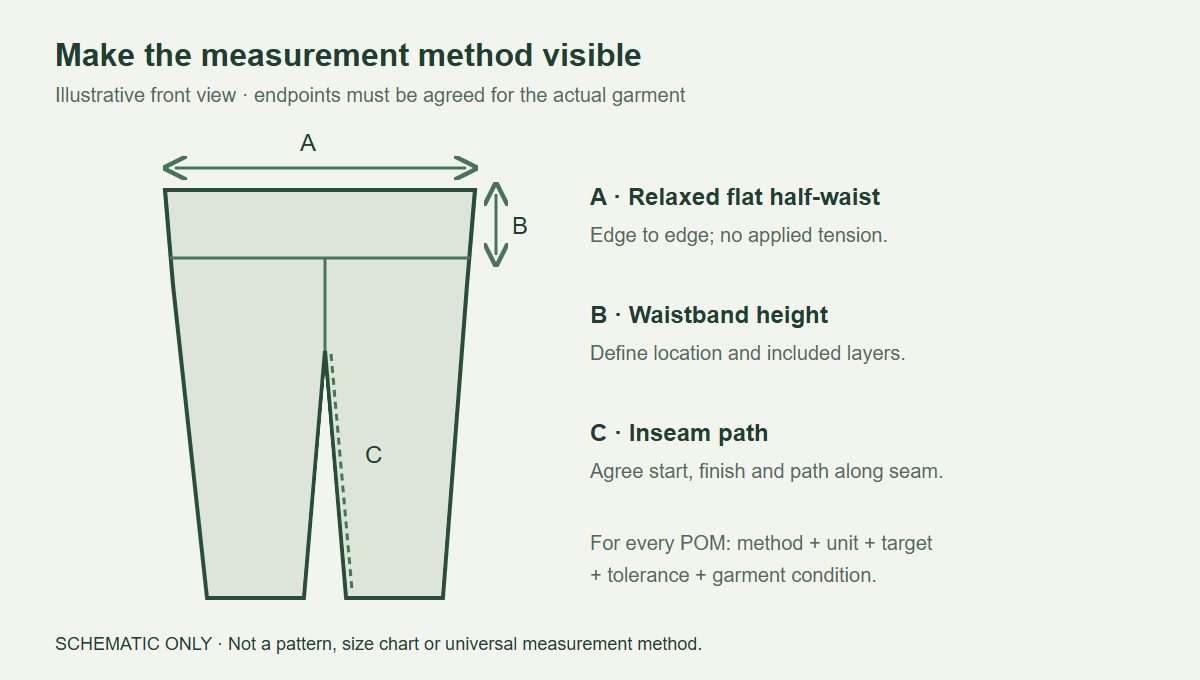
State units, garment condition and measurement path for every critical POM. Distinguish a flat half-width from a circumference, and a relaxed dimension from an extended one. Define where a rise measurement begins and ends and whether a waistband is included. Agree targets and tolerances with the manufacturer; do not paste the same tolerance onto every dimension.
4. Annotate construction and artwork
Use front and back technical drawings, plus enlarged details for the waistband, pocket and gusset. Tie each note to a visible feature. For logos, identify the artwork file and show placement from defined seams or edges. Specify whether distances reference an artwork edge or its center and how the garment is laid out. Ask the sample room to flag construction conflicts before cutting.
5. Hold a clarification review before releasing the sample
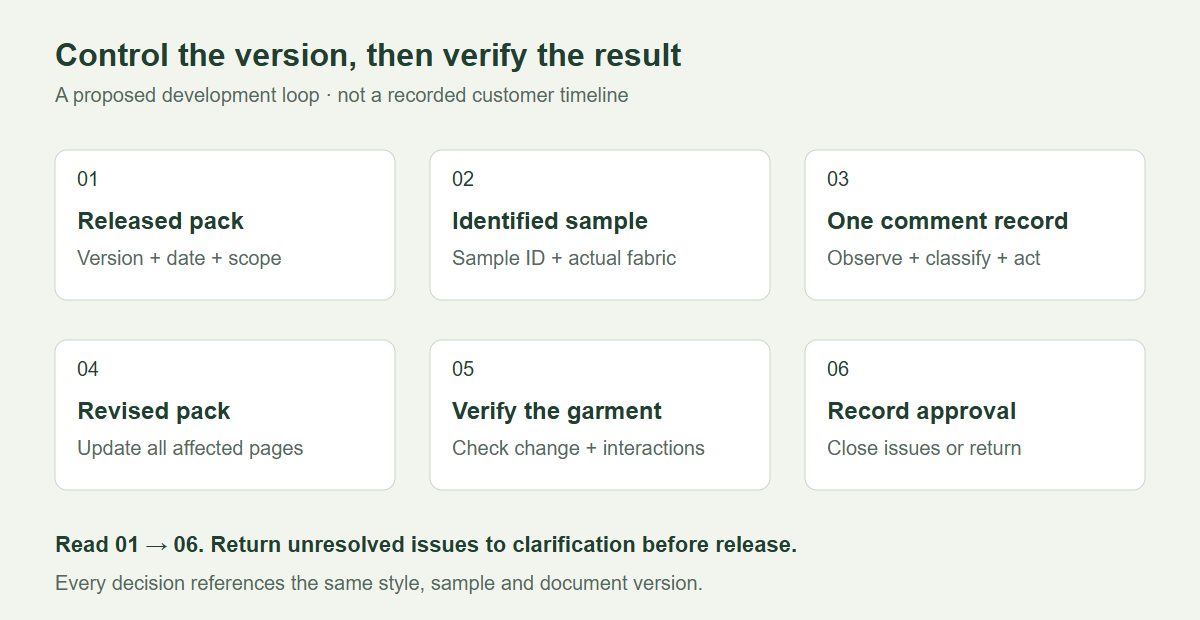
Walk through the pack with the manufacturer. Record missing decisions, material risks and feasibility questions in an open-issue list. Resolve critical items or explicitly agree what a trial will investigate. Release the approved file set with a dated version and sample request. Techpacker’s version-control guidance recommends preserving versions at changes of stage or manufacturer updates; the same principle can be applied to a controlled PDF and source file.
6. Consolidate feedback and diagnose the cause
Tag the received sample with its ID, pack version and actual material. Measure it before prescribing changes, then assess fit and movement against the brief. Classify each issue as an unclear specification, execution deviation, buyer design change or planned trial finding. Send one reconciled comment sheet with supporting images and the intended outcome. Ask the technical team to propose the correction when the pattern solution is uncertain.
7. Verify the revised garment and close the record
Update affected drawings, POMs, BOM items and artwork together. On the next sample, check the requested change and adjacent features it may affect: a waist change can alter fit balance; a pocket change can affect a side panel. Mark an issue closed only after recording verification. Confirm size coverage, actual materials, labels, packing and any remaining production approvals before bulk release.
A sample comment record that can be checked
For the hypothetical leggings, the record below separates the observation from the requested action. Numbers are invented only to illustrate documentation; they are not recommended fit targets, Ohsurewear tolerances or measured customer results.
| Issue | Recorded observation | Next action | Closure evidence |
|---|---|---|---|
| POM W01 | Relaxed flat half-waist target 32.0 ± 0.5; observed 31.0 using the agreed method | Recheck measurement and cause. Restore the specified dimension if confirmed; do not enlarge the target solely to conceal a deviation | New sample ID, actual reading and fit review; open until verified |
| Fabric F01 | Sample tag identifies substitute B; BOM requests reference A | Confirm reference A availability and which approvals must be repeated with it | BOM, physical reference and actual-material garment review |
| Artwork A01 | v01 lacks placement offsets; “too low” cannot be assessed against a released target | Approve a dimensioned placement drawing and update v02 before application | Revised drawing plus identified garment measurement and image |
Retain the original observations when v02 is issued. Each entry should also name the owner, due date, change classification and status. An “approved” email should identify the exact sample and version and state any reservations.
Cost and timing: evaluate avoided rework without inventing savings
A clearer pack takes technical preparation and review time. Its value depends on whether it avoids repeat work while preserving the intended garment. Compare expected development effort with actual results rather than promising a percentage reduction.
- Preparation cost: technical drawing, specification, material identification, pattern input and coordination. Confirm who supplies each item and who owns the deliverables.
- Cost per extra round: agreed sample charge, new material or trim purchases, courier fees and internal review time. Confirm what revision work is included and what is separately charged.
- Time per extra round: clarification, sourcing, pattern work, sewing, dispatch and buyer review. Some tasks can overlap; an avoided sample does not automatically remove all of these days from the launch schedule.
Illustrative break-even check
Net direct benefit = avoidable rounds actually removed × incremental cost per round − extra specification cost.
For a hypothetical budget, $200 in extra specification work and one avoided $280 round would leave $80 in direct benefit. If no round is avoided, direct spending rises by $200. These invented figures explain the calculation; they are not Ohsurewear prices. Use actual invoices, internal time records and comparable project scope to assess the result.
Track clarification-driven rounds separately from design changes and execution corrections. Record elapsed days from a defined starting event and approval dates for each sample. A single project cannot establish a general reduction rate; comparing unlike styles can also mislead.
For Ohsurewear projects: the supplied fact library records MOQ starting at 100 pieces per style per color, with mixed sizes available, subject to project confirmation. Sample timing is confirmed after reviewing the design, materials and customization requirements. Bulk-production timing is confirmed according to approved specifications, material availability and the production schedule. Obtain project-specific dates and start conditions in writing.
Common mistakes that create another round
- Using a body-size chart as the garment specification. Keep intended wearer measurements and finished-garment POMs separate; record the fit relationship and review it in the sample.
- Changing several variables without identifying them. Record fabric, pattern and construction changes together and state which comparisons remain meaningful.
- Mixing chat comments with superseded PDFs. Consolidate decisions in the released version, identify attachments and obtain acknowledgment.
- Calling every correction a tech pack problem. Check whether the original instruction was clear and followed. Record execution deviations separately.
- Approving a sample with unresolved substitutions. State which material, color or size still needs review and block the affected approval.
- Measuring success only by sample count. Track unresolved critical issues and garment approval as well. A quick sign-off with an unverified fit is not evidence of successful development.
Manufacturer perspective: what to confirm with Ohsurewear
Ohsurewear’s supplied fact library describes OEM, ODM and private-label support, sample development from buyer references, and assistance with materials and garment details. It also records a sample room and pattern designers. These capabilities provide a basis for a technical discussion; they do not establish that the company completed the hypothetical project above.
From the sample-room perspective, the useful question is whether every critical decision is actionable. Ask the team to identify what is missing, which references can be matched, which construction details need a trial and how the sample will be checked. Review the scope through Ohsurewear’s custom activewear manufacturing service. Confirm responsibility for drawing, patterns, grading, revisions and file ownership rather than assuming these are included in every quotation.
The fact library records raw-material, printing-process, semi-finished and finished-garment inspection activities. Use the quality-control service page to open a project-specific conversation about measurement methods, inspection records and agreed acceptance criteria. A technical brief and an inspection plan should reference the same approved product version.
Frequently asked questions
What should an activewear tech pack include?
Include style and version identifiers, technical drawings, a bill of materials, color references, garment measurements and methods, tolerances, construction details, artwork, labels and sample acceptance criteria. Add grading information for the required sizes. Make unresolved decisions visible and assign an owner rather than leaving the sample room to guess.
Can a manufacturer work from a photograph?
A photograph can communicate an initial direction, but it rarely defines hidden construction, material identity, measurements or artwork positioning. Ohsurewear’s supplied fact library says design references can support development. Confirm what specification and pattern support the project needs before requesting a sample.
How many sample rounds should a brand expect?
There is no reliable universal number in the supplied evidence. Complexity, material availability, fit objectives and the completeness of the brief all affect development. Define what each sample stage must establish, then agree revision fees and scheduling with the manufacturer. Do not substitute a promised round count for garment approval.
Are garment measurements the same as body measurements?
No. Body measurements describe the intended wearer; garment measurements describe the product under a stated measuring condition. Stretch activewear may use negative ease, meaning some garment dimensions are smaller than the corresponding body dimensions. Record both clearly and confirm fit through the intended movement review.
What tolerances should we use for leggings?
Agree tolerances for each point of measure with the manufacturer, considering the material, construction and measurement method. The example values in this article are hypothetical and are not Ohsurewear production tolerances. A dimension within tolerance still needs a separate fit and function decision.
Does a better tech pack remove the need for fit samples?
No. A document communicates intent; a sample demonstrates how the selected fabric, pattern and construction work together. Review fit, movement, coverage, seams and branding under the agreed conditions. Material substitutions or significant pattern changes may require fresh garment evaluation.
How should fit comments be sent to the factory?
Use a consolidated comment sheet tied to a specific sample and tech pack version. For each issue, record the observation, supporting measurement or image, requested action, affected specification, owner and closure evidence. Confirm feasibility before releasing the next version and keep superseded files out of active use.
What are Ohsurewear’s MOQ and sample lead time?
The supplied fact library records a starting MOQ of 100 pieces per style per color, with mixed sizes available, subject to project confirmation. Sample timing is confirmed after reviewing the design, materials and customization requirements. Ask for written timing, start conditions and revision arrangements for the specific project.