
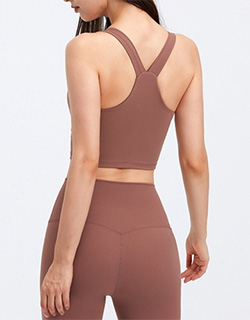
Solving Legging Opacity and Squat-Proof Problems: A Development Example
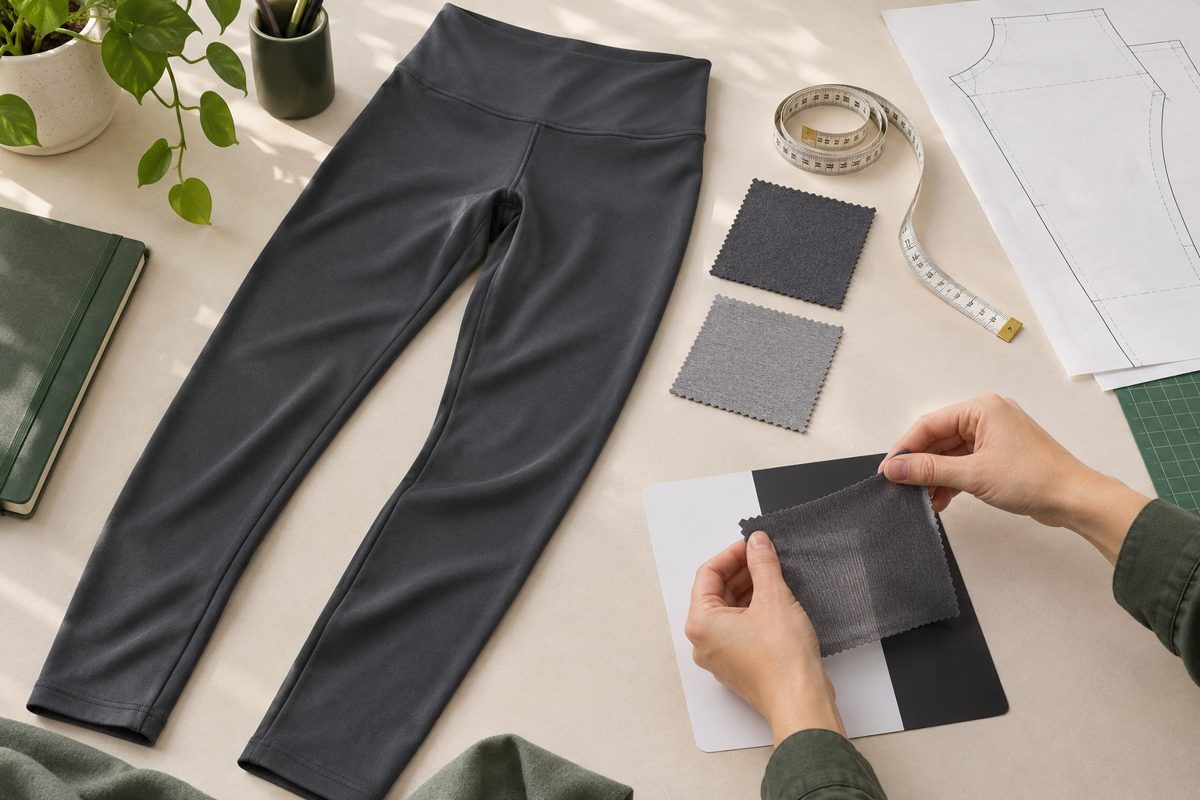
Evidence boundary: This article follows a hypothetical leggings development brief. No authorized customer identity, project timeline, measured improvement or completed production result was supplied. Proposed actions and approval records below should be completed with project evidence.
What do opacity and squat-proof mean?
Opacity describes how effectively a material or garment conceals what is behind it under specified conditions. Squat-proof, as used in this guide, means a finished garment maintains the agreed coverage during the defined squat movement. A fabric can appear opaque when relaxed yet reveal contrast when stretched over the seat. Approval therefore needs wearing conditions as well as a fabric reference.
GSM means grams per square meter, a measure of fabric mass per area. ASTM lists D3776/D3776M as a fabric mass-per-area method; that measurement by itself does not establish a garment’s opacity. Negative ease means the garment measures smaller than the corresponding body dimension and relies on stretch for fit. Too much local extension is a possible contributor to sheerness, so the pattern and material need to be reviewed together.
Coverage is also separate from compression, recovery and moisture management. Do not substitute a stretch result or a supplier’s fabric name for a finished-garment coverage decision. A project-specific visual check must be described as such unless an applicable external method has actually been selected and followed.
The example brief: one leggings style, an unresolved coverage concern
Consider a brand developing high-waisted leggings for studio training. The sample looks acceptable on a hanger, but its buyer reports visible contrast around the seat in a squat. The collection includes charcoal and pale gray. The brand wants to retain its intended soft feel and silhouette while addressing coverage.
The first task is to reproduce and record the concern. It is too early to conclude that the fabric is too light, the size is wrong or an extra lining is necessary. The brand retains the original sample as V0 and identifies its fabric, color, size, measurements and care state. The objective is a repeatable approval decision, followed by a version that can be transferred into production.
Explore the custom gym leggings range for product directions. A relevant high-waist pocket leggings product can start a specification discussion. Catalog descriptions do not replace testing of the fabric, color and size selected for a new order.
Compare solutions against the cause of the problem
The following routes are options to investigate, not measured rankings. Change one main variable where practical so the team can understand the result. If several variables must change together, record them and treat the revised garment as a new combination requiring review.
| Route | When to investigate | Tradeoff to review | Evidence before approval |
|---|---|---|---|
| Different knit or yarn construction | Coverage remains poor at the intended extension | Hand feel, recovery, surface and sourcing minimums may change | Identified swatch and finished sample, evaluated under matched conditions |
| Higher fabric mass | A heavier candidate is available with suitable stretch and feel | Garment weight, warmth, yield and cost | Actual garment coverage and comfort; GSM alone is insufficient |
| Pattern or grading revision | Sheerness is concentrated where the garment is highly strained | Compression, shape, rise balance and waistband stability | Fit and movement review across the defined size plan |
| Lining or a double-layer panel | Extra local coverage is appropriate to the design | Bulk, heat, seam visibility, drying and extra sewing | Complete layered construction after movement and care |
| Color or print adjustment | The concern differs between proposed colorways | Collection design, shade approval and printing requirements | Each actual colorway; a dark sample cannot approve a pale one |
For material discussions, use the Ohsurewear fabric guide, then ask for identified material references. “Nylon/spandex” or “polyester/spandex” is only the beginning of a specification.
Seven steps from a sheerness complaint to a release decision
1. Document the original condition
Record where contrast becomes visible, which garment version is involved, the wearer’s relevant body measurements, selected size, movement and care state. Inspect whether the concern is broad fabric coverage, a localized strained panel, a seam opening or intentional mesh. These observations may require different corrections. Use consented, limited images of the affected area when photography is helpful.
2. Agree a repeatable review setup
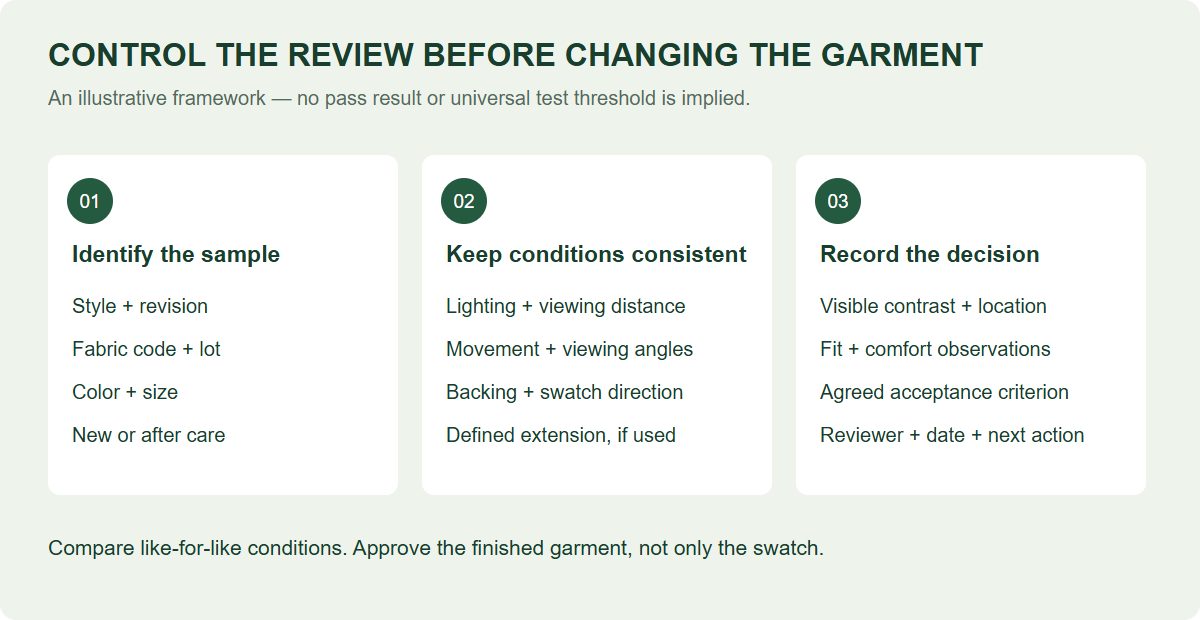
Write down the lighting, background, viewing distance, movement sequence and viewing angles. For swatch screening, specify the backing reference, orientation and extension. For wearing review, specify the intended body-size range, garment size and coverage expectation. Keep those conditions the same across versions. Record camera settings if images support the decision; automatic exposure can make comparisons misleading.
3. Separate fabric screening from garment approval
A swatch over a contrast reference can help compare candidates at a defined extension. It does not reproduce the garment’s full fit or multi-directional strain. Screen the materials first, then sew the shortlisted combination. Where extension is recorded, define the original reference length and direction: a 100 mm marked interval extended to 140 mm represents 40% extension in that direction. This arithmetic example is not a recommended universal test level or pass threshold.
4. Check fit and localized strain
Review hip and seat room, front and back rise, gusset shape, thigh measurements, seam placement and grading against the intended wearer. Observe squat and lunge movement. If the problem is concentrated at the seat, compare a controlled pattern revision while retaining the same identified fabric. Recheck comfort and silhouette as well as coverage; removing all intended compression would change the product brief.
5. Compare revisions using the same matrix
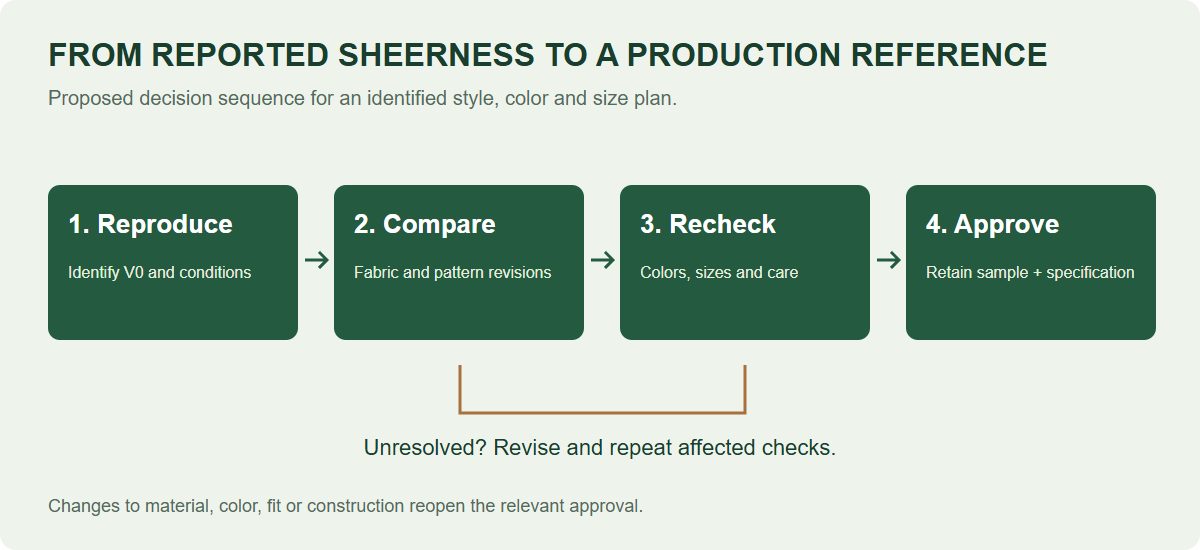
For this hypothetical brief, V1 could compare an alternative fabric with the original pattern, while V2 could compare a pattern revision in the original fabric. Review both colors and the agreed size plan. If neither route meets the requirement, investigate a combined revision or a suitable lining. No version is reported as passing here because actual measurements and approval records are unavailable.
6. Repeat affected checks after agreed care
Agree laundering and drying instructions, cycle count and assessment state before evaluation. Recheck garment measurements, coverage, recovery, seams and decoration where relevant. Distinguish a fresh-sample result from an after-care result. Ask a qualified testing provider to select appropriate supporting methods when a formal performance claim is planned; do not label an improvised squat check as a standardized certification.
7. Lock the approved combination for production
Retain the physical approval sample and link it to fabric code, color standard, pattern version, graded measurements, care label and written inspection criteria. Confirm how lots will be identified and how substitutions will be authorized. Check initial production against that reference before proceeding under the agreed release plan. Reopen relevant approvals if fabric, finish, color, construction or grading changes.
A practical opacity approval record
This template gives the buyer and manufacturer a shared record. Fill it with actual observations and keep unresolved entries open. A photograph without a sample ID and setup cannot explain which version should enter production.
| Record group | Required detail | Decision supported |
|---|---|---|
| Sample identity | Style, V0/V1/V2, fabric code and lot, color, size, pattern revision | Which exact combination was reviewed? |
| Wearer and fit | Relevant body dimensions, intended size interval, garment measurements, strain locations | Does the test represent the proposed fit? |
| Review conditions | Lighting, backing, distance, angles, movement, swatch direction and extension if used | Can the comparison be repeated? |
| Care state | New or after care, procedure, cycle count, drying and assessment state | What condition does the decision cover? |
| Observation and disposition | Location and nature of visible contrast, agreed acceptance criterion, hold/revise/approve, reviewer and date | Is release supported, or what must change? |
Example issue wording: “V0 / pale gray / size M / fabric A: contrast reported at the seat during the defined squat review. Repeat with the recorded setup; compare fabric and pattern routes separately. Hold approval pending review.” This is illustrative wording, not a finding from a real order.
Cost, MOQ and time: budget the correction before bulk cutting
The supplied fact library records Ohsurewear’s starting MOQ as 100 pieces per style per color, with mixed sizes available, subject to project confirmation. One style in two colors therefore starts at 1 × 2 × 100 = 200 pieces on that basis. Fabric, dyeing and customization minimums still need review. This is a planning calculation, not an order quotation.
Compare complete quotes. A fabric change may affect price per meter, usable width and garment yield. A pattern revision may alter consumption. Lining adds fabric and sewing operations. Include sample rounds, agreed testing, labels, inspection, packing and the confirmed delivery basis when relevant. No verified price premium or saving is available for this example.
A useful planning expression is: development cost = sample rounds + material trials + pattern work + agreed testing + sample logistics. The relevant production decision is the revised cost per approved garment, together with the cost of unresolved quality risk. Avoid an invented return-rate saving when no customer data supports it.
Build the schedule around gates: complete brief → available materials → revised samples → fit and coverage review → care checks → final approval → production slot → agreed inspection and shipment. Ohsurewear’s fact library records inconsistent public sampling and bulk timelines. Obtain written dates and start conditions for the actual project, including what happens if a revision is needed.
Common mistakes that leave the original problem unresolved
- Approving a flat swatch only. Add review of the completed garment in the intended fit and movements.
- Choosing a universal GSM target. Evaluate the candidate’s construction, coverage and comfort together.
- Using one dark sample for the range. Review actual colors and document size coverage.
- Changing fabric and pattern without a revision log. Identify which combination was evaluated and retain its specifications.
- Comparing images with different exposure. Control the setup and retain physical samples for approval.
- Assuming a fresh sample covers repeated care. Define and record the required after-care assessment.
- Claiming universal squat-proof performance. Keep wording within the conditions and evidence actually approved.
Manufacturer perspective: transfer the correction into a controllable specification
Ohsurewear’s supplied fact library describes sample development, pattern support, material selection and garment customization. Its published quality-control page describes raw-material checks, printing inspection, semi-finished sampling and finished-garment inspection. These are relevant service capabilities; they do not establish that the hypothetical opacity problem has been solved.
The practical manufacturing lesson in this guide is to connect the approved garment to reproducible inputs. A note reading “make it squat-proof” leaves fabric identity, fit and acceptance open to interpretation. A retained sample, versioned pattern, actual color references and written review conditions give the team a usable production target. This is an editorial recommendation based on the development problem, not a quotation from an unrecorded factory interview.
Use Ohsurewear’s OEM and ODM development service or custom leggings manufacturing service to discuss the brief. Ask who owns the sample revision, which checks will be performed, what evidence will be returned and who signs the release decision.
Frequently asked questions
What makes leggings squat-proof?
For this guide, squat-proof means that the required coverage is maintained during the agreed squat movement, in the stated size, color, lighting and care condition. It is a defined product requirement, not a guarantee for every wearer or situation. Approve the complete garment against a recorded procedure.
What GSM should squat-proof leggings use?
There is no single GSM target established by the supplied evidence. GSM measures fabric mass per area. Select candidate weights together with knit construction, stretch behavior, color and fit, then compare finished garments. A heavier fabric may change heat, hand feel and compression without resolving the actual source of sheerness.
Is nylon/spandex more opaque than polyester/spandex?
A fiber blend alone does not establish opacity. Compare identified fabrics in the relevant colors and constructions under the same conditions. Yarn, knit, finish, garment extension and fit also matter. Either material direction requires sampling and garment approval for the intended use.
Can changing the pattern fix see-through leggings?
It may help when excessive local extension contributes to the problem. Review hip and seat room, rise, gusset and size grading against intended body measurements. Recheck coverage, comfort and waistband stability after revision. A pattern change cannot automatically compensate for a fabric that lacks adequate coverage.
Should we test every color and size?
Evaluate every proposed color and establish a documented size coverage plan. Include sizes and body proportions likely to place greater local strain on the garment, along with a reference size. Do not treat approval of one dark middle-size sample as evidence for the entire collection.
Does a phone squat-test video prove performance?
A video can support a recorded review, but exposure, lighting, distance, compression and viewing conditions affect what is visible. Keep the setup consistent, obtain wearer consent and retain sample identifiers. Use physical sample approval and agreed evaluation criteria alongside images; a video alone does not establish a universal claim.
What are Ohsurewear’s MOQ and lead time?
The supplied fact library records a starting MOQ of 100 pieces per style per color, with mixed sizes available, subject to project confirmation. Sampling and bulk timing need written confirmation after design, material and customization review. The library contains conflicting published timelines, so this guide promises no fixed number of days.
Is this a completed Ohsurewear customer case?
No. The B729-96 plan requests a customer case, but authorized customer records, before-and-after results and project photographs were not supplied. The scenario, comparison routes and record template are illustrative. The scene image is AI-generated and the diagrams explain the proposed process; none documents an actual customer result.