
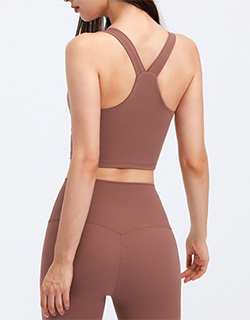
What Is Private Label Activewear? Costs, Benefits and Limitations
Private-label activewear guide · Evidence checked August 31, 2026
Direct answer: Private-label activewear is a supplier-developed or existing garment platform sold under a buyer's brand, usually with selected logos, labels, colors and packaging rather than a product engineered from zero. It can reduce development work and speed up market testing, but it does not guarantee low minimums, immediate stock, exclusive designs or zero sampling. The real commercial model is defined by the written scope: base style, available changes, component minimums, setup fees, production method, ownership, quality controls and reorder terms.
This guide explains the costs, benefits and limitations for clothing brands. Supplier terminology varies, so use the matrices and calculations below as a briefing tool rather than treating “private label” as a universal contract definition.

What Counts as Private-Label Activewear?
The usual starting point is an existing sample, pattern, fit block or catalog style owned or controlled by the supplier. The buyer selects a product and applies brand identifiers such as a heat-transfer logo, neck or waistband label, hangtag, care label and packaging. Some programs also permit stock fabric colors, limited trim options or small measurement changes.
| Program type | Starting inventory | Typical buyer choices | Main constraint |
|---|---|---|---|
| Stock blank program | Finished unbranded garments may be available | Logo, labels and packaging | Available stock, sizes, colors and branding compatibility |
| Made-to-order base style | No finished stock required; supplier reproduces an existing style | Branding plus selected standard colors or fabrics | Garment and component minimums, booking and production capacity |
| Modified private label | Existing style or pattern is adapted | Branding plus limited fit, pocket, trim or material changes | Changes can trigger pattern work, sampling, tests, cost and longer lead time |
Private Label, ODM and OEM: Where Is the Line?
| Decision factor | Private label | ODM | OEM |
|---|---|---|---|
| Starting point | Existing or pre-developed supplier style | Supplier design platform plus planned adaptation | Buyer concept, design or controlled specification |
| Product-development load | Usually lowest | Shared, with greater supplier contribution | Usually highest for the buyer |
| Differentiation | Primarily brand, presentation and curated assortment | Moderate to high, depending on agreed changes | Potentially highest when the specification is original |
| Control burden | Base style and allowed options | Adaptation scope, rights and approvals | Complete specification, engineering and validation |
| Best planning use | Fast category validation or brand-led assortment | Brands needing a proven platform and development support | Brands with a differentiated product concept and technical control |
The labels overlap in practice. A private-label request becomes ODM-like when modifications require meaningful pattern, fit, material or construction development. It becomes OEM-like when the buyer replaces the supplier platform with a substantially original specification. Compare deliverables, not acronyms.
What Does Private-Label Activewear Cost?
There is no reliable universal price per unit. Product cost depends on garment type, fabric, construction, quantity, color, branding method, labels, packaging, sampling, tests and logistics. A usable budget separates recurring unit costs from one-time or batch-level charges.
Recurring product costs
- Base garment or cut-and-sew value
- Logo application
- Brand, size and care labels
- Hangtags and packaging
- Per-unit inspection or handling
Setup and development costs
- Samples and courier charges
- Logo screens, films, molds or digitizing
- Label and packaging setup
- Color or technique trials
- Pattern changes and material tests
Landed and risk costs
- Freight, duties and insurance
- Payment and currency costs
- Inspection and corrective work
- Defect or loss allowance
- Markdown and unsold inventory exposure
Illustrative Private-Label Cost Model
This example is a replaceable planning model, not an Ohsurewear quotation. It shows why setup allocation and inventory risk belong beside the garment price.
| Input | Example assumption | Calculation | Example result |
|---|---|---|---|
| Order quantity | 2 styles × 2 colors × 100 units | 2 × 2 × 100 | 400 units |
| Base garments | $10.40 per unit | 400 × $10.40 | $4,160 |
| Branding and packaging | $1.35 per unit | 400 × $1.35 | $540 |
| Samples | 4 combinations × $65 | 4 × $65 | $260 |
| Logo and label setup | One combined batch | Fixed charge | $180 |
| Inspection and inbound freight | Illustrative batch amount | Fixed charge | $620 |
| Project cash cost | All above items | $4,160 + $540 + $260 + $180 + $620 | $5,760 |
| Landed planning cost | Project cash cost ÷ units | $5,760 ÷ 400 | $14.40 per unit |
If 5% of the order is unavailable for full-price sale, the 380 sellable units must recover the same $5,760 cash cost: $5,760 ÷ 380 = $15.16 per sellable unit before marketing, fulfillment, returns and operating overhead. A low factory price does not eliminate commercial risk.
Model Margin After Markdown, Not Only at Full Price
Assume a $42 retail price and the $14.40 landed planning cost above. If 70% of units sell at full price, 20% sell at 25% off and 10% sell at 50% off, weighted average revenue is:
The modeled gross product contribution is $37.80 − $14.40 = $23.40 per unit before marketing, fulfillment, platform fees, returns and overhead. Run the same formula with your realistic sell-through and discount assumptions. Private label can reduce development risk while leaving demand risk fully with the brand.
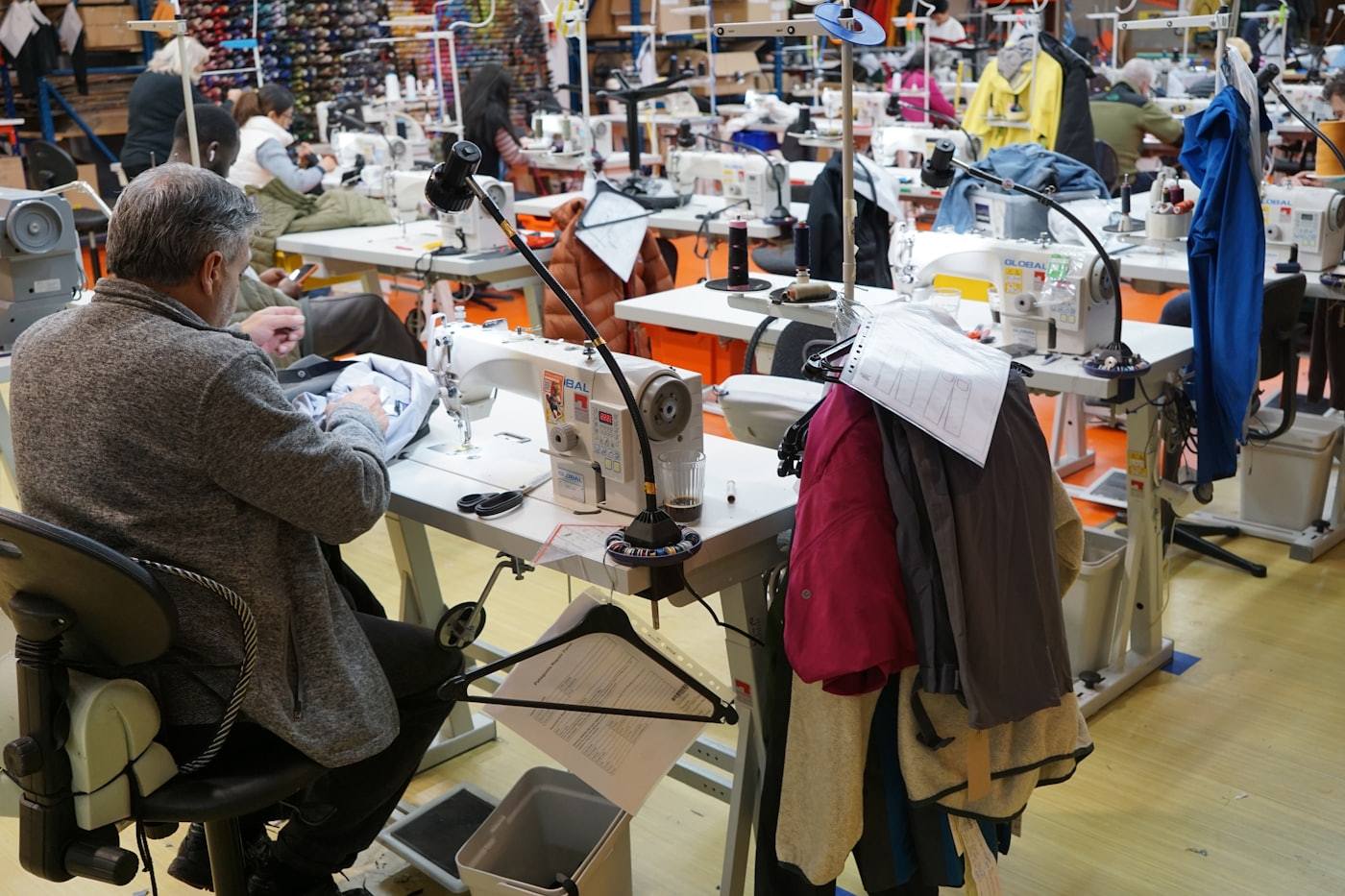
How the Private-Label Process Works
- Write the commercial brief. Define customer, activity, selling market, size range, quantity, launch date and target landed cost.
- Select the exact base style. Record the sample code, revision, fabric, color and measurement reference.
- Confirm the program type. Establish whether stock exists or the style will be produced after order.
- Map every brand component. Specify logos, labels, hangtags, packaging, files, dimensions, positions and colors.
- Price all minimums. Separate garment, color, fabric, trim, logo, label and packaging requirements.
Private-Label Approval Flow
- 1
Approve the base garment
Check fit, measurements, stretch, recovery, opacity, support, mobility, seams and finishing. A catalog photograph is not an approval reference.
- 2
Approve branding trials
Validate logo position, dimensions, color, hand feel, stretch behavior and wash durability on the actual fabric.
- 3
Freeze labels and packaging
Confirm content, language, size mapping, fiber and care information, barcodes, warnings and destination-market requirements.
- 4
Release a production package
Combine the approved garment, measurements, material code, artwork, label layouts, packaging specification and quality criteria into one dated version.
- 5
Inspect and archive
Verify bulk against the released references and keep final files, supplier codes and deviations for the next reorder.
Benefits of Private-Label Activewear
Faster product selection
A proven starting point can remove blank-page design and early pattern-development work.
Lower technical workload
The brand can concentrate on customer, positioning, assortment, content and distribution while still approving product essentials.
Earlier demand testing
A focused capsule can test product category, price, color and channel response before a larger original-development program.
Simpler repeat orders
A stable base style and archived production package can make reordering more predictable, subject to material and capacity availability.
Limitations and Hidden Tradeoffs
- Limited product exclusivity: similar base styles may be offered to other buyers unless a specific restriction is negotiated.
- Less technical differentiation: logo and color changes rarely create a unique fit or performance system.
- Component minimums: labels, packaging, custom colors and trims can exceed the garment minimum.
- Supplier dependency: a discontinued fabric, pattern or base style can interrupt reorders.
- Quality still varies: a pre-developed style does not remove the need for sample approval and bulk inspection.
- Compliance remains market-specific: branding does not transfer legal responsibility away from the seller.
- Inventory risk remains: faster development does not prove demand, price acceptance or sell-through.
Private-Label Fit Scorecard
Give the project one point for each “yes.” This is an original planning tool, not a supplier acceptance rule.
- We can build the offer around an existing garment platform.
- Our differentiation is mainly brand, community, assortment or channel.
- We can accept limited silhouette and construction changes.
- We have a defined target customer and realistic launch quantity.
- We can approve samples, artwork, labels and packaging promptly.
- We understand every garment and component minimum.
- We budgeted setup, freight, duties, inspection and defects.
- We modeled markdowns, returns and unsold inventory.
- We accept that the supplier may reuse its base design.
- We have a backup plan for discontinued materials or styles.
8–10: Strong private-label candidate.
5–7: Potential fit after clarifying economics or control points.
0–4: Compare ODM or OEM, or reduce the initial assortment.
Questions to Ask a Private-Label Activewear Supplier
| Topic | Question | Evidence to request |
|---|---|---|
| Availability | Is this style stocked, made to order or dependent on a material booking? | Dated stock or production-status record |
| Minimums | What minimum applies to the garment, color, logo, label and packaging? | Component-level MOQ breakdown |
| Changes | Which options are standard, and which trigger development fees or new timing? | Option matrix and itemized quotation |
| Rights | Who owns and may reuse the base style, pattern, artwork and modified files? | Ownership and license clauses |
| Quality | Which measurements, tolerances, tests and defect criteria control acceptance? | Quality plan and approved references |
| Reorders | How long are the style, fabric, colors and pricing expected to remain available? | Material codes, validity period and substitution process |
Worked Example: A Four-SKU Yoga Capsule
A startup chooses one supplier legging and one sports-bra base style in two standard colors, creating four style-color combinations. The brand adds heat-transfer logos, woven size labels, care labels, hangtags and recyclable mailers. It accepts the existing fabric and fit, so the supplier does not create a new pattern.
The team approves one garment sample per style, a logo technique trial on the actual fabric and digital packaging proofs. Its purchase order identifies minimums separately: 100 garments per color, 1,000 woven labels and 500 mailers. Excess labels and packaging are recorded as owned inventory for later orders.
The project remains private-label because product architecture is unchanged. If the startup later requests a new waistband, pocket system, fabric and measurement set, it should be rescoped as an ODM or OEM-style development rather than forcing the changes into the original private-label quote.
Frequently Asked Questions
Is private-label activewear the same as dropshipping?
No. Private label describes branded product ownership or presentation. Dropshipping describes fulfillment from a third party to the customer. A program can use both, either or neither.
Is private label cheaper than OEM?
It can require less original development, but total cost still depends on product, quantity, branding, packaging, freight, duties, tests and inventory. Compare total landed and risk-adjusted cost.
Can private-label activewear be customized?
Usually within an option boundary. Logos, labels and packaging are common; color, fabric, fit or construction changes may require new minimums, samples and a different development model.
Does private label guarantee a low MOQ?
No. Finished stock may support smaller orders, while made-to-order garments, custom colors, labels or packaging can create higher component minimums.
Who owns a private-label design?
The supplier commonly retains its pre-existing base design and pattern, while the buyer retains its trademarks and artwork. Any transfer, restriction or exclusivity must be written.
Is private label suitable for a startup?
It can be a strong fit when the startup has a clear customer and route to market but does not need original product engineering. The startup still needs a margin model, approval process and inventory plan.
Use Private Label to Validate a Market, Not to Skip Product Control
Private-label activewear works best when a proven product platform creates a meaningful speed or workload advantage and the brand can differentiate through positioning, assortment and customer experience. The safest project records the exact base style, all permitted changes, every minimum, full landed cost, approval evidence and reorder conditions.
Ohsurewear's product catalog and industry blog can support early product and manufacturing research. Project-specific availability, MOQ, prices, samples, lead times, testing, rights and delivery terms should be confirmed in a current quotation.