
Organic Cotton for Activewear: Benefits, Limitations and Best Uses
A practical sourcing guide for brands developing cotton-rich gym tees, studio wear and everyday training layers.
Organic cotton is a strong option for comfort-focused activewear such as gym T-shirts, warm-up layers and low-impact studio clothing. It offers a familiar cotton feel and verifiable organic sourcing when supported by documentation. However, organic status alone does not guarantee quick drying, stretch recovery or compression; choose the fabric construction, blend and tests around the intended activity.
What is organic cotton in activewear?
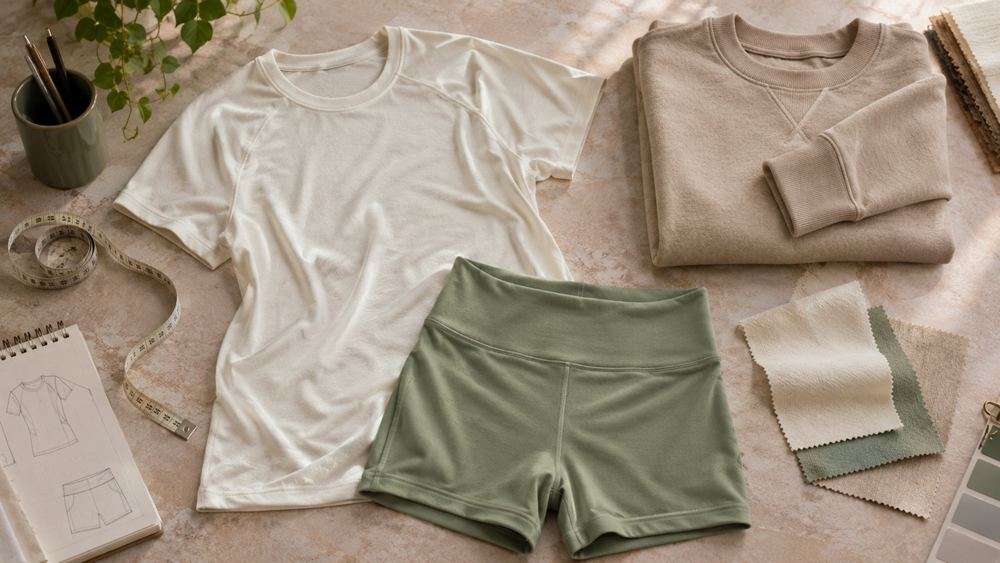
Organic cotton is cotton grown under a recognized organic agriculture standard. For a finished garment, a credible organic-content claim also needs traceability through the textile supply chain. A cotton fiber’s farming status and the performance of the resulting fabric answer different questions.
A garment described as organic cotton activewear may be made from 100% organic cotton or a blend containing organic cotton and other fibers. The full composition matters: a cotton-rich stretch jersey and a cotton fleece can both contain organic cotton while behaving very differently during exercise.
Textile Exchange’s organic cotton certification explanation distinguishes farm certification from tools used to track cotton after harvest. Ask which part of the supply chain the available evidence covers before approving a product description.
Benefits that matter to a clothing brand
- A familiar cotton hand feel. Cotton can provide a soft, absorbent base for garments worn before training, during lighter activity and throughout the day. Yarn quality and finishing still influence the actual touch.
- A clear material sourcing objective. A documented organic supply chain gives a brand a specific sourcing attribute to explain, rather than a vague environmental promise.
- Several useful garment directions. Jersey, rib, interlock and terry constructions can support different fits and weights. Organic content does not require every product in a range to use the same fabric.
- Flexibility in collection design. A brand can develop cotton-rich tops and warm-up layers alongside separately tested synthetic performance pieces, choosing each material for its role.
Organic cultivation does not automatically make the fabric softer than comparable conventional cotton. Fiber quality, yarn, knitting, dyeing and finishing are important variables. Compare finished swatches rather than approving the fabric on its name.
Organic cotton vs conventional cotton vs synthetic activewear fabrics
The table below is a development guide, not a ranking of every fabric. Compare candidates with similar weight, construction and finishing where possible, then evaluate the actual garment.
| Fabric route | Reason to consider it | Main limitation to check | Evidence to request |
|---|---|---|---|
| 100% organic cotton | Cotton feel for relaxed tees and everyday layers | Wet comfort, dimensional change and shape recovery | Organic traceability, composition and wash results |
| Organic cotton with elastane | Cotton-rich feel with added stretch for fitted studio pieces | Recovery, opacity and waistband behavior; stretch is not compression proof | Full blend, stretch/recovery results and finished-garment fitting |
| Organic cotton with polyester | A route to balance cotton touch and fabric engineering goals | Drying and durability benefits depend on the actual blend and construction | Organic proportion, other fiber identity and comparable performance tests |
| Conventional cotton in a comparable construction | A useful control for hand feel, fit and cost comparison | No organic-content claim without relevant evidence | Matched specifications, wash results and itemized quotation |
| Polyester/elastane or nylon/elastane | A candidate for close-fitting, higher-sweat or supportive designs | Fiber name alone does not establish drying, support or durability | Moisture, recovery, opacity and wear-test results for the intended use |
Decision rule: use organic status to evaluate sourcing, and use fabric and garment testing to evaluate performance. Neither replaces the other. Ohsure’s activewear fabric guide can support the initial material discussion.
Where organic cotton works best—and where to test more carefully
Gym T-shirts and everyday training tops
Relaxed or regular-fit tees are a sensible first development project when the brief emphasizes cotton touch and everyday wear. Assess neck rib recovery, body twist, underarm comfort and print behavior after washing. For a heavy-sweat training top, compare wet comfort and drying against the brand’s existing performance tee before choosing the fabric.
Warm-up hoodies and recovery layers
French terry or fleece can suit warm-up, travel and post-training garments. Decide whether the fabric should feel light enough for indoor use or substantial enough for a cooler setting. Check surface pilling, cuff recovery, pocket distortion and the dry time of the finished garment. A heavier fabric is not automatically more durable.
Low-impact studio wear and athleisure
Cotton-rich stretch fabrics can be candidates for studio tops, relaxed shorts and selected yoga pieces. Verify movement, seam comfort and bagging at knees or the seat. Fitted bottoms require opacity checks in the intended sizes and colors, including during deep bending. A soft swatch is not sufficient evidence that leggings will stay opaque or recover their shape.
High-sweat, compression and wet-weather use
Cotton absorbs and retains moisture, so untreated cotton-rich fabrics may become wet and feel heavier during sustained sweating. This does not mean all cotton fabrics perform alike: CottonWorks describes engineered moisture-management cotton, illustrating how yarn treatment and construction can change behavior. Availability of any specific technology must be confirmed; this article does not establish that Ohsure offers it.
For compression garments, high-support bras or long sessions in cool, wet conditions, set stricter functional requirements and compare several fabric routes. Do not infer support, drying speed or protection from organic content. Cotton’s absorption mechanism is described in the CottonWorks fiber performance guide; that source explains fiber behavior rather than certifying any activewear garment.
How to verify organic cotton before approving a claim
Start with the claim you intend to make. “Contains organic cotton,” a certification logo and a fully certified finished-product claim can require different evidence and approvals. A certificate for a yarn mill does not, by itself, establish certification of a garment made further along the supply chain.
| Evidence | What it helps establish | What it does not establish alone |
|---|---|---|
| Organic Content Standard (OCS) | Third-party verification of organic material content and chain of custody | Quick drying, fit, compression or the wider processing criteria covered by GOTS |
| Global Organic Textile Standard (GOTS) | Organic fiber requirements plus processing, environmental and social criteria | That every product from a listed business is covered, or that a blend qualifies merely by its percentage |
| Scope certificate | The named entity’s certified scope, processes, product categories and validity | That your particular shipment contains certified goods |
| Transaction certificate and linked shipment records | A connection between certified goods and a particular transaction or shipment | Permission to apply any logo or wording without meeting the relevant claims rules |
| Composition or performance test report | The tested sample’s fiber composition or specified measured properties | Organic farming origin or an intact certified supply chain |
According to the official OCS overview, OCS verifies organic material content and traceability; GOTS adds processing requirements. The official GOTS key features describe two label grades: at least 95% certified organic fibers for “Organic,” and at least 70% for “Made with Organic Materials.” These thresholds are only part of the requirements; permitted additional fibers, processing and labeling conditions also matter.
- Identify the legal entity. Request the supplier’s legal name, site address, certification scheme, certificate or license number, issuer and certificate copy.
- Check scope and dates. Match relevant manufacturing or trading activities and product categories. Check coverage for the planned production period, not only the inquiry date.
- Verify independently. Use the GOTS certified suppliers database or Textile Exchange company directory. Ask the issuing certification body about missing or inconsistent entries.
- Connect the evidence to the order. Reconcile product descriptions, material composition, quantities, seller, buyer and shipment references with invoices and packing documents. Use the Textile Exchange transaction authentication route where applicable.
- Approve wording before printing. Confirm the intended finished-product claim and any logo permission with the relevant certification body or scheme. Archive the approval with the artwork version.
Ohsure lists organic cotton as a material option. This guide does not confirm a current Ohsure GOTS or OCS certificate, certificate number or certified finished-product scope. Request project-specific evidence before making a certification claim. For future orders, recheck the applicable standards and transition rules at the time of approval.
Seven steps to develop organic cotton activewear
Define the activity and selling promise
Specify the garment, fit, climate, activity intensity and intended wash care. Separate essential performance needs from sourcing goals. A studio tee and a running base layer should not share a brief simply because both are activewear.
Choose the organic-content and certification route
Write down the full target composition and the evidence needed for your intended claim. Confirm whether the available supply chain can support that route before investing in branded labels.
Compare finished swatches
Review construction, weight in grams per square meter (GSM), usable width, color and finish. Use a reference garment for touch and drape. Keep labeled swatches so later samples can be compared with the same approved material.
Build the technical specification
Provide graded measurements, tolerances, seam details, trims, branding placement and packaging requirements. Define the required post-wash measurements and functional checks. A photograph helps explain style, but cannot communicate these details on its own.
Review a garment sample before and after care
Check fit, movement, opacity and seam comfort, then wash and dry under the agreed conditions. Re-measure key points and compare against the original sample. Repeat the agreed checks after revisions that change material or construction.
Approve the production reference
Freeze the fabric, color, size specification, trims, print method, artwork and packaging. Keep the approved sample and written acceptance criteria together. Decide how material substitutions and out-of-tolerance results will be handled.
Confirm bulk inspection and shipment evidence
Agree on inspection points, sampling rules and required documents before production. Obtain the applicable shipment-linked organic records and approved labeling evidence as part of the order documentation.
A sample acceptance checklist buyers can reuse
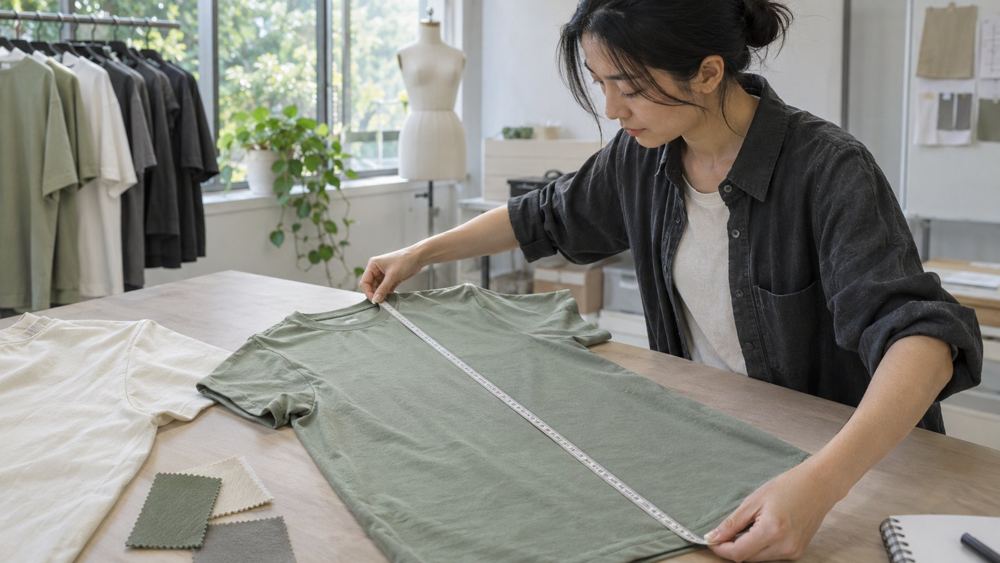
Use this checklist to turn general requests such as “good quality cotton” into reviewable conditions. It is a proposed buyer worksheet, not an Ohsure test report or a set of universal pass limits. Agree the method, procedure, number of cycles, sampling and acceptable result before testing.
| Checkpoint | What to record | Why it affects approval |
|---|---|---|
| Composition and fabric identity | Full blend, supplier reference, GSM, construction, finish and lot | Prevents approval of a sample that cannot represent the ordered material |
| Dimensional stability | Length/width before and after agreed laundering; care conditions and cycles | Shows whether the product can maintain the specified fit |
| Skew and garment twist | Side-seam position and garment balance after care | A tee may remain wearable in size while its seams visibly rotate |
| Stretch and recovery | Agreed extension, repeated use and residual growth | Flags bagging at necklines, cuffs, elbows, knees and seat |
| Moisture behavior | Drying or wicking result using a selected method and comparison fabric | Tests the specific performance claim rather than assuming it from the fiber |
| Color, surface and branding | Wash/rub/perspiration colorfastness as relevant, pilling and print condition | Checks appearance and transfer risks under the intended use |
| Finished-garment wear trial | Movement, wet comfort, opacity and seam pressure in representative sizes | Connects fabric results with how the actual garment behaves |
The AATCC standards directory lists separate methods for laundering dimensional change, moisture management, wicking and drying. This separation matters: a good wicking result does not establish a good drying result. For dimensional change, AATCC TM135 addresses fabrics; select an appropriate garment method when evaluating finished clothing.
Worked measurement example
If a marked length changes from 50.0 cm to 48.5 cm, dimensional change is (48.5 − 50.0) ÷ 50.0 × 100 = −3.0%. That describes a 3% reduction in that measured direction. It is an illustration, not an Ohsure result or an automatic pass. Measure the other direction separately and apply the agreed acceptance limits.
A simple in-house wash trial can identify obvious problems early. It should not be described as an accredited laboratory result or as compliance with a named test method unless the required procedure was actually followed.
Cost, MOQ and lead-time factors
There is no reliable universal organic cotton premium. Compare quotations for the same finished garment, including the same fabric specification, order volume, colors, testing and claim requirements. A lower price may reflect a lighter fabric, a different blend or a different documentation scope.
| Factor | Possible cost or schedule effect | Question to settle |
|---|---|---|
| Fabric specification | Yarn, GSM, construction, width and finish affect price and consumption | Is the quotation based on the approved swatch? |
| Stock vs custom material | Custom knitting or dyeing can introduce material minimums and extra stages | Is the exact material reserved, or still to be produced? |
| Organic evidence and claim route | Document review, certified processing and label approval require coordination | What evidence, fees and responsibilities are included? |
| Sampling and validation | Additional sizes, revisions or laboratory work add cost and time | How many sample rounds and which tests are included? |
| Order mix and branding | More colors, artwork setups and special trims can change minimums and unit cost | What MOQ applies to each style, color and component? |
| Packing and delivery | Packaging, freight and destination charges affect landed cost | Which charges and delivery responsibilities are included? |
Understand the order minimum
Ohsure’s published starting MOQ is 100 pieces per style per color, with mixed sizes available. Final order requirements are subject to project confirmation. Material, color, branding and packaging requirements may affect the applicable minimum.
For example, one tee style in three colors at 100 pieces per color means 300 pieces, with the size breakdown agreed within each color. Adding a second style in the same three colors would mean 600 pieces if the same minimum applies. These are planning examples, not quotations or confirmation that a particular organic fabric is available at that quantity.
Calculate comparable cost
Budget per ordered piece = (garments + development + agreed testing + labels/packing + freight + applicable destination charges) ÷ order quantity. Keep the delivery basis consistent when comparing offers. Do not compare a factory-price quotation with a delivered-price quotation as though they include the same costs.
Build the schedule around approval gates
Track material availability, color approval, sample development, testing and revisions, bulk production, inspection, document completion and transport. Some stages can overlap; others depend on an earlier approval. Agree which event starts each quoted lead time and who must respond at each gate.
Sample timing is confirmed after reviewing the design, materials and customization requirements. Bulk-production timing is confirmed according to the approved specifications, material availability and production schedule. Ask whether estimates use working or calendar days, and keep transport separate from production timing.
Common mistakes when sourcing organic cotton activewear
- Buying the organic claim before defining the garment. Establish the activity, fit and performance requirements first; then source a compatible documented fabric.
- Equating absorption with quick drying. Check moisture transport and drying separately, using the actual finished fabric.
- Approving only an unwashed sample. Review shrinkage, twist, rib recovery and print behavior under the intended care conditions.
- Treating elastane content as proof of support. Stretch percentage alone cannot establish compression or sports-bra support. Evaluate the full garment.
- Accepting an unrelated certificate. Match the legal entity, activities, product scope, validity and order-linked evidence.
- Assuming a certified fabric makes every subsequent process certified. Discuss cutting, sewing, printing, trading and labeling coverage for the intended finished-product claim.
- Using broad environmental promises. Organic content alone does not quantify a garment’s water savings, carbon footprint, recyclability or biodegradation. Use a specific supported claim.
- Changing a component after approval without reassessment. Recheck fit, performance and relevant claim eligibility when the material, finish, trim or production route changes.

The Ohsure manufacturing perspective
Ohsurewear is an activewear manufacturer in Dongguan, Guangdong, supporting OEM, ODM and private-label projects. Its published material options include organic cotton. Its services include development from design references, garment manufacturing, branding and packaging customization.
For buyers, the useful manufacturing lesson is to approve material, fit and branding together. A fabric change can alter drape and garment dimensions, while a logo application can affect the feel of the same panel. Check the complete sample rather than approving the cloth, pattern and artwork independently.
Ohsure’s published quality-control process describes raw-material inspection, printing-process inspection, semi-finished sampling inspection and finished-garment checks. It includes attention to color, weight, pilling, colorfastness, shrinkage, measurements and stitching. Agree which checks apply to your order, the methods used and the acceptance criteria; a service description is not a batch test report.
A copyable inquiry brief
“We are developing [garment] for [activity and climate], with [fit] and a target retail position of [range]. Please propose an available fabric with [full target composition], [GSM], [construction] and [colors]. Our planned quantity is [pieces per style per color], with [size mix]. We require [organic claim/evidence route], [wash and performance checks], [branding], [packaging] and delivery to [destination]. Please separate sampling, bulk production, testing, documentation and freight, and confirm material minimums and lead-time start conditions.”
Frequently asked questions
Is organic cotton good for sweaty workouts?
It depends on the finished fabric and the workout. An untreated cotton-rich garment may retain moisture and feel wet during sustained exercise. Compare drying and wet comfort with a suitable benchmark before using it for high-sweat training.
Is organic cotton softer than regular cotton?
Not automatically. Fiber quality, yarn, construction and finishing influence softness. Compare similar finished fabrics rather than treating organic status as a hand-feel grade.
Can organic cotton be used for leggings?
A cotton-rich stretch fabric can be considered for selected low-impact or casual leggings. Approve recovery, waistband stability, wash performance and opacity in movement. Organic content does not establish suitability for compression or intensive training.
Does 95% organic cotton and 5% elastane mean GOTS certified?
No. Meeting a numerical organic-content threshold does not establish certification. The additional fiber, processing chain, product scope and labeling must meet the applicable requirements, supported by the relevant certification evidence.
What is the difference between OCS and GOTS?
OCS focuses on verified organic material content and chain of custody. GOTS adds processing requirements, including environmental and social criteria. Select the route around the intended claim and confirm coverage of the actual product.
Can a fiber-composition test prove cotton is organic?
No. A composition report can help identify the fibers in a tested sample, but it does not establish certified organic farming origin or traceability. Request supply-chain evidence separately.
What is Ohsure’s MOQ for organic cotton activewear?
The published starting MOQ is 100 pieces per style per color, with mixed sizes available. Confirm the selected organic fabric, color, garment and customization requirements; the starting MOQ is not a guarantee for every material.
How long does development and production take?
Ohsure confirms sample timing after reviewing design, materials and customization. Bulk timing depends on approved specifications, material availability and production scheduling. Request separate milestones for testing, approvals, production and transport rather than using one blanket delivery estimate.