
Sustainable Activewear Manufacturing: Materials, Certifications and Supply-Chain Verification
A practical sourcing guide for brands developing leggings, sports bras, training sets and everyday activewear with verifiable material claims.
Sustainable activewear manufacturing combines fit-for-purpose materials, documented sourcing, controlled production and evidence that supports each product claim. Start with the garment’s performance needs, specify material content, verify certificate scope and order records, and test the finished sample. Approve only the wording and labels supported by the actual product and its supply chain.
Technical references checked November 2, 2026.
What is sustainable activewear manufacturing?
For a clothing brand, sustainable activewear manufacturing is a sourcing and production approach that considers materials, processing, product life and supply-chain accountability together. The word “sustainable” is too broad to function as a fabric specification. Turn it into requirements that a supplier can quote, manufacture and document.
A useful brief separates four questions: what the garment contains, how relevant production stages are controlled, how the garment performs in use, and what evidence supports the public claim. A certificate may answer part of this brief. It does not replace sample approval, factory assessment or a product-specific explanation of environmental benefits.
Define the claim before choosing the label. “Contains a documented percentage of recycled polyester in the main fabric” is a much more precise starting point than “planet-friendly collection.” Likewise, a claim about organic cotton should identify the covered material and applicable certification route.
Compare materials against the garment’s job
Choose candidate fabrics by use case and test the actual construction. Composition alone does not establish compression, moisture management, softness or durability. Ohsurewear’s activewear fabric guide is a starting point for material discussions; request the exact composition, weight, construction, finish and color availability for your project.
| Candidate material | Possible development use | What to evaluate | Evidence to request |
|---|---|---|---|
| Recycled polyester with elastane | Training tops, leggings or sets when the construction meets the brief | Recovery, opacity, pilling, colorfastness and print compatibility | Fiber breakdown, claimed recycled share, supplier scope and order-linked evidence |
| Recycled nylon with elastane | Fitted leggings and bras where the selected fabric meets fit requirements | Surface feel, abrasion, recovery and shade consistency | Nylon source and percentage, complete blend and traceable lot references |
| Organic cotton or an organic cotton blend | T-shirts, hoodies and casual movement layers | Shrinkage, shape retention, hand feel and suitability for the intended activity | Organic claim evidence, blend details and finished-product certification eligibility |
| Modal or bamboo-derived cellulosic blends | Soft tops and casual activewear where the sample is suitable | Care behavior, recovery, opacity and seam stability | Exact fiber identity, source and processing evidence; plant origin alone is insufficient |
These are development options, not a ranking of environmental impact. If a supplier proposes a substitution, compare the replacement fabric and its documents again. Do not assume a different weight, mill or dye lot inherits the approved fabric’s properties.
For product references, explore custom recycled fabric gym wear and organic cotton clothing options. Category names identify sourcing directions; verify each selected item’s composition and evidence before making a certified-product claim.
GRS, RCS, GOTS and OEKO-TEX answer different questions
| Standard | Main scope | Buyer check | What it does not establish by itself |
|---|---|---|---|
| RCS — Recycled Claim Standard | Recycled material content and chain of custody | Applicable material, company scope and shipment evidence | Broader environmental performance of the whole garment |
| GRS — Global Recycled Standard | Recycled content, custody and additional social, environmental and chemical processing requirements | Product eligibility, covered processes and approved claim | Recyclability or a quantified carbon reduction |
| GOTS — Global Organic Textile Standard | Organic fibers plus processing, environmental and social requirements | Certified entities and the applicable finished-product scope | That any garment containing some organic cotton can carry a GOTS label |
| OEKO-TEX® STANDARD 100 | Testing the covered textile article for harmful substances | Certificate validity, covered article and intended skin-contact use | Organic origin, recycled content or overall sustainability |
Textile Exchange distinguishes between GRS business-to-business eligibility from 20% recycled content and consumer-facing labeling requiring at least 50%, with other scheme conditions still applying. A percentage alone does not authorize a logo. See the official RCS and GRS explanation.
GOTS identifies label grades requiring at least 95% or at least 70% certified organic fibers, respectively. Other fiber and processing conditions apply; a stretch blend’s composition must be checked for eligibility. See GOTS key features. STANDARD 100 addresses harmful-substance testing for the covered article; review the official STANDARD 100 scope separately.
Scope certificates and transaction certificates
A scope certificate (SC) identifies a certified organization’s permitted products and activities. A transaction certificate (TC) links certified products to shipment details. An SC supports supplier qualification; it does not prove that every delivery is certified. Textile Exchange explains this distinction in its standards FAQs.

How to verify a sustainable activewear supplier in seven steps
The following is a recommended buyer workflow. Use it to agree responsibilities with your supplier and certification body.
Write one technical and evidence brief
List garment use, style code, size range, composition, fabric weight, color, trims, branding, quantities and intended markets. Add the precise material claim and the records needed to substantiate it. Make documentation part of the quotation request.
Map who handles the material
Identify the contracting seller, fabric source, dyeing or finishing operation, garment factory and relevant subcontractors. Record which operations are covered by which certificate. Investigate gaps before placing a certified order.
Authenticate supplier credentials
Check legal entity, address, certificate number, issuer, validity, product category and process scope. Use Textile Exchange’s certified-company directory, Global Standards’ supplier resources or OEKO-TEX Label Check as appropriate. Save the lookup date and result. Resolve mismatches directly with the issuing body.
Connect the fabric to your order
Use a shared reference across the purchase order, fabric code, color, lot, composition declaration, invoices and packing records. Agree who will obtain shipment-level proof, what it will cover and when it can be issued. Use Textile Exchange’s transaction authentication route where applicable. Do not expect a future shipment’s final TC at the first sampling discussion.
Test the production-intent sample
Evaluate the intended fabric and trims in the assembled garment. Agree methods and acceptance criteria for stretch recovery, pilling, shrinkage, colorfastness, seam performance and dimensions, plus opacity where relevant. Use representative sizes and colors. A wear trial complements laboratory work; it does not replace it.
Freeze specifications and label wording
Identify the approved sample revision, bill of materials, tolerances, inspection plan, packaging and artwork. Specify whether the claim covers main fabric, a component or the finished article. Confirm scheme approvals before printing certification marks, and require written approval for substitutions.
Reconcile the delivery and retain the evidence
Match the shipped styles, quantities and lots to final records. Recheck discrepancies and keep unresolved claims on hold. Archive the approved wording, certificates, lookup records, test reports and order references together for customer and retailer questions.
A compact evidence register for every style
| Record | Minimum useful fields | Suggested owner |
|---|---|---|
| Material specification | Style, fabric code, composition, weight, construction, color, revision | Product development |
| Certificate check | Scheme, certificate number, entity, scope, validity, issuer, lookup date | Sourcing |
| Order traceability | PO, fabric lot, shipment reference, TC status where applicable | Supplier and purchasing |
| Quality evidence | Sample revision, test method, result, acceptance criterion, exceptions | Quality team |
| Claim approval | Exact wording, covered component, artwork approval, evidence location | Brand product/content owner |
Use “pending,” “verified” and “not applicable” distinctly. Record the reason for “not applicable”; an empty field should not silently become an approval.
What affects cost, MOQ and lead time?
Compare quotations against the same technical brief. The sourcing question is whether the proposed material, documentation and quality plan fit your budget and launch window.
| Factor | Cost effect to clarify | Time dependency to confirm |
|---|---|---|
| Fabric and color | Material price, mill minimum, custom dyeing and unused balance | Stock availability or knitting/dyeing slot |
| Sampling and testing | Sample rounds, courier charges and agreed laboratory tests | Material readiness, revisions and test turnaround |
| Documentation or certification work | Included records, service charges and any additional audit needs | Certificate status, review and shipment-document issue dates |
| Branding and packaging | Logo setup, labels, hangtags and packaging minimums | Artwork approval and label permissions |
| Bulk and delivery | Inspection, packing, freight and quoted delivery basis | Final approval, production booking and transport |
MOQ example: Ohsurewear’s published starting MOQ is 100 pieces per style per color, with mixed sizes available. Two styles in three colors each create six style-color combinations: at that starting minimum, the plan totals 600 pieces. Fabric, branding and packaging requirements may change the final order conditions. This is a quantity illustration, not a quotation.
Budget method: add garment production, sampling, testing, agreed documentation charges, packaging and delivery costs. Then compare that project totalwith the expected accepted quantity. Do not add a generic “sustainable premium” without supplier quotes.
Scheduling method: work backward from the launch date through delivery, bulk inspection, production, approved sample, testing and material booking. Some tasks can overlap; production-intent material approval remains a dependency for reliable sampling. Record whether dates mean working or calendar days and what starts each stage.
Ohsurewear’s sample timing is confirmed after reviewing the design, materials and customization requirements. Bulk-production timing is confirmed according to the approved specifications, material availability and production schedule. Ask for a project schedule rather than treating an advertised range as a commitment.

Common mistakes that weaken a sustainability claim
- Using a certificate image without checking it. Verify the entity, dates and covered operations with the relevant official resource or issuer.
- Promoting the whole garment using a component claim. Keep the scope precise. Main fabric, lining, cups, elastics and trims may have different compositions.
- Calling an entire blend recycled. Document each fiber share. In a hypothetical main fabric containing 80% documented recycled polyester and 20% conventional elastane, the recycled share of that fabric is 80%; this does not calculate the recycled share of the complete garment.
- Accepting a material change after approval. A replacement mill, fabric or finish needs a fresh evidence and sample review.
- Publishing carbon or water savings from a fiber name. Request a defined baseline, system boundary and product-relevant assessment before using numerical comparisons.
- Treating “natural,” “bamboo” or “recycled” as an all-purpose guarantee. Ask what specific attribute is supported and how it relates to the intended garment.
- Ignoring product life. An attractive sourcing story does not resolve shrinkage, seam failure or poor recovery. Keep quality acceptance criteria in the same brief.
The manufacturing perspective: lock the material before the message
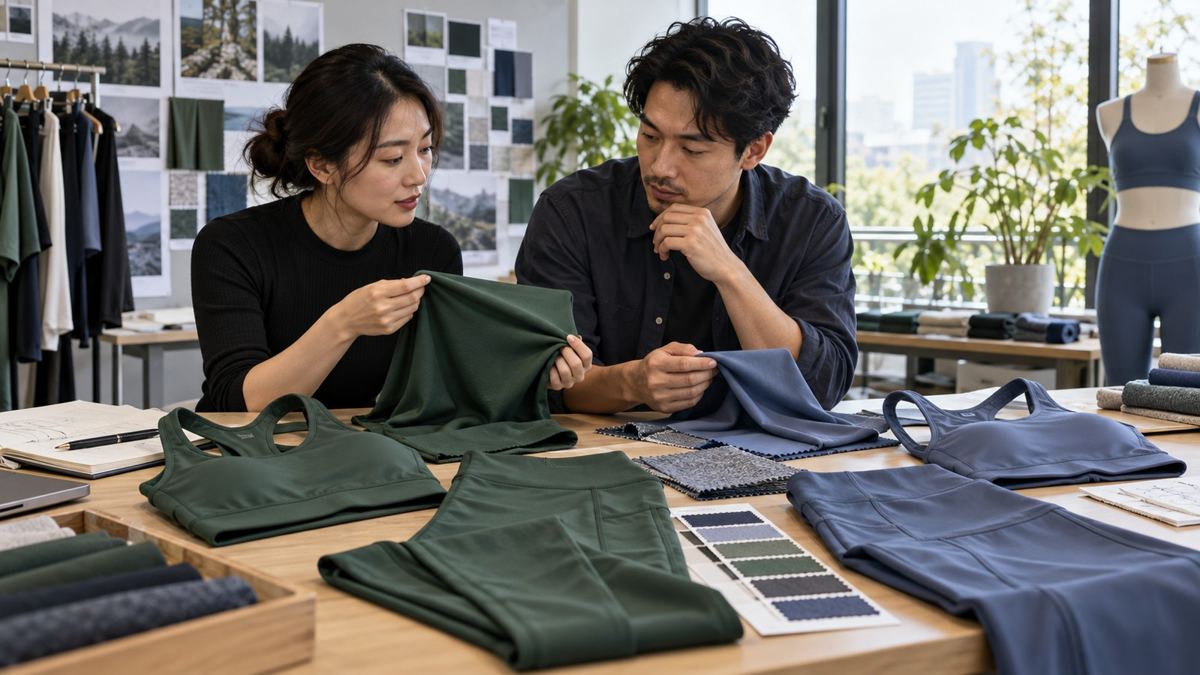
At the sample table, material selection and garment construction must be reviewed together. A change in fabric weight or recovery can alter a waistband’s behavior, a bra’s support or the appearance of a printed logo. This is a practical development consideration, not a claim about an Ohsurewear customer project.
Ohsurewear’s supplied company fact library describes design-reference review, sample development, OEM/ODM manufacturing, branding and packaging support. Its quality-control information covers raw materials, printing, semi-finished products and finished garments, including checks such as shrinkage, pilling, colorfastness, measurements and stitching. These activities help frame a project inspection plan; agree the actual methods and tolerances separately.
For a sustainability-focused order, bring the supplier a material brief and evidence checklist alongside your design. Use custom activewear manufacturing services to discuss the sample and production scope, private-label services for labels and packaging, and quality-control information to build the acceptance plan.
Frequently asked questions
What makes an activewear manufacturer sustainable?
Assess the evidence behind material sourcing, relevant production practices, working conditions and product quality. A useful supplier can identify what it can substantiate for your order, explain gaps and agree on measurable requirements. A general sustainability statement is insufficient for a product-specific claim.
Is recycled polyester always the best material for activewear?
No single material suits every design. Compare the exact fabric’s stretch recovery, opacity, comfort, care behavior and documented content. Recycled content is one sourcing attribute; it does not by itself establish the overall environmental impact or performance of a garment.
Does GRS mean a garment is recyclable?
GRS addresses recycled inputs and its defined processing requirements. Treat end-of-life recyclability as a separate question: assess the garment’s blend, trims, construction and a real collection and recycling route before making that claim.
Can a fabric supplier’s certificate cover a finished garment automatically?
No. Check the applicable supply-chain and product scope, including processing after the fabric stage. Ask the certification body what documentation and approvals are required for the finished product and intended claim.
Is OEKO-TEX STANDARD 100 the same as organic certification?
No. STANDARD 100 concerns testing for harmful substances within the certified article’s scope. Organic fiber claims require separate evidence. Verify the certificate number and article coverage rather than treating different labels as interchangeable.
Does Ohsurewear offer recycled or organic cotton options?
Ohsurewear lists recycled fabrics and organic cotton options. Availability, composition, material minimums and supporting documentation must be confirmed for your project. This article does not establish Ohsurewear or any particular garment as certified to the standards discussed.
What is Ohsurewear’s minimum order quantity?
MOQ starts at 100 pieces per style per color, with mixed sizes available. Final order requirements are subject to project confirmation, including fabric, dyeing, branding and packaging requirements.
How much more does sustainable activewear cost?
There is no reliable universal premium. Request an itemized quote for the same fabric specification, quantities, testing, documentation, labels and delivery basis. Compare the full project cost and the cost per accepted garment, rather than two unit prices with different exclusions.
How long will sampling and production take?
Sample timing is confirmed after reviewing the design, materials and customization requirements. Bulk-production timing depends on approved specifications, material availability and the production schedule. Include revisions, testing, document review and transport as separate milestones.
What should be ready before publishing a sustainability claim?
Keep the approved composition, applicable certificate verification, order-to-lot references, relevant test records and final approved wording together. Confirm label or logo permission where required. If shipment evidence is still pending, keep the corresponding claim on hold.
Build your next activewear brief around verifiable requirements
Start with your style references, size range, quantities by color, performance needs and exact material claim. Ask Ohsurewear to confirm fabric availability, sample scope, supporting records and quotation conditions before committing to production.
Explore recycled fabric gym wear · Explore organic cotton clothing · Discuss custom manufacturing