
Recycled Polyester vs Recycled Nylon for Activewear
How to compare fabric performance, development costs and recycled-content evidence before approving your next collection.
What are recycled polyester and recycled nylon?
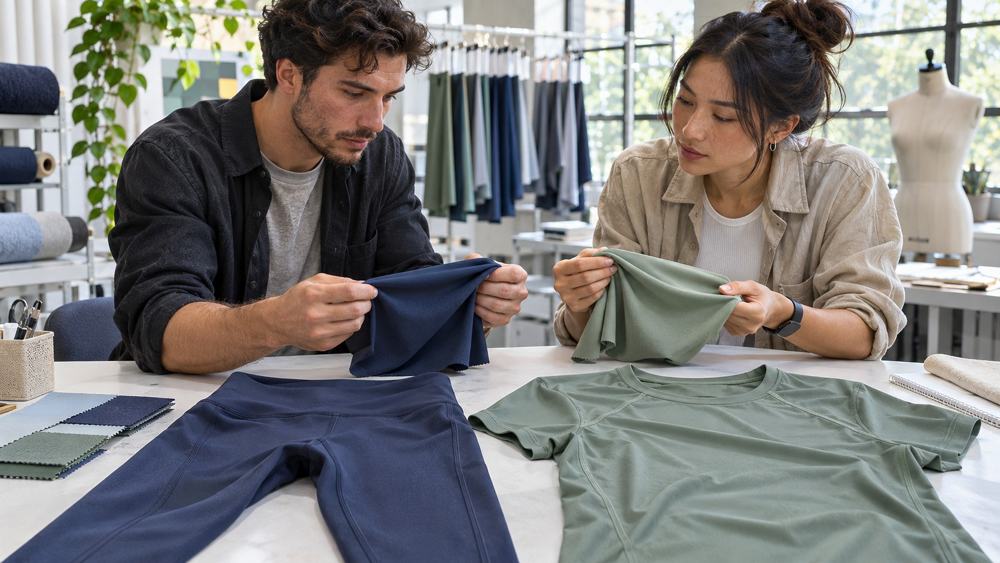
Recycled polyester is polyester produced using recovered polyester feedstock. Apparel polyester is commonly PET, or polyethylene terephthalate. Sources can include used PET bottles and textile waste; the feedstock and recycling route must be confirmed for the selected yarn. Patagonia describes both bottle-derived polyester and work on additional waste streams in its polyester sourcing overview.
Recycled nylon is polyamide produced using recovered nylon feedstock. Ask whether the material is PA6 or PA66, where the waste originated, and how it was processed. For example, Aquafil describes recovering nylon from fishing nets, fabric scraps, used carpets and industrial plastic for its regenerated nylon system. That is one producer’s documented process, not evidence that every recycled nylon fabric comes from ocean waste.
Recycled content and total composition are different measurements. A hypothetical fabric containing 78% recycled nylon and 22% conventional elastane has a 78% recycled fraction by fabric mass, assuming the documentation supports that composition. It is not a 100% recycled fabric. The percentage also does not automatically describe the whole garment, including lining, elastic, thread, trims and labels.
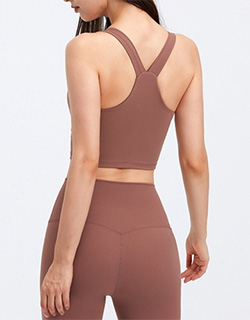
Ohsure’s recycled fabric gym wear range currently lists recycled polyester bras, leggings and bike shorts. A specific recycled nylon composition, color, quantity and supporting evidence require project confirmation.
Recycled polyester vs recycled nylon at a glance
The table below is a sourcing shortlist, not a test report. Product directions draw on Ohsure’s activewear fabric guide; validate each proposed recycled fabric separately.
| Decision factor | Recycled polyester | Recycled nylon | What to verify |
|---|---|---|---|
| First samples to request | Training tees, printed workout pieces and leggings. | Soft-touch leggings, fitted bras and studio pieces. | The actual fabric, fit, color and finish for your intended activity. |
| Moisture behavior | Polyester generally has lower moisture regain than nylon. | Nylon generally takes up more moisture within the fiber. | Wicking and drying separately; fiber absorption does not establish garment drying time. |
| Hand feel | Can be smooth, textured or brushed. | A useful candidate for a soft, smooth hand. | Blind comparison after washing; neither fiber guarantees a particular feel. |
| Stretch and support | Depend on knit, yarn, elastane and garment construction. | Depend on the same construction variables. | Extension, recovery, waistband stability and movement in the intended size. |
| Printing and branding | Request print trials where sublimation is part of the brief. | Confirm a print and bonding method suitable for the particular fabric. | Color, migration, heat effects, logo adhesion and stretch after laundering. |
| Wear resistance | Assess pilling, abrasion and seam performance on the finished fabric. | Assess the same; do not assume all nylon constructions outperform polyester. | Agreed methods, acceptance criteria and post-wash appearance. |
| Price and lead time | Quote the exact stock or custom-developed fabric. | Quote the exact grade, source and available colors. | Material minimums, usable width, consumption, evidence costs and replenishment. |
| Environmental claims | Specify recycled share, feedstock and traceability. | Specify the same; request proof for any fishing-net claim. | Evidence for the actual order and a fair basis for any impact comparison. |
Technical context: Coats’ textile-fiber reference reports lower moisture regain for polyester than nylon. This is a fiber property, not a ranking of finished activewear comfort.
Which should you sample for your product?
For training tops and printed collections
Start with a recycled polyester candidate when your brief emphasizes a training tee or an all-over printed collection, then confirm drying, hand feel and print suitability. A recycled claim alone says nothing about a moisture-management finish or how long it remains effective. UNIFI explicitly notes that performance benefits depend on fabric construction in its moisture technology information.
For close-fitting leggings and sports bras
Include recycled nylon in your sample comparison when softness and next-to-skin feel are priorities. Compare it with a recycled polyester candidate at a similar usable weight and intended stretch. For leggings, review opacity at working stretch, waistband recovery and seam comfort. For bras, assess the complete construction, including lining, elastic and support during the intended movement.
A heavy brushed polyester knit and a lightweight nylon knit may both have a recycled claim, but they answer different product briefs. Use Ohsure’s custom gym leggings range to define your silhouette and construction before asking for material alternatives.
For a collection with several activities
You can use different fabrics for different styles. First decide whether the priority is matching color, matching hand feel or matching a performance target across the set. Approve lab dips and finished samples under consistent lighting: the same color reference does not guarantee identical appearance across polyester and nylon.
How to compare the two fabrics fairly
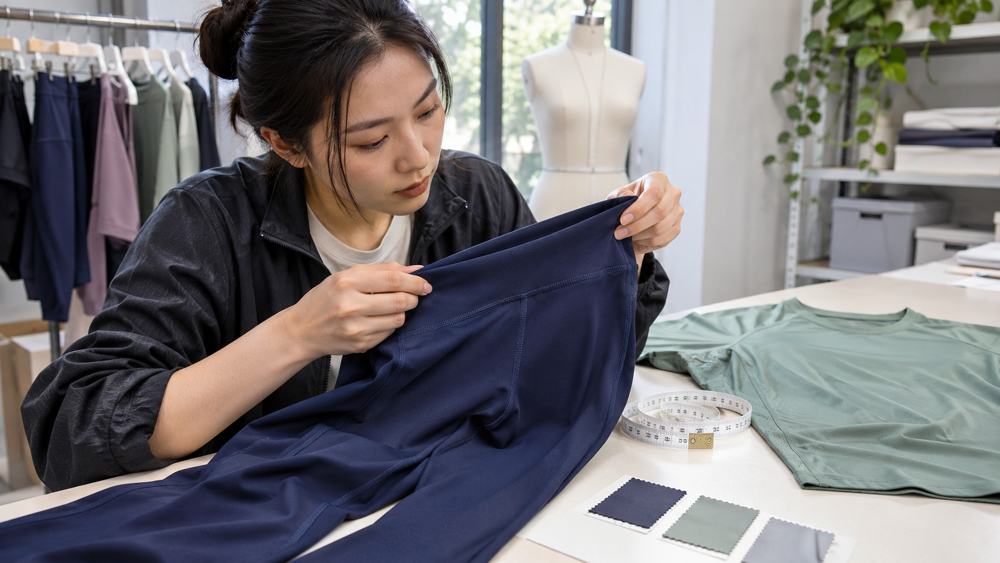
Create a sample card for each candidate with fabric code, full composition, recycled share, construction, GSM, usable width, color, finish, supplier and batch reference. Keep the garment pattern and evaluation conditions as consistent as possible. If you change elastane level, weight and knit at the same time, you are comparing complete fabric options, not isolating fiber type.
| Question | Evaluation | Record before approval |
|---|---|---|
| Does sweat move and evaporate? | Evaluate liquid transport and drying as separate properties. A laboratory can select appropriate methods such as AATCC TM195 and TM201. | Method edition, conditions, specimen identity, pretreatment and agreed target. |
| Does the garment recover? | Assess stretch and recovery plus repeated movement in the finished sample. | Test direction, extension/load, recovery interval and any lasting growth. |
| Is coverage adequate? | Review opacity in intended sizes, movements and lighting, including the lightest proposed colors. | Fit, stretch level, background and acceptance decision. |
| Will appearance survive wear? | Agree pilling, abrasion, colorfastness and laundering evaluations appropriate to the use. | Test method, wash protocol, rating target and comparison photographs. |
| Will bulk match the sample? | Compare approved fabric and garment references with incoming materials and production samples. | Lot references, measurement tolerances, shade limits and inspection plan. |
The AATCC method list distinguishes liquid moisture management, wicking and drying methods. NC State’s comfort testing overview also treats these as separate evaluations. Agree the current method and acceptance criteria with the lab; this article does not prescribe a universal pass threshold.
Use both unwashed samples and samples laundered according to an agreed protocol. A practical wearer review can identify rubbing, waistband movement and perceived dampness, but it does not replace a documented test behind a measurable performance claim.
Verify recycled-content evidence before approving claims
A useful evidence file connects the organization, material and transaction. Textile Exchange explains that a scope certificate establishes a company’s certified scope, while a transaction certificate identifies certified products in a specific transaction. A supplier’s certificate does not mean every product it sells is certified.
| Evidence | What to check | Limit of the evidence |
|---|---|---|
| Scope certificate | Legal entity, site, certificate number, standard, validity dates, products and relevant processes. | Does not establish that your shipment is certified. |
| Transaction certificate or applicable verified transaction record | Buyer and seller, product description, composition, recycled share, quantity and shipment references. | Must correspond to the actual goods and applicable certification system. |
| Material and order records | Fabric code, specification, lot references, purchase order, invoice and packing information. | Commercial records alone are not independent recycled-content certification. |
| Performance report | Fabric or garment identity, test method, date, results and laboratory. | Performance results do not prove recycled origin or chain of custody. |
| Approved claim and artwork | Exact percentage and component described, supporting documents, and any required label or logo approval. | A certificate image is not permission to put a certification logo on a garment. |
Search the entity or certificate in Find a Certified Company. Authenticate the transaction through Textile Exchange’s transaction portal where applicable. Save the lookup date and result; refer mismatches or unclear status to the issuing certification body using independently verified contact details.
The RCS and GRS overview describes recycled-material and chain-of-custody verification; GRS also addresses processing-related social, environmental and chemical requirements. Neither is a universal certificate of superior sports performance. Textile Exchange is transitioning its standards system, so confirm the rules applicable to your order date and proposed claim before approving packaging.
What changes cost and development time?
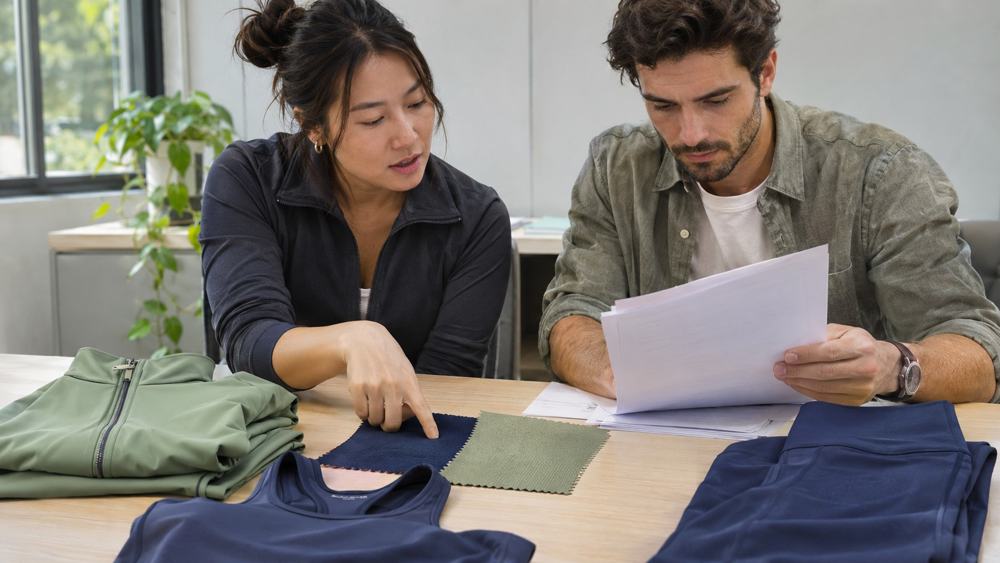
There is no defensible universal price premium for recycled nylon over recycled polyester. Compare dated quotations on the same garment, quantity, quality requirements, currency and delivery basis. A stock fabric can be a different commercial proposition from a custom-developed fabric, regardless of polymer.
| Variable | Cost effect | Timing question |
|---|---|---|
| Yarn, knit and finish | Grade, branded inputs, brushing, finishing and usable width affect the material comparison. | Is the approved fabric available, or must it be knitted and finished? |
| Color and material minimums | A small garment order can still trigger a larger mill or dye-lot commitment. | When can the mill confirm the color and reserve the required lot? |
| Pattern yield and quality | Cutting waste, shrinkage allowance and rejected pieces affect cost per accepted garment. | Must the pattern or process be revised after sample evaluation? |
| Samples, tests and documents | Include development, lab work, documentation and label review where charged. | Which approvals or records are needed before the next stage? |
| Branding, packing and delivery | Print trials, trims, labels, packaging and freight change the total. | Have artwork, packaging and shipping arrangements been confirmed? |
Compare fabric cost per garment, not just price per kilogram
Illustrative calculation: a pattern consuming 1.2 linear meters of 1.5-meter usable-width fabric at 220 GSM uses 1.2 × 1.5 × 0.220 = 0.396 kg. With a hypothetical 10% additional material allowance, the planning quantity becomes 0.4356 kg per garment. Multiply by the quoted price per kilogram, then add the other agreed costs. These are teaching assumptions, not an Ohsure specification or quotation. Recalculate for each fabric’s actual width, weight and cutting yield, and avoid counting waste twice.
MOQ planning: Ohsure’s published starting point is 100 pieces per style per color, with mixed sizes available, subject to project confirmation. On that basis, two styles in three colors would mean 2 × 3 × 100 = 600 pieces, not 100 pieces across the collection. Confirm material minimums separately.
Schedule planning: sample timing is confirmed after reviewing design, materials and customization requirements. Bulk-production timing depends on approved specifications, material availability and the production schedule. Ask for a milestone plan covering material confirmation, sample approval, testing, production, inspection and shipping; include revisions and document review in the launch calendar.
Seven steps to choose and approve the material
- Define the product and its claims. State the activity, wearer, garment type, fit, target hand feel, budget and launch date. List any intended drying, support or recycled-content claim.
- Request two identifiable fabric candidates. Ask for full composition, recycled share, fabric code, weight, width, construction, color, finish and availability. Confirm whether recycled nylon can be sourced for your project.
- Check the documentation path. Review relevant scope, identity and validity before ordering. Agree which transaction evidence can be supplied, by whom and at what stage.
- Develop comparable samples. Use a consistent garment brief and record unavoidable differences. Review fit, hand feel, movement, coverage and branding.
- Run the agreed evaluation. Document wear and wash observations; commission suitable testing where the product claim or specification needs it. Resolve failures before bulk approval.
- Compare complete quotations and milestones. Include consumption, material minimums, samples, testing, documentation, branding and delivery arrangements. Record the basis and validity of each quote.
- Freeze the approved specification. Retain reference swatches and the approved garment, define bulk tolerances and inspection criteria, and reconcile shipment evidence before releasing final claims.
For support turning a reference into an approved sample and production brief, see Ohsure’s custom activewear manufacturing service. Discuss logo, label and packaging details through the private-label service after the fabric and claim wording are clear.
Common mistakes that weaken the comparison
- Choosing a polymer instead of a fabric. “Nylon is softer” is not an approval specification. Compare identified samples after laundering.
- Calling every polyester fabric quick-drying. Ask for results on the proposed construction and distinguish moisture transport from drying.
- Treating all recycled nylon as recovered fishing nets. Record the actual feedstock; use an ocean-related claim only when supported.
- Ignoring elastane, lining and trims. Define whether a percentage covers the main fabric, a component or the complete garment.
- Accepting an unrelated or expired certificate. Match the entity, site, scope and dates, and resolve discrepancies with the issuer.
- Assuming recycled means recyclable. A recycled input does not demonstrate an available collection and recycling route for the finished stretch garment.
- Approving bulk from a hand swatch alone. Check the intended garment, size, shade and branding before committing to production.
Neither material can be called environmentally superior in every application from its name alone. Any comparative environmental claim needs a consistent assessment boundary and evidence for the relevant supply chains. This guide does not assign either material a carbon-saving percentage.
Manufacturing perspective: connect fabric approval to bulk inspection
Ohsure’s published quality-control process covers raw materials, printing, semi-finished products and finished garments. Listed checks include fabric shade, weight, pilling, colorfastness and shrinkage, plus garment measurements, stitching and accessories. These are inspection categories; agree the methods, sampling and tolerances for your order.
A practical manufacturing lesson is to carry the approved fabric code and reference sample through every stage. If a replacement material is proposed, review the specification, performance and evidence again before accepting it. A visually similar substitute can change fit, recovery, printing behavior or the recycled-content statement.
Keep two approval records: one for what the garment must do, and one for what the brand may say about it. The recommendations here are a buyer-facing synthesis of published services and sourcing practice, not a claim about Ohsure’s internal operating procedure or an invented customer case study.
Frequently asked questions
Is recycled nylon better than recycled polyester for leggings?
It is a useful candidate when a soft, smooth feel is important, but it is not an automatic winner. Compare finished fabrics for opacity, recovery, pilling, fit and cost. A recycled polyester construction may better meet a particular leggings brief.
Which material dries faster?
Polyester generally has lower fiber moisture regain, but finished-fabric drying also depends on construction, weight, finish and test conditions. Request comparative drying results on the proposed fabrics rather than inferring a drying time from the fiber name.
Can both materials be used in sports bras?
Both can be considered. Assess the complete bra, including fabric recovery, lining, elastic, seams and support for the intended activity. The fiber name and recycled percentage do not establish support performance.
Is recycled nylon always more expensive?
No universal price relationship applies to every order. Compare dated quotations with the same product requirements, quantity, documentation scope and delivery basis, including material consumption and mill minimums.
Does recycled polyester always come from bottles?
No. Bottles are one feedstock; textile and other suitable polyester waste streams also exist. Ask for evidence of the source used in the selected yarn. A general recycled claim does not establish bottle-to-fiber or textile-to-textile origin.
Does a supplier’s GRS certificate cover my entire order?
Not automatically. Check the certified entity, scope and validity, then obtain the applicable order or shipment evidence. Confirm any requirements for the brand’s intended claim or certification logo before using it.
Does 100% recycled yarn mean 100% recycled leggings?
No. Elastane, lining, elastic, thread and other components may be conventional. Identify the component covered and calculate the relevant recycled proportion using documented composition and an appropriate basis.
Are recycled polyester and recycled nylon garments automatically recyclable?
No. Recycled content describes material inputs. A finished garment needs a suitable collection, sorting and recycling route; blends, trims and construction must be considered. Do not promise garment recyclability from the yarn’s recycled origin alone.
Can Ohsure supply a particular recycled nylon fabric?
Confirm the composition, weight, color, minimum quantity and evidence requirements directly for the project. The reviewed recycled product range lists recycled polyester items; it does not establish availability of every recycled nylon specification.
What should I send to request a useful quotation?
Send the garment reference or tech pack, intended activity, composition preferences, recycled-content target, sizes, colors, quantities, branding, testing requirements, documentation needs, destination and launch date. Ask for fabric alternatives and a confirmed milestone schedule.