
When Should an Activewear Brand Move From Private Label to OEM?
PRIVATE LABEL TO OEM DECISION GUIDE
When Should an Activewear Brand Move From Private Label to OEM?
Move from private label to OEM when repeat demand is stable enough to absorb a larger production commitment, product differentiation has become commercially important, and the expected contribution from better fit, fabric or construction exceeds the added development cost and risk. Do not switch only because OEM sounds more professional. Switch when the numbers and operating readiness support it.
For many activewear startups, private label is the sensible first model: select an existing product, add approved branding, test a market and learn what customers actually buy. OEM becomes useful later, when an existing base product limits the brand's fit, performance or identity. The decision is therefore a stage-gate, not a status upgrade.

Private Label and OEM Solve Different Problems
Private label
The supplier already has a base style or specification. The brand chooses from available options and adds permitted branding, colors or packaging.
- Best for fast market validation
- Lower development burden
- Less control over fit and construction
- More risk of product similarity
OEM
The manufacturer produces against the brand's approved specification, normally using a tech pack, measurements, materials, construction details and quality criteria.
- Best for a proven, differentiated product
- More sampling and approval work
- Greater control over product execution
- Higher exposure to development and inventory risk
If these terms are still unclear, start with the OEM, ODM and private-label comparison. Brands that need a narrower control comparison can also review OEM versus private label activewear.
The Short Answer: Use Five Readiness Gates
Repeatable demand
You can forecast a core style from actual reorder and sell-through data rather than launch optimism.
Valuable differentiation
A defined fit, fabric, support, pocket, seam or finishing change matters to the target customer.
Positive unit economics
The expected margin or retention benefit can repay sampling, testing, tooling and added operating work.
Technical readiness
The brand can approve measurable specifications instead of relying on adjectives such as premium or supportive.
Cash-flow capacity
The business can fund development, deposits, balance payment, freight and a slower conversion of cash back into sales.
Practical rule: a brand is usually ready to test OEM when all five gates are supported by evidence. If only one or two are true, improve the private-label offer first.
Gate 1: Demand Must Be Repeatable, Not Merely Popular Once
A strong launch does not automatically justify a custom program. Discounts, influencer exposure, seasonality or stockouts can distort the first result. Look for repeat orders, stable conversion, low dependence on promotion and a size curve that remains reasonably consistent across selling periods.
| Signal to review | Evidence that supports an OEM test | Warning sign |
|---|---|---|
| Core-style demand | Multiple selling periods with identifiable baseline demand | One launch spike or one viral post |
| Reorder behavior | Customers or retailers reorder the same use case | Demand moves entirely to new colors or trends |
| Size curve | Size mix is stable enough to plan production | Frequent stockouts make the size data unreliable |
| Returns | Return reasons identify fixable product issues | Returns are not coded or measured |
| Sales concentration | A core product remains important without constant discounting | Most units sell only on clearance |
Use the planned OEM quantity as the denominator, not total annual brand sales. A business may be growing while one proposed style remains too uncertain to support its own color and size allocation.
Gate 2: The Product Difference Must Be Specific and Valuable
OEM is justified by a product requirement that an available private-label base cannot reliably deliver. Examples include a proprietary measurement set, a revised waistband construction, tested pocket placement, a defined compression target, a fabric specification or a seam configuration designed for a particular movement.
Write the proposed difference as a testable requirement:
Too vague
“Make the leggings more premium and more flattering.”
Actionable
“Revise the waist height and graded measurements, add an approved internal structure, and verify fit across the agreed size set.”
A visual change alone can sometimes remain within private label or ODM. OEM makes more sense when the intended result depends on coordinated decisions about pattern, material, trims, stitching, tolerances and inspection. Review what activewear OEM manufacturing includes before assigning responsibilities.
Gate 3: Calculate the OEM Break-Even Point
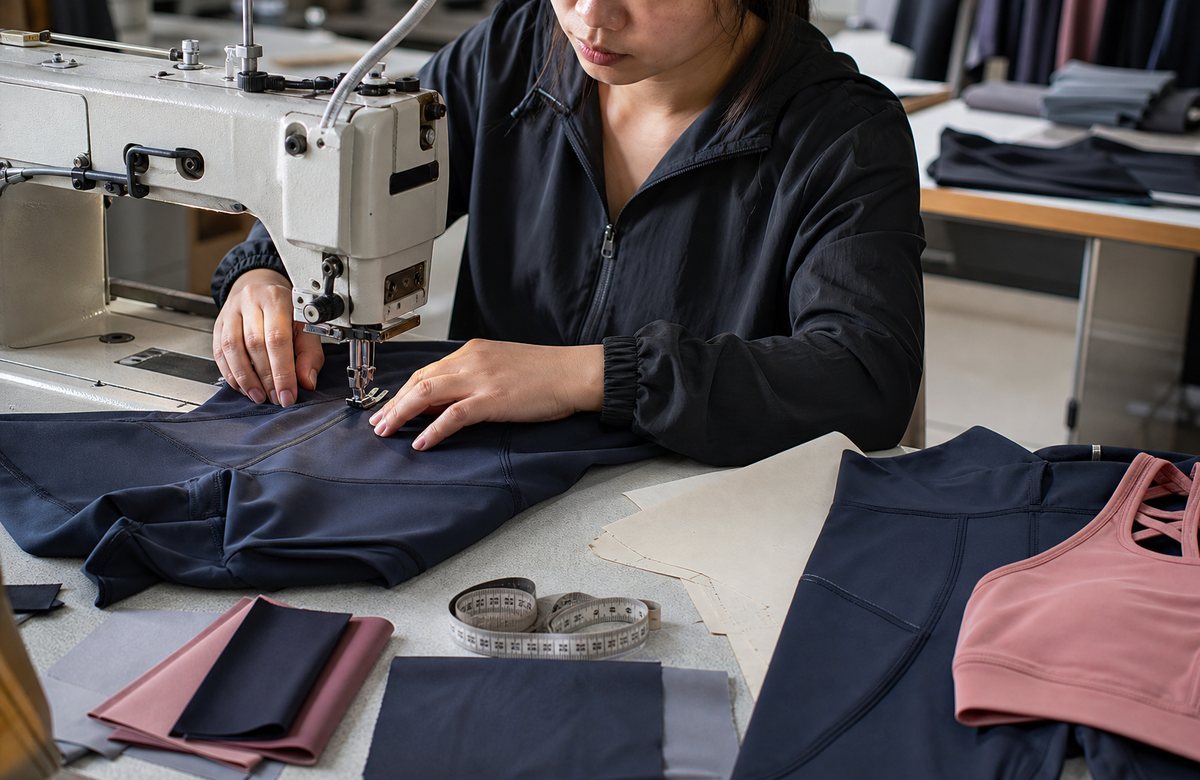
OEM may reduce or increase the quoted unit price. Either way, the decision should include the costs that sit outside the unit quote: tech-pack work, patterns, samples, testing, custom-dye or trim minimums, packaging revisions, inspections and team time.
Incremental break-even units
OEM fixed development cost ÷ expected contribution improvement per unit
Suppose an OEM program adds an illustrative US$4,800 in one-time development and verification cost. If the expected contribution improvement is US$4 per sellable unit, the simple break-even volume is 1,200 sellable units. If the improvement is only US$2, the break-even volume becomes 2,400 units.
| Illustrative input | Scenario A | Scenario B | Scenario C |
|---|---|---|---|
| One-time OEM cost | US$4,800 | US$4,800 | US$4,800 |
| Contribution improvement per sellable unit | US$2 | US$4 | US$6 |
| Simple break-even volume | 2,400 units | 1,200 units | 800 units |
These numbers are examples, not supplier quotations. Replace them with landed cost, expected selling price, return allowance, defect allowance and the actual development budget. The U.S. Small Business Administration expresses the general break-even relationship as fixed costs divided by selling price minus variable cost. For an OEM decision, compare the incremental economics of the two sourcing models.
For budget categories and cost boundaries, use the related guides to OEM activewear manufacturing cost and private-label activewear launch cost.
Gate 4: Your Team Must Be Able to Approve a Specification
In private label, many product decisions are inherited from the supplier's existing style. In OEM, the brand must make and record more of those decisions. A manufacturer can advise on manufacturability, but the brand still needs a controlled approval process.
Minimum OEM readiness file
- Target customer, activity and product use case
- Technical drawing and construction callouts
- Base measurements, grading intent and tolerance expectations
- Fabric performance requirements and acceptable substitutes
- Color references, trims, labels and packaging requirements
- Sample comments recorded by version
- Wear-test and measurement approval criteria
- Market-specific labeling and compliance responsibilities
- Approved bulk standard and inspection plan
For U.S. sales, textile labeling and care instructions are not details to add at the end. FTC guidance covers fiber content, country of origin, responsible-business identification and care labeling. The responsible brand or importer should confirm the rules for every destination market and keep a reasonable basis for care instructions.
Gate 5: Cash Flow Must Survive the Longer Commitment
OEM ties cash to a longer chain: development, sampling, material commitment, production, quality control, balance payment, freight, duties and sell-through. A profitable forecast can still create a cash shortage if payments occur months before revenue.
Build a dated cash plan with a downside case. Include one extra sample round, a production delay, a slower sales month and a realistic allowance for non-sellable units. If that scenario threatens payroll, marketing or the next reorder, the product may be ready for OEM while the business is not.
A Weighted OEM Readiness Scorecard
Use this scorecard as a discussion tool, not as an automatic approval. Score each factor from 0 to 5, multiply by the weight, and divide the total by 5 to obtain a score out of 100.
| Factor | Weight | 0 means | 5 means |
|---|---|---|---|
| Repeatable demand | 25% | No reliable style-level history | Stable, forecastable core demand |
| Differentiation value | 20% | No defined customer benefit | Clear, testable product advantage |
| Unit economics | 20% | Added cost has no recovery path | Downside case remains attractive |
| Technical readiness | 15% | No controlled specification | Complete approval file and owner |
| Cash-flow capacity | 15% | Deposit would strain operations | Downside cash plan is fundable |
| Supplier and IP controls | 5% | Responsibilities remain unclear | Ownership, confidentiality and change control are documented |
Below 50: remain private label and close the evidence gaps.
50–69: run a limited development feasibility study; do not commit bulk yet.
70–84: consider one controlled OEM pilot with a core style.
85–100: the project may be ready for formal quotation, sampling and risk review.
The thresholds are an original planning framework, not an industry standard. A serious failure in compliance, cash flow or specification control should stop the project regardless of the total score.
Use a Hybrid Transition Instead of Switching the Whole Range
Most brands do not need to replace every private-label SKU. A lower-risk transition keeps stable supporting products in private label while moving one high-volume, high-feedback core style into OEM development.
- Select one core problem. Choose a style with repeatable demand and a specific limitation.
- Freeze the commercial target. Define target landed cost, planned quantity, launch window and acceptable risk.
- Build the specification. Convert customer feedback into measurable design and performance requirements.
- Develop and test. Review samples, measurements, fit, wash behavior and relevant use conditions.
- Approve a controlled pilot. Keep colors and variants narrow enough to learn without fragmenting inventory.
- Compare outcomes. Measure margin, returns, reviews, repeat purchase and operational workload against the private-label baseline.
Supplier agreements should also define ownership and permitted use of drawings, patterns, specifications and other project IP. WIPO guidance emphasizes clear supplier IP terms, including confidentiality, licensing or assignment where appropriate. Obtain qualified legal advice for the markets and relationships involved.
When You Should Stay With Private Label
- Your assortment changes faster than you can gather reliable reorder data.
- The main objective is testing audiences, channels or price points.
- The desired changes are mostly logo, label, color or packaging choices already offered by the supplier.
- You cannot yet define fit, material or performance requirements.
- OEM deposits and development costs would consume the cash needed to sell the inventory.
- The team has no clear person responsible for sample comments and final approval.
Staying private label can be a disciplined choice. The goal is not maximum customization; it is an offer customers value and the business can operate profitably.
Frequently Asked Questions
Is there a sales-volume threshold for moving to OEM?
No universal threshold applies. Use forecastable units for the proposed style and compare them with development break-even, supplier quantity requirements, size-color allocation and cash exposure.
Does OEM always have a higher MOQ than private label?
Often, but not always. Quantity can depend on fabric availability, custom dyeing, trims, print processes, style complexity and how the order is divided across colors and sizes. Ask for the basis of every minimum.
Can a startup begin directly with OEM?
Yes, if it has a validated product need, sufficient technical capability and enough capital for development and inventory risk. Without those conditions, private label or ODM may create faster and cheaper learning.
Should the brand switch because customers ask for new colors?
Not necessarily. New colors may fit the existing private-label or ODM program. OEM is more relevant when the request requires a new fit, construction, material specification or performance outcome.
How many OEM styles should be developed first?
Usually as few as needed to test the thesis. One core style with controlled variants produces clearer learning than a broad collection with fragmented inventory.
What is the biggest transition risk?
Committing bulk before the specification, approved sample, test criteria, responsibilities and cash plan are complete. OEM gives more control, but it also gives the brand more decisions to get right.
Decision Summary
Move from private label to OEM when a proven core product needs a measurable improvement, the expected economics repay development, the team can control the specification, and the cash plan withstands delays and slower sell-through. Start with one pilot, preserve a private-label baseline, and expand only after the product and operating data confirm the case.
Editorial note: Cost figures, weights and score bands in this guide are illustrative planning tools. Supplier capability, quantity, price, lead time, testing and compliance requirements must be confirmed for the exact product and destination market. Reviewed sources include U.S. Small Business Administration break-even guidance, U.S. Federal Trade Commission apparel-labeling guidance, and World Intellectual Property Organization supplier-IP guidance. Published September 5, 2026.